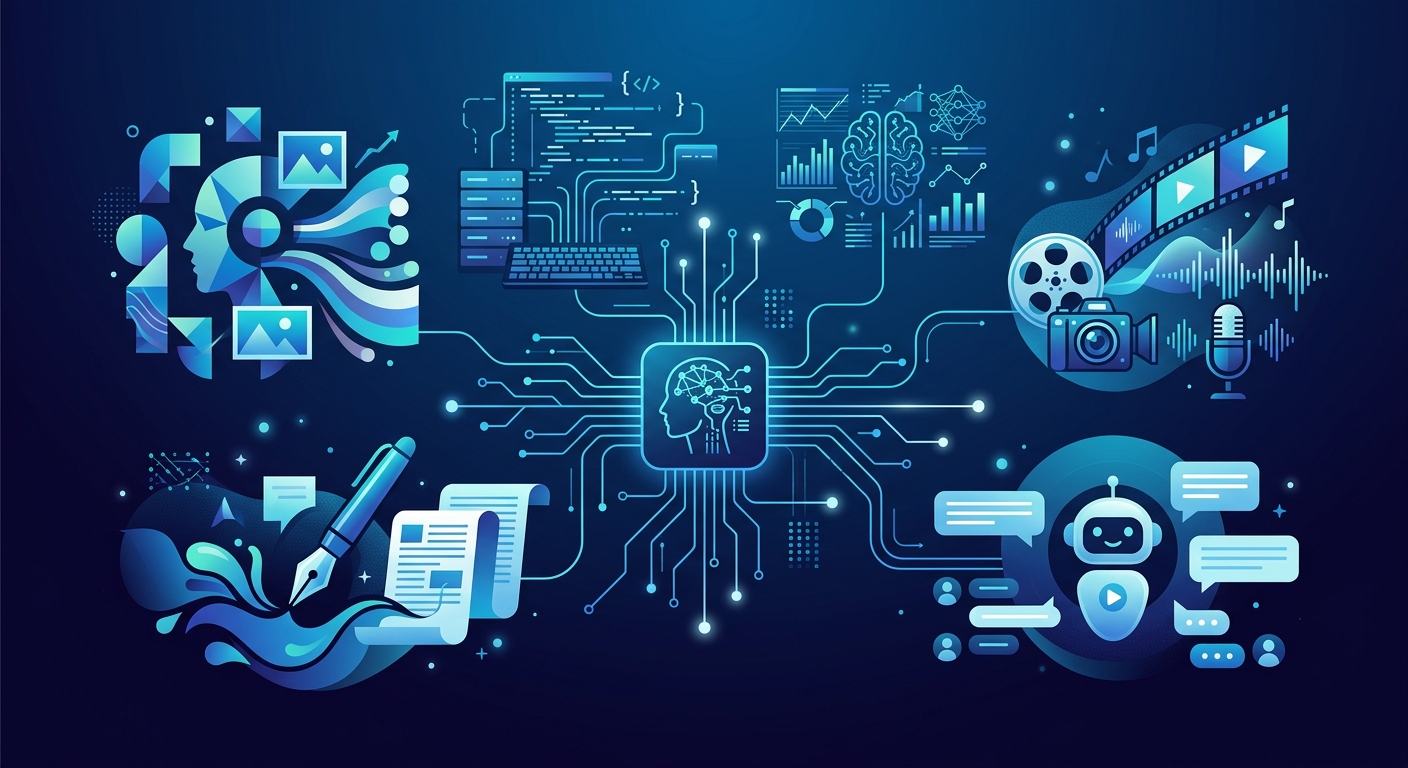
Generative AI (GenAI) is a category of artificial intelligence capable of creating new content—including text, code, images, and synthetic data—by learning patterns from existing datasets. Unlike traditional predictive AI, which classifies or forecasts based on historical data, generative models synthesize novel outputs that mimic human creativity and logic. In the enterprise sector, generative AI applications have evolved from simple chatbots into sophisticated orchestration layers that drive core business value across the Software Development Life Cycle (SDLC), healthcare research, and financial services.
Key Takeaways
- SDLC Transformation: GenAI is automating the full software lifecycle, from turning ideas into user stories to generating production-ready code and documentation.
- Synthetic Data Innovation: Healthcare and biomedical sectors are using AI to generate high-fidelity synthetic data, enabling research without compromising patient privacy.
- Operational Shifts: Leading firms like Goldman Sachs and PwC are moving beyond pilots to integrate GenAI into internal platforms and proprietary codebases.
- Risk Management: Successful deployment requires addressing copyright concerns, energy consumption, and the inherent biases in training datasets.
The Evolution of Generative AI Applications in the Enterprise
The transition from predictive to generative models marks a paradigm shift in how organizations approach automation. For decades, Artificial Intelligence Business Applications were limited to "if-then" logic and statistical forecasting. Today, generative AI applications use Large Language Models (LLMs) to understand context, enabling them to perform complex reasoning tasks previously reserved for human experts.
In the early stages of adoption, enterprises focused on "low-stakes" use cases such as marketing copy generation and internal knowledge retrieval. However, as the technology matures, we are seeing a move toward Strategic Use of AI in Business & Enterprise where GenAI is embedded into the product development process itself. This evolution is characterized by a shift from generic, public-facing tools to fine-tuned, domain-specific models that use an organization's unique data assets.
Right Now: How GenAI is Changing the SDLC
Generative AI is currently reshaping the Software Development Life Cycle (SDLC) by acting as a force multiplier for engineering teams. Rather than simply providing autocomplete suggestions, modern AI Written Code solutions are now integrated directly into internal development platforms.
According to Bain & Company, Goldman Sachs has successfully integrated generative AI into its internal development environment. By fine-tuning models on the bank's internal codebase and project documentation, they provide engineers with context-aware solutions that extend to automated testing and documentation, significantly accelerating development cycles.
At PwC, the impact is equally significant. PwC reports that their in-house teams use GenAI to transform raw ideas into structured requirements, which are then converted into user stories, test cases, and eventually, documented code. This end-to-end automation reduces the manual overhead of administrative tasks, allowing developers to focus on high-level architecture and problem-solving.
Key Insight: Enterprise GenAI is moving from "generalist" assistants to "specialist" tools fine-tuned on proprietary codebases, resulting in context-aware suggestions that outperform generic models.
Coming Soon: New Kinds of Software and Business Models
As generative AI applications become more reliable, we are entering an era of "AI-first" software. This transition will likely lead to new business models where software is no longer a static tool but a dynamic service that evolves based on user interaction. We are seeing the emergence of AI Technology in Business that prioritizes outcome-based value over seat-based licensing.
For example, in the realm of AI Agent Solutions, companies are beginning to deploy autonomous agents that handle entire workflows—such as sales outreach or invoice exception handling—without constant human intervention. This shift allows businesses to scale operations horizontally without a linear increase in headcount, fundamentally changing the cost structure of growth.
The Final Stage: GenAI Agents Will Be the Next Agile
Many industry experts believe that the widespread adoption of AI agents will be as transformative as the Agile manifesto was for software development. While current "copilots" require a human to initiate and review every action, the next stage involves fully autonomous agents capable of complex reasoning and multi-step execution.
To move from copilots to production-ready agents, organizations must solve the "universal context layer" challenge. This involves building a robust architecture that includes a dedicated data layer and standardized integration protocols to ensure agents can navigate complex enterprise workflows safely. Enterprise AI Agent Orchestration is becoming the standard for managing these autonomous entities, ensuring they adhere to AI Agent Data Privacy Compliance standards.
Synthetic Data Generation for Biomedical Innovation
One of the most promising generative AI applications is the creation of synthetic data, particularly in fields where privacy and data scarcity are major hurdles. In healthcare, synthetic data generation is being used to support biomedical innovation while adhering to strict Data Security and privacy regulations.
According to the Duke-Margolis Institute for Health Policy, global regulators and payers are exploring synthetic data to support decision-making in medical product development. This allows researchers to simulate clinical trial cohorts or generate high-fidelity medical images without using actual patient records.
Research published in PMC highlights that AI-driven models can now simulate lifelike human faces and histological sections at resolutions of 1,024 x 1,024 pixels. These high-fidelity images are crucial for training machine learning models in specialties like pathology and dermatology, where diverse datasets are often difficult to obtain.
"Generative AI is shown to preserve and, in some cases, worsen biases and inaccuracies in datasets. We think a go-slow, cautious approach is warranted in using synthetic data to train clinical algorithms." — Hernandez-Boussard, Professor of Medicine (Stanford Medicine)
Time to Rethink Ways of Working
The integration of generative AI applications requires a fundamental rethinking of organizational workflows. It is not enough to simply "add AI" to existing processes; businesses must redesign their operations to take full advantage of the speed and scale these tools provide. This often involves a transition toward How AI is Used in Business for Growth, where the focus shifts from cost-cutting to value creation.
For instance, in product design, companies like Loft use GenAI for early-stage conceptualization and sketching. However, as noted by MIT Sloan Management Review, many firms pause the use of GenAI during high-stakes engineering and physical prototyping phases due to concerns about the reliability of AI-generated specs. This suggests a hybrid model—where AI handles the creative breadth and humans handle the technical depth—is currently the most effective approach.
Addressing the Challenges: Copyright, Carbon, and Context
Despite the enthusiasm, generative AI applications face significant headwinds. One major gap in current literature is the lack of specific legal frameworks to protect businesses against copyright infringement claims arising from AI-produced code. While some insurance providers are beginning to offer AI-specific policies, the legal landscape remains volatile.
Furthermore, the environmental impact of GenAI cannot be ignored. Generative models consume significantly more energy than traditional manual methods or even standard predictive AI. For example, generating an AI image or a complex code block requires far more compute power than a simple search query. Businesses must weigh these ROI & Performance Metrics against their corporate sustainability goals.
Comparison: Traditional Automation vs. GenAI Agents
| Feature | Traditional Rule-Based RPA | Generative AI Agents |
|---|---|---|
| Logic Basis | Pre-defined "If-Then" rules | Probabilistic reasoning & LLMs |
| Adaptability | Low; breaks on minor UI changes | High; understands context and intent |
| Data Input | Structured data only | Unstructured (text, voice, images) |
| Use Case | Invoice Exception Handling | Complex customer sentiment analysis |
| Maintenance | High manual upkeep | Self-improving through feedback loops |
Frequently Asked Questions
What are the most common generative AI applications in business today?
The most common applications include automated content creation, code generation for software development, synthetic data generation for research, and enhanced customer support through sophisticated chatbots.
How is generative AI different from traditional AI?
Traditional AI is typically discriminative—it categorizes existing data. Generative AI is creative, using its training to produce entirely new, original outputs like text, images, or code.
Can generative AI replace software engineers?
Rather than replacing engineers, GenAI acts as a productivity tool. As seen at Goldman Sachs, it accelerates development cycles by handling routine tasks like testing and documentation, allowing engineers to focus on architecture.
What are the risks of using synthetic data in healthcare?
The primary risks include the preservation or worsening of biases present in the original training data and potential inaccuracies that could lead to flawed clinical decisions if not rigorously validated.
How can a business start implementing generative AI?
Start with a clear Enterprise AI Strategy, identifying low-risk, high-value pilots. Ensure you have a robust data governance framework and consider fine-tuning models on proprietary data for better context.
What to Do Next
To successfully operationalize generative AI applications, enterprise leaders should follow a structured roadmap:
- Audit Current Workflows: Identify bottlenecks in the SDLC or data processing that could benefit from automation.
- Establish Governance: Implement Continuous AI Agent Monitoring to ensure quality and compliance.
- Focus on Proprietary Data: Move away from public models toward internal platforms that use your unique business context.
- Invest in Upskilling: Prepare your workforce for a collaborative environment where AI handles the "heavy lifting" of data synthesis.
For those looking to scale, exploring The Agentic Enterprise model offers a blueprint for integrating autonomous agents into the core of the business, driving long-term enterprise value.