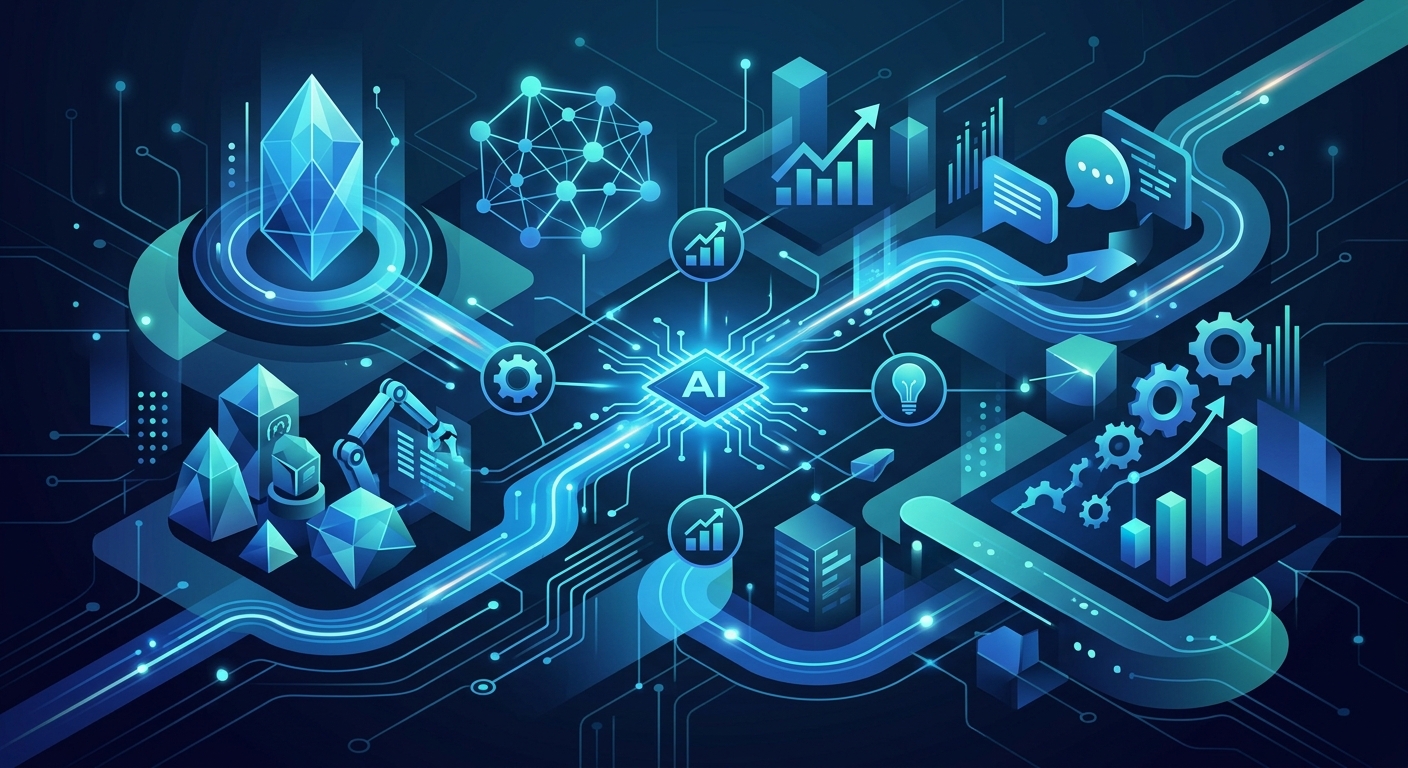
Artificial intelligence (AI) is no longer a speculative technology; it has become the primary engine for operational efficiency and strategic differentiation in the modern enterprise. As organizations move beyond simple pilot programs, the integration of artificial intelligence business applications is reshaping how companies interact with customers, manage supply chains, and develop new products. This transformation is driven by the convergence of massive datasets, increased computational power, and the emergence of Generative AI, which has expanded the scope of automation from routine tasks to complex creative processes.
Key Takeaways
- Three Pillars of AI: Most enterprise applications fall into process automation, cognitive insight (predictive analytics), or cognitive engagement (chatbots and NLP).
- Generative AI Shift: One-third of organizations now use Gen AI regularly in at least one business function, according to McKinsey.
- Trustworthiness is Mandatory: Compliance with frameworks like the NIST AI Risk Management Framework is now a prerequisite for large-scale deployment.
- Strategic ROI: Success is measured not just by cost savings, but by the ability to scale autonomous decision-making through enterprise AI agent orchestration.
The Evolution of Artificial Intelligence Business Applications
The history of AI in business has shifted from the "expert systems" of the 1980s to the deep learning models of the 2010s, and finally to the large language models (LLMs) of today. Originally, artificial intelligence business applications were designed to handle highly structured data—think of a system that flags a credit card transaction as fraudulent based on a set of rigid rules. Today, AI systems process unstructured data such as video, audio, and natural language, allowing for a level of nuance that was previously impossible for machines.
According to McKinsey's 2023 state of AI report, 40% of organizations plan to increase their AI investments specifically due to advances in generative AI. This represents a fundamental shift in the enterprise mindset: AI is no longer just a way to save money on back-office tasks; it is a tool for top-line revenue growth and strategic innovation.
High-Impact Enterprise AI Use Cases Across Verticals
To understand the landscape of use cases for AI, we must look at how specific industries are applying these technologies to solve long-standing friction points. In many cases, these applications are transitioning from traditional rule-based software to autonomous agents that can reason through exceptions.
Financial Services and Compliance
In banking, AI is used for real-time fraud detection and automated regulatory monitoring. The move toward autonomous regulatory change monitoring allows firms to stay ahead of global policy shifts without manual oversight. This is particularly critical as organizations navigate the AI Risk Management Framework (AI RMF 1.0) from NIST, which emphasizes that AI must be valid, reliable, and safe.
Supply Chain and Logistics
Supply chain optimization is perhaps the most quantifiable area of AI impact. By using predictive analytics to forecast demand, companies can reduce logistics costs and inventory carrying costs. AI systems analyze thousands of variables—from weather patterns to geopolitical shifts—to predict demand fluctuations with significantly higher accuracy than manual modeling. This level of precision is essential for maintaining lean operations in a volatile global market.
Sales and Marketing
Marketing and customer service currently lead the way in total adoption. Organizations are deploying enterprise AI SDR strategies to scale outreach without increasing headcount. Furthermore, Natural Language Processing (NLP) has become the dominant technology behind customer-facing chatbots, moving beyond simple scripts to sophisticated sentiment analysis that can de-escalate frustrated customers before a human agent is ever involved.
Process Automation vs. Cognitive Engagement
When evaluating enterprise AI use cases, it is helpful to categorize them based on their function. Most successful deployments fall into one of three categories:
- Robotic Process Automation (RPA) & Cognitive Automation: These systems handle the "hands" of the organization—moving data from one system to another. While traditional RPA is rule-based, AI-enhanced RPA can handle invoice exception handling by understanding the context of a document rather than just looking at fixed coordinates.
- Cognitive Insight: These are the "eyes" of the organization. They use machine learning to detect patterns in massive amounts of data. Examples include predictive maintenance for manufacturing equipment or identifying which customers are most likely to churn.
- Cognitive Engagement: This is the "voice" of the organization. These applications use NLP and Generative AI to interact with employees and customers. This includes everything from internal HR helpdesks to external customer support bots.
Key Insight: McKinsey found that one-third of respondents say their organizations are using gen AI regularly in at least one business function, signaling a move from experimental labs to production environments.
Implementing Enterprise AI Use Cases: Strategic Considerations
Moving from a pilot program to a full-scale deployment requires more than just technical expertise; it requires a robust governance framework. One of the primary hurdles for enterprise leaders is the "black box" problem—the difficulty in explaining how an AI reached a specific conclusion.
The Importance of Trustworthy AI
As noted in the NIST guidelines, trustworthiness is a core requirement for enterprise deployment. A system that is 99% accurate but fails in a way that creates legal liability or ethical breaches is not viable for a Fortune 500 company. Organizations must implement continuous AI agent monitoring to ensure that models do not drift over time or begin producing incorrect information.
Data Privacy and Security
Data is the fuel for AI, but it is also a significant liability. Enterprise AI applications must be built with strict data privacy compliance in mind. This often involves using synthetic data for training or deploying models within a private cloud environment to ensure that sensitive customer information never leaves the organization's perimeter.
Measuring ROI on AI Investments
Calculating the return on investment for AI can be more complex than for traditional software. While traditional automation is measured by "hours saved," AI is often measured by "outcomes achieved." For example, in customer service, the metric is shifting from Average Handle Time (AHT) to first-contact resolution and customer satisfaction scores.
| Industry | Primary AI Metric | Strategic Value |
|---|---|---|
| Manufacturing | Downtime Reduction | Predictive maintenance prevents costly line stoppages. |
| Sales | Lead Conversion Rate | AI SDRs handle high-volume follow-ups that humans miss. |
| Finance | Fraud Detection Rate | Real-time analysis reduces losses and customer friction. |
| Healthcare | Diagnostic Accuracy | AI assists clinicians in identifying rare conditions earlier. |
For a deeper dive into these calculations, leaders should refer to measuring AI agent ROI for customer support and other performance-based frameworks.
The Impact of AI on the Workforce
There is a legitimate concern about how artificial intelligence business applications will affect employment. While some roles will inevitably be automated, the broader trend is one of augmentation. For example, AI is significantly affecting computer and mathematical occupations by automating code generation, but it is also creating a need for "AI Orchestrators" who can manage these systems.
Research published in Nature suggests that AI is transforming the workplace by taking over repetitive cognitive tasks, allowing human workers to focus on higher-order problem-solving and interpersonal relationships. This shift is explored in detail in our research on jobs replaced by AI, which analyzes how 923 different occupations are being reshaped by these technologies.
Future Trends: The Rise of Agentic AI
The next frontier of artificial intelligence business applications is the move from "assistant" to "agent." While an assistant helps a human complete a task, an agent can be given a goal and autonomously determine the steps needed to achieve it. This is the core of The Agentic Enterprise, where AI agents collaborate across departments to optimize the entire business lifecycle.
Frequently Asked Questions
What are the most common artificial intelligence business applications today?
The most common applications include customer service chatbots (NLP), automated financial reporting, predictive maintenance in manufacturing, and personalized marketing recommendations.
How does Generative AI differ from traditional AI in business?
Traditional AI is primarily predictive (e.g., "Will this customer churn?"), whereas Generative AI is creative (e.g., "Write an email to this customer to prevent them from churning"). Generative AI can produce new content, code, and data.
What is the NIST AI Risk Management Framework?
The NIST AI RMF is a voluntary framework designed to help organizations manage the risks associated with AI, focusing on characteristics like validity, safety, and bias reduction.
Can AI replace human decision-making in strategy?
While AI can simulate thousands of strategic scenarios and predict outcomes, human leaders are still required to set the ethical direction, manage stakeholders, and make final value-based judgments.
What is the biggest challenge in implementing enterprise AI?
Most organizations struggle with moving from a successful pilot (Proof of Concept) to a production environment. This is often due to data silos, lack of specialized talent, and concerns over AI governance.
Is AI secure for handling sensitive customer data?
AI can be secure if implemented using private instances and robust audit trails. Organizations must ensure that data used for training is anonymized and compliant with privacy laws.