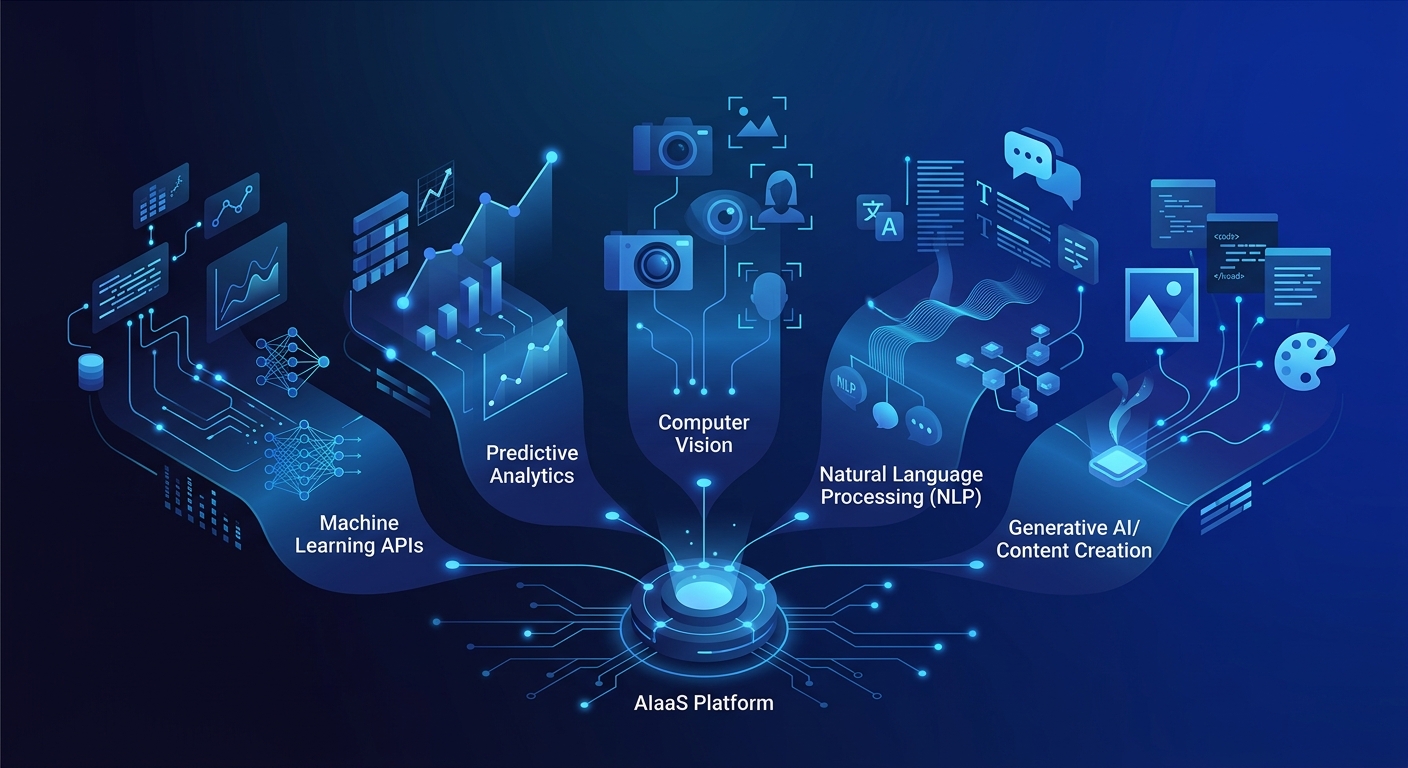
Artificial Intelligence as a Service (AIaaS) is a third-party offering of artificial intelligence tools that allows companies to implement AI capabilities without the high upfront cost of specialized hardware like GPUs or the need for deep in-house data science expertise. By using the cloud, AIaaS democratizes access to sophisticated algorithms, enabling even small-to-medium enterprises to compete with global tech giants. According to the Stanford HAI AI Index Report 2024, the cost of training large-scale language models via cloud services decreased by 25.1% compared to 2022, making these services more accessible than ever.
Key Takeaways
- Definition: AIaaS is a delivery model where AI capabilities are provided via the cloud by third-party vendors.
- Cost Efficiency: It eliminates the need for expensive on-premise GPU clusters and reduces the barrier to entry for machine learning.
- Top Providers: The market is led by Amazon Web Services (AWS), Microsoft Azure, and Google Cloud Platform (GCP).
- Scalability: Businesses can scale their AI usage up or down based on real-time demand, paying only for the compute or API calls they use.
What Is AI as a Service (AIaaS)?
AI as a Service (AIaaS) is an out-of-the-box solution that provides artificial intelligence software and tools via a cloud-based delivery model. Much like Software as a Service (SaaS), AIaaS allows organizations to "rent" intelligence. This includes everything from simple natural language processing (NLP) APIs to complex machine learning (ML) frameworks and fully managed platforms.
The primary goal of AIaaS is to bridge the gap between business needs and technical complexity. In the past, deploying a custom image recognition model required a dedicated team of Ph.D. researchers and millions of dollars in infrastructure. Today, a developer can integrate that same capability using a single line of code through an AIaaS provider. This shift is critical as organizations look for strategic use of AI in business to drive competitive advantages.
How Does AI as a Service Work?
AIaaS works by hosting pre-trained models and computational resources on the provider's infrastructure. Users interact with these services through Application Programming Interfaces (APIs) or Software Development Kits (SDKs).
- Data Input: The user sends data (text, images, or audio) to the cloud service through a secure API.
- Processing: The AIaaS provider runs the data through their proprietary or open-source models (such as GPT-4, Llama, or BERT) hosted on their high-performance GPUs.
- Output: The processed result—whether it's a translation, a sentiment score, or an object detection coordinate—is sent back to the user's application.
This model allows for various deployment configurations, including public cloud, private cloud, and hybrid models, which are often used to address stringent data security and privacy concerns within the enterprise.
Different Types of AIaaS Offerings
To understand the landscape of AI as a Service examples, it helps to categorize them based on their technical function and level of abstraction.
1. Bots and Digital Assistants
These are the most visible forms of AIaaS. They include chatbots and virtual assistants that use NLP to interact with human users. Many companies use these to automate customer service, significantly affecting the ROI for enterprise customer support automation.
2. Cognitive Computing APIs
These are modular services that perform specific tasks. Examples include:
- Computer Vision: Identifying objects in images or videos.
- Speech-to-Text: Converting spoken language into written transcripts.
- Translation: Real-time language conversion.
3. Machine Learning Frameworks
For organizations that want more control, providers offer environments where developers can build, train, and deploy their own models. These frameworks provide the "plumbing" for ML without requiring the user to manage the underlying hardware.
4. Fully Managed Machine Learning Platforms
These services provide a complete end-to-end workflow, from data labeling and feature engineering to model deployment and monitoring. Examples include Amazon SageMaker and Google Vertex AI.
Leading AI as a Service Examples in 2024
The market is currently dominated by "The Big Three" cloud providers, though specialized vendors are carving out significant niches in generative AI and specialized domains.
| Provider | Key AIaaS Product | Primary Use Case |
|---|---|---|
| Amazon Web Services | Amazon Bedrock / SageMaker | Building and scaling generative AI applications |
| Microsoft Azure | Azure OpenAI Service | Enterprise-grade access to GPT-4 and DALL-E |
| Google Cloud | Vertex AI | Developing and deploying ML models at scale |
| IBM Cloud | Watsonx | Trusted AI and data platform for enterprise scale |
| OpenAI | Public API | Direct integration of LLMs into proprietary apps |
Key Insight: According to MDPI Electronics (2023), the AIaaS market was estimated at $15.4 billion in 2023, with a projected compound annual growth rate (CAGR) of 37%, highlighting the rapid transition toward cloud-based intelligence.
The Real Benefits of Adopting AIaaS
For enterprise decision-makers, the shift from "building AI" to "consuming AI as a service" offers several strategic advantages:
- Cost Efficiency: By avoiding the "GPU scarcity" and high capital expenditure (CAPEX) of hardware, companies switch to an operating expenditure (OPEX) model. You pay for what you use, whether that's 100 API calls or 100,000.
- Speed to Market: Pre-trained models allow for rapid prototyping. A company can deploy a generative AI application in weeks rather than years.
- Access to Elite Talent: AIaaS providers employ the world's top AI researchers. By using their services, you benefit directly from that expertise without hiring them.
- Scalability: Cloud providers offer near-infinite compute. As your user base grows, the AI infrastructure scales automatically to meet demand.
Hidden Costs of Scaling AIaaS
While the initial pilot phase of an AIaaS project often seems inexpensive, scaling to production can reveal significant hidden costs that enterprises must plan for.
One of the most overlooked expenses is data egress fees. When moving large volumes of data between different cloud environments or from an on-premise system to a cloud AI provider, these fees can accumulate rapidly. In some multimodal pipelines, egress costs can exceed 20% of the total monthly spend.
Furthermore, API rate limits can force enterprises into higher, more expensive tiers or require complex engineering workarounds to cache responses. Decision-makers should also account for the operational overhead of monitoring these services to ensure continuous AI agent monitoring and quality assurance, as model drift can lead to degraded performance over time.
Common Use Cases for AIaaS in the Enterprise
Modern businesses are integrating AI services across every department to drive enterprise value.
Predictive Maintenance
In manufacturing and energy, AIaaS platforms ingest IoT sensor data to predict when a machine is likely to fail. This is a core component of predictive maintenance strategies, allowing companies to schedule repairs before a breakdown occurs.
Financial Automation
AI services are widely used to automate invoice processing. By comparing AI agents for invoice exception handling vs. traditional workflows, companies find that AIaaS can handle non-standard documents that would otherwise require manual human intervention.
Sales and Marketing
Enterprises are deploying AI SDR strategies to scale autonomous outreach. These services use NLP to craft personalized emails and respond to common lead inquiries, allowing sales teams to focus on closing deals rather than prospecting.
Choosing the Right AIaaS Platform
Selecting a provider is more than a technical decision; it is a long-term strategic partnership. Consider the following criteria:
- Vendor Lock-in: Evaluate how easy it is to move your data and models if you decide to switch providers. Proprietary formats can make migration difficult.
- Compliance and Security: Ensure the provider meets industry-specific standards (HIPAA, GDPR, SOC2). This is especially critical for AI agent data privacy compliance.
- Integration Ease: Does the provider offer robust SDKs for your existing tech stack? Check for compatibility with your current CRM or ERP systems.
- Model Performance: Not all LLMs or vision models are equal. Test your specific data against multiple providers to find which offers the highest accuracy for your use case.
Key Insight: Cloud AI services let organizations work around the talent gap that held back adoption, as long as they stay rigorous about data sovereignty (NIST AI Resource Center).
Frequently Asked Questions
What is the difference between AIaaS and SaaS?
SaaS (Software as a Service) provides a complete application for a specific business task (like Salesforce for CRM). AIaaS (AI as a Service) provides the underlying intelligence components (like text analysis or image recognition) that can be integrated into other applications.
Is AIaaS secure for sensitive company data?
Most major providers offer enterprise-grade security, including encryption at rest and in transit. However, it is vital to use private instances or VPC (Virtual Private Cloud) deployments if you are handling highly sensitive proprietary data to ensure it is not used to train public models.
Do I need a data scientist to use AIaaS?
While you don't necessarily need a Ph.D. to use API-driven AIaaS, having someone who understands data structures and model evaluation is beneficial. Many AIaaS tools are designed for citizen developers and software engineers.
How is AIaaS typically priced?
Most providers use a pay-as-you-go model. Common metrics include the number of API calls, the number of tokens processed (for LLMs), or the number of hours of compute time used for training.
Can AIaaS help with regulatory compliance?
Yes, there are specialized autonomous regulatory change monitoring AI services that help teams track legal changes and ensure their operations remain compliant automatically.
Final Thoughts
AI as a Service has fundamentally changed the landscape of corporate innovation. By lowering the barriers to entry, it has driven a surge in how companies are using AI to solve complex problems. As the technology matures, the focus for enterprise leaders will shift from simply accessing AI to strategically orchestrating these services to build a truly agentic enterprise.
Whether you are looking to automate your customer support, optimize your supply chain, or scale your sales outreach, there is likely an AIaaS example that fits your needs. The key is to start with a clear business problem, pilot with a modular service, and scale while keeping a close eye on data security and long-term costs.