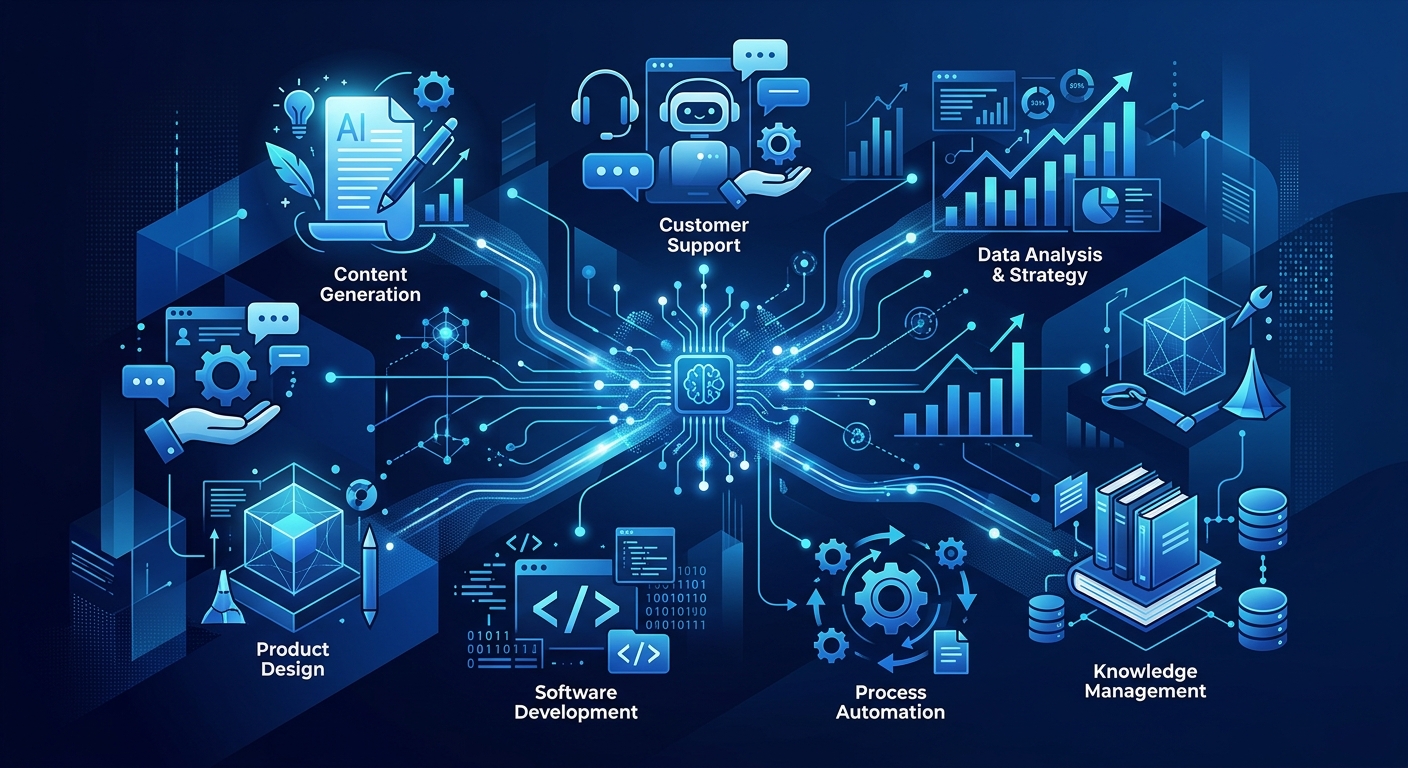
Generative AI (GenAI) is a category of artificial intelligence that creates new content—including text, images, audio, and code—by learning patterns from existing data. Unlike traditional AI, which primarily classifies or predicts, GenAI synthesizes novel outputs that mimic human creativity and logic. In 2025, enterprise adoption has shifted from experimental "shadow AI" to structured, functional integration. Organizations are no longer asking what the technology can do, but where it can deliver the highest return on investment (ROI).
According to research from McKinsey & Company, generative AI could add between $2.6 trillion and $4.4 trillion annually to the global economy. For large-scale organizations, this value is concentrated in automating high-volume cognitive tasks, enabling teams to operate at a scale previously impossible without massive headcount increases. This evolution is particularly visible in how companies move toward The Agentic Enterprise, where AI does not just assist but autonomously executes complex workflows.
Key Takeaways
- Economic Impact: GenAI has the potential to automate up to 70% of current business activities, adding trillions to the global economy.
- Core Pillars: 75% of GenAI's value is concentrated in four areas: Customer Operations, Marketing, Software Engineering, and R&D.
- Efficiency Gains: Professional writing tasks see a 37% reduction in completion time when augmented by generative tools.
- Strategic Shift: Successful implementation requires moving from basic LLM prompts to Retrieval-Augmented Generation (RAG) and sophisticated governance.
Core Enterprise Use Cases for Generative AI
Generative AI is reshaping the foundational pillars of corporate operations. By moving beyond simple chat interfaces, enterprises are building integrated systems that use Large Language Models (LLMs) to handle massive data sets and complex logic.
Automating Content Supply Chains
In the modern enterprise, the demand for content—from internal training manuals to external marketing collateral—often outpaces human capacity. Generative AI solves this by creating a "content supply chain" where initial drafts are generated based on structured data. For example, a global retailer can use GenAI to produce thousands of unique product descriptions in minutes, ensuring SEO optimization and brand consistency across diverse markets.
Synthesized Knowledge Retrieval for Internal Teams
One of the most powerful enterprise use cases is the creation of internal knowledge bases using Retrieval-Augmented Generation (RAG). Instead of searching through thousands of PDF documents on a SharePoint drive, employees can ask a natural language question. The AI retrieves the specific relevant passages and synthesizes a direct answer, citing the source document. This significantly reduces "information friction" and accelerates decision-making.
Accelerating Software Development Lifecycles
Software engineering is perhaps the most advanced sector for GenAI adoption. Engineering teams use AI to generate boilerplate code, refactor legacy systems, and automatically generate documentation. According to McKinsey, GenAI helps software engineers complete tasks significantly faster, particularly in code generation and debugging. This impact is explored further in our analysis of Computer and Mathematical Occupations.
Artificial Intelligence Business Applications by Department
To understand the true breadth of enterprise use cases for generative AI, one must look at departmental implementation. The technology is not a monolith; it adapts to the specific constraints and goals of each business unit.
| Department | Primary GenAI Use Case | Key Benefit |
|---|---|---|
| Customer Service | Hyper-personalized chatbots | 24/7 resolution of complex queries |
| Marketing | Rapid creative iteration | Personalized ad copy at global scale |
| Legal | Automated contract analysis | Reduced risk and faster compliance review |
| R&D | Molecular simulation | Shorter drug discovery and material cycles |
| Sales | Autonomous outreach | Scaling SDR operations |
Customer Service and Personalization
In customer operations, GenAI enables bots to handle nuance. Unlike traditional rule-based bots, GenAI-powered agents understand intent and sentiment. They can resolve complex billing disputes or technical troubleshooting issues without human intervention, escalating only the most sensitive cases. This is a primary driver in measuring AI agent ROI.
Legal and Compliance Document Analysis
Legal departments use GenAI to summarize thousands of pages of regulations or to identify anomalies in vendor contracts. This "semantic search" capability ensures that compliance teams never miss a critical clause. For organizations in highly regulated sectors, using autonomous regulatory change monitoring has become a competitive necessity rather than a luxury.
Marketing and Creative Operations
Marketing teams use GenAI for rapid creative iteration. Instead of waiting weeks for a design agency to provide variations of a campaign, internal teams can generate dozens of images and copy variations in hours. This allows for hyper-segmentation, where different audience demographics see content tailored specifically to their preferences and regional dialects.
Strategic Implementation: Moving Beyond Pilot Programs
Transitioning from a successful pilot to a full-scale enterprise rollout requires more than just a software license. It requires a fundamental shift in data architecture and organizational governance.
Data Security and Governance Frameworks
Enterprises must ensure that their proprietary data does not leak into public training sets. This is why many are opting for private LLM instances or VPC-hosted models. Implementing AI agent data privacy compliance ensures that PII (Personally Identifiable Information) is redacted before it ever reaches the model processing layer.
Measuring ROI on AI Investments
To justify the significant compute costs of GenAI, enterprises need a clear view of what each stage of an AI project costs, as set out on our pricing page. Instead of counting seats, companies can measure the value of AI spend by successful resolutions and completed tasks. This aligns the AI vendor's incentives with the business's efficiency goals. Common metrics include reduction in Average Handle Time (AHT) and increase in First Contact Resolution (FCR).
Key Insight: MIT research found that generative AI reduced the time taken for mid-level professional writing tasks by 37%, allowing employees to focus on higher-value strategic work.
Advanced Use Cases in Research and Development (R&D)
In the pharmaceutical and materials science industries, GenAI is being used to simulate molecular structures. Traditionally, drug discovery involves years of trial and error in physical labs. GenAI can predict how certain proteins will fold or how chemicals will interact, potentially shortening the drug discovery cycle by years. This use case represents the "high-end" of GenAI value, where the technology directly contributes to multi-billion dollar product breakthroughs.
Similarly, in engineering, GenAI assists in generative design. Engineers can input specific constraints—such as weight, material strength, and cost—and the AI generates thousands of potential design iterations that a human might never consider. Explore more on this in our guide to Architecture and Engineering Occupations.
Managing the Risks: Hallucinations and Bias
Despite the benefits, enterprise use cases for generative AI must account for "hallucinations"—instances where the AI confidently provides false information. To combat this, enterprises use continuous AI agent monitoring. These protocols involve "human-in-the-loop" systems where high-stakes outputs are verified by subject matter experts before being finalized.
Furthermore, algorithmic bias remains a critical concern. If a model is trained on biased historical data, it may produce biased outputs in hiring or credit scoring. Robust audit trails are essential for transparency and regulatory compliance.
Frequently Asked Questions
What are the most common enterprise use cases for generative AI?
The most common uses include automated content generation for marketing, code assistance for software developers, and intelligent knowledge retrieval for internal HR and legal departments.
How does GenAI improve customer service?
GenAI improves customer service by powering chatbots that can understand complex natural language, resolve issues without human help, and provide personalized recommendations based on customer history.
Is generative AI secure for enterprise data?
Yes, provided the enterprise uses private cloud instances or enterprise-grade API agreements that prevent the model provider from using the company's data for training purposes.
Can GenAI replace human employees?
While GenAI can automate up to 70% of certain tasks, it is primarily used to augment human capacity. Most roles will evolve rather than disappear, as seen in our research on jobs replaced by AI.
What is the expected ROI of GenAI implementation?
ROI varies by department, but studies show up to a 37% reduction in task completion time for writing and a 20–30% increase in productivity for software engineering teams.
What is Retrieval-Augmented Generation (RAG)?
RAG is a technique where an AI model retrieves specific information from a private database before generating a response, ensuring the answer is grounded in the company's own factual data.
Conclusion: Future-Proofing Your AI Strategy
The era of generative AI is not a fleeting trend; it is a fundamental shift in how enterprise work is performed. To remain competitive, organizations must move beyond the hype and focus on scalable AI use cases that deliver measurable value. By prioritizing data security, establishing clear governance, and focusing on departmental needs, leaders can transform their organizations into truly Agentic Enterprises.
As the technology matures, the gap between AI-enabled companies and laggards will widen. The time to build the infrastructure for GenAI is now, ensuring that your organization is ready to capture its share of the trillions in economic value this technology promises to unlock.