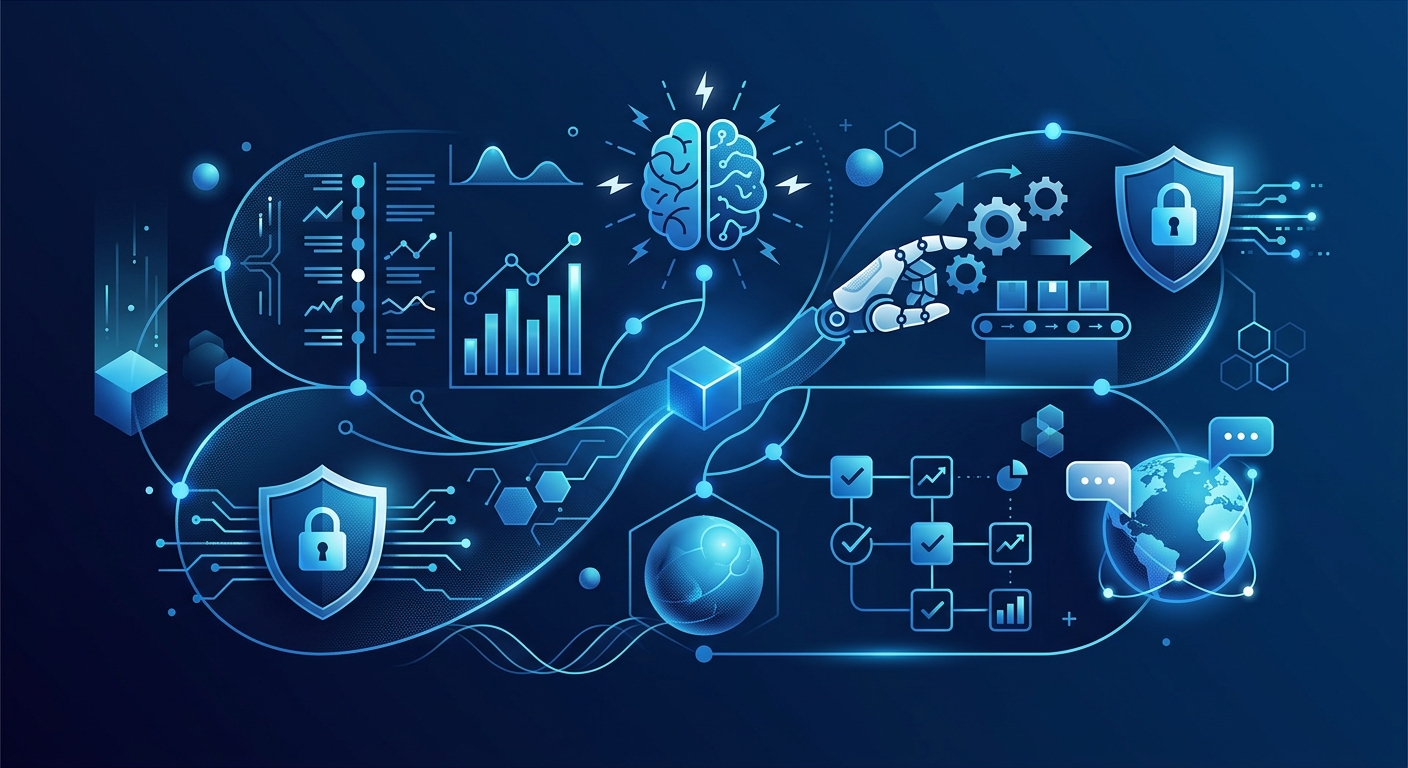
Enterprise Artificial Intelligence (AI) is the application of advanced machine learning, natural language processing, and deep learning technologies to solve complex business problems at scale. Unlike consumer-grade AI, enterprise AI use cases focus on security, scalability, and integration with proprietary data. Today, the landscape is shifting from experimental pilots to "AI-augmented" operational workflows where human expertise is enhanced by automated intelligence. Organizations are no longer asking if AI works; they are determining where it creates the most defensible competitive advantage.
Key Takeaways
- Shift to Augmentation: 80% of enterprises will have deployed GenAI-enabled applications by 2026, transitioning from chatbots to complex workflow automation.
- Productivity Gains: Generative AI has been shown to improve worker performance by up to 40% in analytical and creative tasks.
- Data Grounding: Retrieval-Augmented Generation (RAG) is the gold standard for connecting LLMs to internal corporate knowledge safely.
- Operational Resilience: Predictive AI remains the leader in supply chain and manufacturing, specifically for minimizing downtime and demand forecasting.
The Evolution of Enterprise AI Use Cases
The history of enterprise AI is a progression from descriptive analytics to prescriptive action. Initially, businesses used AI for "Big Data" projects—processing massive datasets to find historical trends. This evolved into predictive modeling, where algorithms forecasted future sales or customer churn based on past behavior.
Today, we are in the era of Generative AI (GenAI) and Agentic AI. The focus has shifted from merely predicting what might happen to creating content, code, and decisions in real time.
Enterprise AI use cases now emphasize "human-in-the-loop" systems. For example, in Architecture and Engineering Occupations, AI acts as a co-pilot that suggests structural optimizations rather than a replacement for the lead architect. This evolution ensures that as AI handles the cognitive load of data processing, human leaders focus on high-level strategy and ethics.
Critical Enterprise Use Cases for Generative AI
Generative AI (GenAI) is a subset of AI that can create new content, including text, images, and code, based on the data it was trained on. In the enterprise, the most valuable applications of GenAI involve grounding these models in a company's unique, private data.
1. Internal Knowledge Management (RAG)
Retrieval-Augmented Generation (RAG) is an architecture that allows an AI to query a specific set of documents before generating a response. This prevents "hallucinations" and ensures the AI provides answers based only on approved corporate literature. This is significant for HR, legal, and technical support teams who must navigate thousands of internal SOPs.
2. Automated Software Engineering
AI is reshaping the software development life cycle (SDLC). Beyond simple code completion, AI agents now assist in Enterprise AI Agent Orchestration Terms & Implementation Patterns. They can refactor legacy code, generate unit tests, and even identify security vulnerabilities before code is committed.
3. Hyper-Personalized Marketing and Sales
Modern sales teams use AI to scale personalized outreach. By analyzing LinkedIn profiles, past purchase history, and company news, AI can draft highly personalized emails that feel human-written. This is further explored in our guide on Enterprise AI Sdr Deployment Strategy.
Key Insight: Gartner projects that by 2026, 80% of enterprises will have used Generative AI APIs or deployed GenAI-enabled applications, up from less than 5% in 2023.
Operational Efficiency: AI in Supply Chain and Finance
While GenAI captures headlines, predictive AI continues to drive substantial ROI in the back office. These use cases focus on pattern recognition and anomaly detection.
AI-Powered Demand Forecasting
Traditional forecasting relies on historical sales. AI-driven forecasting incorporates external variables—weather patterns, geopolitical shifts, and social media trends—to predict inventory needs with 95%+ accuracy. This reduces the "bullwhip effect" in supply chains, where small fluctuations in demand cause massive overstocks at the warehouse level.
Financial Anomaly Detection and Procurement
In finance, AI is used to spot fraud and optimize spend. AI Agents for Invoice Exception Handling can automatically reconcile discrepancies that would take a human accountant hours to investigate. By comparing invoices against purchase orders and contracts in real time, AI prevents leakage and ensures compliance with vendor terms.
Predictive Maintenance
Predictive maintenance is the use of AI and IoT sensors to predict when a piece of machinery will fail before the failure occurs. By analyzing vibration, temperature, and sound data, AI can schedule maintenance only when necessary, saving enterprises millions in unplanned downtime. For a deeper look, see our Predictive Maintenance Guide.
AI in Cybersecurity: Real-Time Threat Intelligence
Cybersecurity is perhaps the most critical enterprise AI use case because the adversaries are also using AI. Modern security operations centers (SOCs) use AI for:
- User and Entity Behavior Analytics (UEBA): Identifying when a legitimate user's account is behaving abnormally, suggesting a credential compromise.
- Automated Incident Response: AI can automatically isolate an infected laptop from the network the moment a ransomware strain is detected, far faster than a human analyst could react.
- Vulnerability Management: Prioritizing which software patches to apply first based on the actual risk of exploitation in the wild.
Organizations must follow frameworks like the NIST AI Risk Management Framework to ensure their security AI is robust, explainable, and trustworthy.
Compliance and Regulatory AI Agents
For highly regulated industries like banking and healthcare, keeping up with changing laws is a full-time job for hundreds of employees. Autonomous Regulatory Change Monitoring AI tracks thousands of global regulatory bodies and alerts legal teams only to the changes that affect their specific business units. This reduces the risk of non-compliance fines and allows legal experts to focus on interpretation rather than manual tracking.
To ensure these systems remain accurate, companies should implement Continuous AI Agent Monitoring Protocols to check for "drift" in the AI's understanding of complex legal language.
Customer Support and the Agentic Enterprise
The transition from simple chatbots to the "Agentic Enterprise" represents the next frontier. An AI agent is an autonomous system that can perceive its environment, reason about goals, and take actions to achieve them. In customer support, this means an agent doesn't just answer a question about a return policy; it actually processes the return, updates the CRM, and issues the shipping label.
Enterprises are seeing strong ROI here. We've documented how Measuring AI Agent ROI for Customer Support involves looking at more than just "deflection rates." It includes measuring customer satisfaction (CSAT), resolution speed, and the reduction in agent burnout.
| Use Case | AI Type | Primary Benefit | ROI Metric |
|---|---|---|---|
| Knowledge Retrieval | GenAI (RAG) | Faster information access | Hours saved per employee |
| Demand Forecasting | Predictive ML | Inventory optimization | Reduction in carrying costs |
| Code Generation | GenAI | Faster product shipping | Sprint velocity increase |
| Fraud Detection | Anomaly Detection | Risk mitigation | Total fraud losses prevented |
Implementation Roadmap for Enterprise Decision-Makers
Scaling from a proof-of-concept (POC) to a global rollout requires a structured approach. Most failures occur because organizations treat AI as a software purchase rather than a process transformation.
- Identify the "High-Value, Low-Complexity" Quad: Start with use cases that have high data availability and clear ROI metrics, such as Automated Regulatory Change Tracking.
- Establish Data Governance: AI is only as good as the data it consumes. Ensure your data is cleaned, labeled, and stored in a way that respects AI Agent Data Privacy.
- Build a "Human-in-the-loop" Workflow: Every AI output should be auditable. Implement AI Agent Audit Trails to maintain transparency for stakeholders and regulators.
- Monitor and Iterate: Use ROI & Performance Metrics to determine if the AI is meeting its objectives. AI models require constant tuning to remain effective.
Key Insight: Successful enterprise AI deployment requires a shift from "Project-based" thinking to "Platform-based" thinking, where a single AI infrastructure supports multiple use cases across the organization.
Frequently Asked Questions
What is the most common enterprise use case for AI today?
Currently, the most common use case is Generative AI for internal knowledge retrieval and document summarization. This allows employees to find information across vast corporate silos quickly using natural language queries.
How does Enterprise AI differ from Consumer AI (like ChatGPT)?
Enterprise AI is built with strict requirements for data privacy, security (SOC2/GDPR compliance), and the ability to integrate with proprietary systems via APIs. It often uses RAG to ensure it doesn't leak sensitive data or provide inaccurate information.
Is AI going to replace most enterprise jobs?
AI is primarily reshaping jobs rather than eliminating them. For example, in Computer and Mathematical Occupations, AI handles routine coding and debugging, allowing developers to focus on higher-level system architecture and problem-solving.
What is RAG in the context of enterprise AI?
Retrieval-Augmented Generation (RAG) is a technique that gives an LLM access to specific, external data (like your company's product manuals) to provide more accurate and context-aware responses without needing to retrain the entire model.
How do we measure the ROI of an AI use case?
ROI is measured by calculating the cost of the AI (compute, licensing, and management) against the value of time saved, errors reduced, and additional revenue generated.