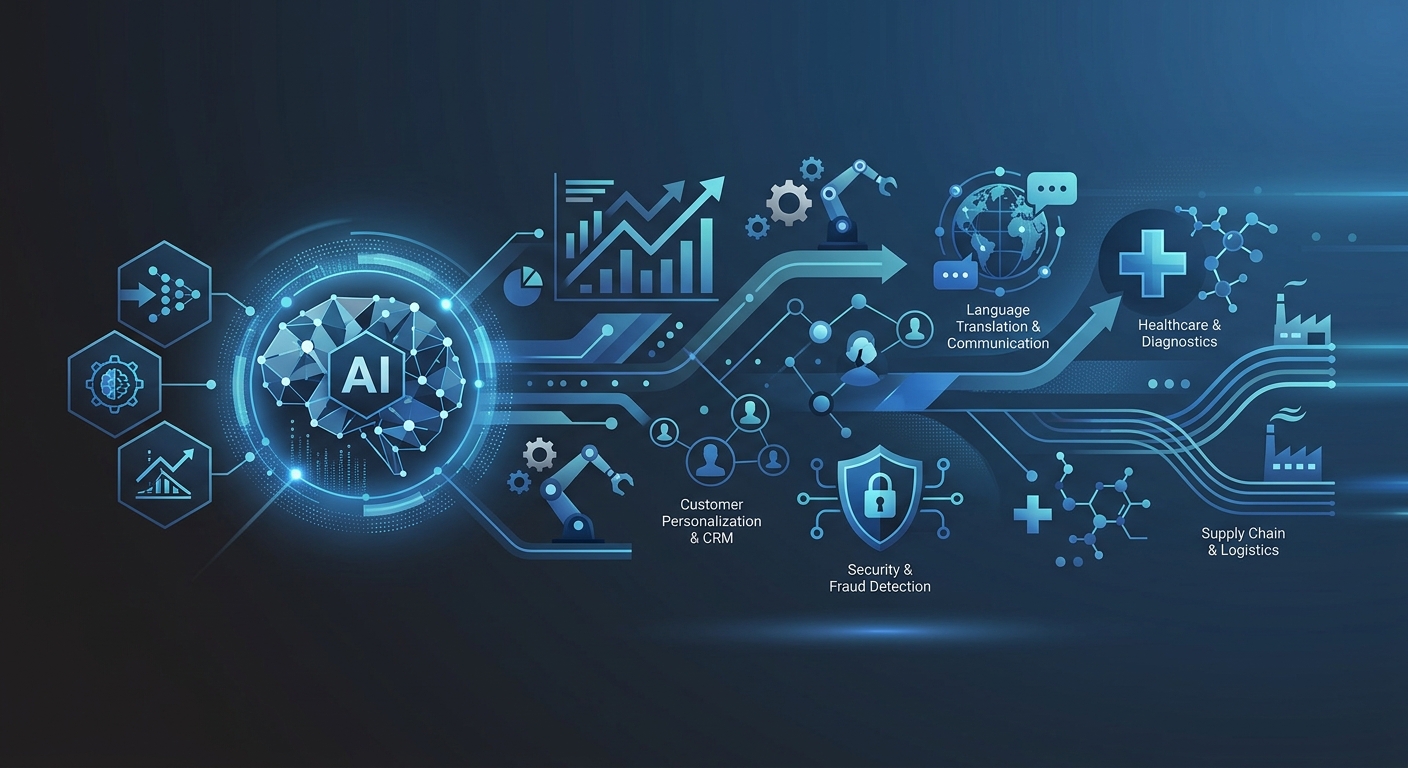
The transition of Artificial Intelligence (AI) from a speculative technology to a core enterprise requirement is now complete. In 2024, the discussion has shifted from "what is AI?" to "which AI use cases deliver the highest return on investment (ROI)?" For modern organizations, the application of machine learning (ML) and Large Language Models (LLMs) is no longer about novelty; it is about operational resilience and competitive differentiation.
This guide explores the most critical AI use cases across industries, providing a roadmap for leaders to move from experimentation to scalable implementation.
Key Takeaways
- Efficiency Gains: High-skilled workers can complete 12.2% more tasks with AI assistance, significantly increasing departmental throughput.
- Dual Strategy: Successful firms balance "Everyday AI" (productivity) with "Transformative AI" (bespoke core business logic).
- Predictive Power: AI-driven predictive maintenance reduces downtime by forecasting equipment failure before it happens.
- Risk Management: Robust frameworks like the NIST AI RMF are essential for mitigating bias and ensuring data privacy in high-stakes deployments.
The Evolution of Enterprise AI Use Cases
An AI use case is a specific business challenge or process that is addressed through the application of artificial intelligence technologies to achieve a measurable outcome. Historically, AI use cases were confined to narrow data science projects, such as basic churn prediction. Today, they encompass the The Agentic Enterprise, where autonomous agents handle multi-step workflows with minimal human intervention.
We categorize modern AI applications into two distinct buckets: Everyday AI and Transformative AI. Everyday AI focuses on productivity—think of it as a "co-pilot" for every employee. In contrast, Transformative AI involves bespoke models designed to solve complex, industry-specific problems, such as protein folding in pharmaceuticals or real-time grid management in energy.
Strategic Enterprise Use Cases for Generative AI
Generative AI has democratized access to machine learning. By using LLMs, enterprises are transforming departments that were previously considered "manual-heavy."
1. Automated Content and Marketing Operations
Enterprise use cases for generative AI in marketing go beyond simple copy generation. Organizations are using AI to localize content across 30+ languages simultaneously, ensuring brand voice consistency while adhering to local cultural nuances. This reduces the time-to-market for global campaigns by as much as 60%.
2. Knowledge Management and Semantic Search
Internal knowledge silos are a significant drag on productivity. Modern AI use cases involve creating "Chat with your Data" interfaces. By using Retrieval-Augmented Generation (RAG), employees can query thousands of internal PDFs, wikis, and Slack logs to find immediate answers to complex policy or technical questions. This is particularly relevant for Architecture and Engineering Occupations where technical documentation is dense.
3. Software Engineering and Code Generation
AI is not replacing developers; it is augmenting them. Use cases include legacy code migration (e.g., converting COBOL to Java), automated unit testing, and real-time bug detection. This allows senior engineers to focus on system architecture rather than boilerplate code.
Operational Efficiency: AI Use Cases in Logistics and Supply Chain
In the physical world, AI use cases add a layer of intelligence over complex global supply chains. The integration of AI with Internet of Things (IoT) sensors enables a level of visibility that was previously out of reach.
Predictive Analytics for Demand Forecasting
Traditional forecasting relies on historical sales data. Modern AI use cases incorporate external variables—weather patterns, geopolitical shifts, and social media trends—to predict demand with up to 95% accuracy. This prevents overstocking and reduces the capital tied up in inventory.
Route Optimization and Last-Mile Delivery
AI algorithms now solve the "traveling salesman problem" in real time. By analyzing traffic, fuel consumption, and delivery windows, AI reduces fleet mileage by 10–15% annually. This is a primary driver for organizations looking to meet ESG (Environmental, Social, and Governance) targets while cutting costs.
| Industry | Primary AI Use Case | Key Benefit |
|---|---|---|
| Manufacturing | Predictive Maintenance | 30% reduction in unplanned downtime |
| Retail | Hyper-personalization | 20% increase in Customer Lifetime Value (CLV) |
| Logistics | Dynamic Routing | 15% reduction in fuel costs |
| Healthcare | Medical Imaging | 40% faster diagnostic turnaround |
AI in Healthcare: Diagnostics and Drug Discovery
Healthcare represents one of the most high-stakes environments for AI. The primary use cases here focus on augmenting human expertise to save lives and reduce costs.
- Medical Imaging Analysis: AI models can detect anomalies in X-rays, MRIs, and CT scans with a precision that rivals or exceeds human radiologists. This is especially critical in early-stage cancer detection.
- Accelerated Drug Discovery: Traditionally, bringing a drug to market takes 10 years and billions of dollars. AI is shortening this timeline by simulating how molecules interact, effectively "folding" proteins in a digital environment to identify viable candidates before a single lab test is conducted Nature.
Financial Services: Fraud Detection and Risk Management
For the financial sector, AI use cases are centered on security and compliance. As transactions become instantaneous, human-led fraud detection is no longer sufficient.
- Real-time Fraud Prevention: AI systems analyze patterns across millions of transactions per second to flag anomalies that suggest credit card theft or money laundering.
- Automated Regulatory Tracking: Financial institutions use Autonomous Regulatory Change Monitoring AI to stay compliant with shifting global laws. This reduces the risk of multi-million dollar fines and ensures that AI Agent Data Privacy Compliance is maintained.
- Invoice Exception Handling: Instead of manual reviews, AI agents for invoice exception handling identify discrepancies in billing, speeding up accounts payable cycles.
Customer Support: The Rise of Autonomous Agents
Customer service has evolved from basic chatbots to sophisticated autonomous agents. The goal is no longer just to deflect tickets, but to resolve them.
Key Insight: Some vendors now price AI helpdesk automation per successfully resolved customer issue, so buyers should compare pricing models and ask what controls they keep over go-live.
These agents can now handle complex tasks such as processing returns, troubleshooting technical hardware, and managing Enterprise AI Sdr Deployment Strategy for outbound sales. By measuring AI Agent ROI for Customer Support, firms often find that AI can handle 70% of routine inquiries, allowing human agents to focus on high-empathy escalations.
Implementing AI: From Proof of Concept to Scale
Moving an AI use case from a pilot to a production environment requires more than good code. It requires a strategic framework.
Step 1: Identify High-Value Problems
Do not start with the technology; start with the pain point. Identify where Jobs Replaced by AI or augmented by AI can generate the most immediate value. Focus on processes with high volume and high repeatability.
Step 2: Establish Governance
Every AI deployment must adhere to the NIST AI Risk Management Framework. This involves setting up Continuous AI Agent Monitoring Protocols to ensure the model does not drift or develop biases over time.
Step 3: Data Readiness
AI is only as good as the data it consumes. Enterprises must ensure their data is clean, labeled, and accessible. Implementing AI Agent Audit Trail Best Practices ensures that every decision made by an AI can be traced back to its source data, which is vital for legal and ethical accountability.
Frequently Asked Questions
What are the most common AI use cases for small businesses?
Small businesses often benefit most from "Everyday AI" tools like automated email drafting, basic customer service chatbots, and AI-driven social media scheduling. These tools require low upfront investment but provide immediate time-saving benefits.
How do I calculate the ROI of an AI use case?
ROI is calculated by comparing the total cost of ownership (TCO)—including licensing, compute, and training—against the value of time saved, error reduction, and increased output. Check our guide on ROI & Performance Metrics for specific formulas.
Is AI going to replace my workforce?
AI is primarily a tool for augmentation. While it may automate specific tasks, it often shifts human roles toward higher-value activities. For a detailed breakdown of impact by sector, see our analysis on Computer and Mathematical Occupations.
How does AI improve predictive maintenance?
By analyzing vibration, temperature, and sound data from machinery, AI identifies patterns that precede a breakdown. This allows for "just-in-time" repairs. Learn more in our Predictive Maintenance Guide.
What is the risk of using GenAI for internal data?
The primary risks are data leakage and "hallucinations." To mitigate these, enterprises use private LLM instances and RAG architectures to ensure data never leaves their secure environment. Refer to our Data Security policy for best practices.
Can AI be used for social services?
Yes, AI use cases in Community and Social Service Occupations include optimizing resource allocation for food banks and predicting at-risk youth scenarios to provide early intervention.
Conclusion: The Path Forward
The landscape of AI use cases is vast and growing. For the enterprise, the goal is not to implement AI for the sake of innovation, but to solve fundamental business problems with greater speed and precision. Whether through Enterprise AI Agent Orchestration or simple automation, the time to act is now. Organizations that fail to integrate these technologies into their core strategy risk falling behind in an increasingly automated economy.