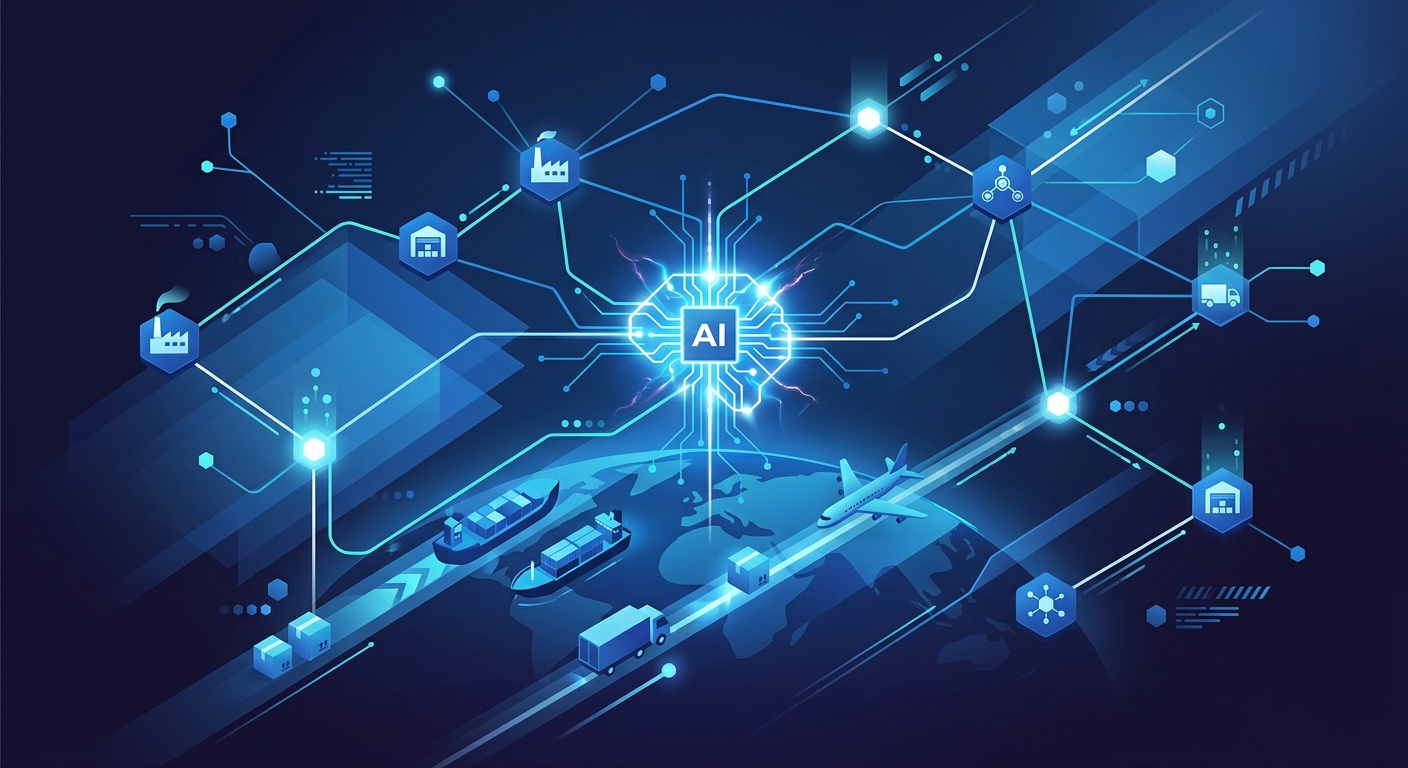
Artificial Intelligence (AI) is a mature, transformative force in Supply Chain Management (SCM) that enables organizations to transition from reactive operations to predictive, self-optimizing ecosystems. As global trade becomes increasingly volatile, the integration of supply chain artificial intelligence allows enterprises to process massive datasets, identify hidden patterns, and execute autonomous decisions that were previously impossible for human operators. According to research published in the International Journal of Production Economics, the academic and industrial focus on AI has shifted from purely theoretical frameworks to empirical implementations that solve real-world logistical bottlenecks.
Key Takeaways
- Maturity Transition: AI has evolved from a niche automation tool into a core driver of smart logistics and resilient supply chain architectures.
- Efficiency Gains: The combination of AI with IoT and Big Data is a primary driver for enhancing smart logistics systems and reducing operational costs IEEE Xplore.
- Sustainability Focus: Modern AI applications are increasingly focused on building resilience and promoting sustainability rather than just cutting costs.
- SME Accessibility: Small-to-medium enterprises can now use "open-weight" models and external platforms to bypass the need for massive proprietary datasets.
Abstract: The State of AI in Global Logistics
Supply chain artificial intelligence is a multifaceted discipline that uses machine learning (ML), natural language processing (NLP), and computer vision to optimize the movement of goods, services, and information. The current landscape is defined by high empirical growth; a systematic search of peer-reviewed literature identified over 150 journal articles between 1998 and 2020 focusing specifically on AI's application in logistics ScienceDirect 2021. This growth reflects the market's high expectations for AI to drive transformative changes in business and society.
Today, AI is no longer just about "doing things faster." It is about managing complexity. In modern supply chain operations, AI addresses complexity by improving operational efficiency and providing the visibility required to navigate geopolitical disruptions and environmental mandates. As organizations move toward the Agentic Enterprise, the role of AI shifts from basic decision support to autonomous agent orchestration.
Keywords
Artificial Intelligence, Supply Chain Management (SCM), Machine Learning, Smart Logistics, Predictive Analytics, Demand Forecasting, Sustainability, Resilience, Internet of Things (IoT), Big Data, Enterprise AI.
Introduction to Artificial Intelligence and Supply Chain Integration
Supply chain management is inherently a data-rich environment, making it an ideal candidate for AI. Traditional rule-based systems often fail when faced with non-linear variables, such as sudden weather shifts, port strikes, or rapid changes in consumer sentiment. Artificial intelligence and supply chain integration address this by using deep learning models that can ingest both structured data (like historical sales) and unstructured data (like social media trends or news reports).
Deloitte notes that the primary goal of AI in modern supply chain management is to address the complexity inherent in global networks Deloitte US. By creating a "digital twin" of the supply chain, AI allows leaders to simulate thousands of scenarios and choose the path that maximizes resilience and minimizes risk. This proactive stance is essential for maintaining a competitive edge in an era where Business and Financial Operations Occupations are being reshaped by automated intelligence.
Artificial Intelligence: Definition and Taxonomy in SCM
To understand the impact of AI, we must define its specific components within the logistics context:
- Machine Learning (ML): Algorithms that improve through experience. In SCM, ML is used for demand forecasting and route optimization.
- Natural Language Processing (NLP): Systems that understand human language. These are used for AI agents for invoice exception handling.
- Computer Vision: AI that interprets visual data. This is critical for AI warehouse automation and quality control.
- Robotic Process Automation (RPA): While not "intelligent" in the cognitive sense, when paired with AI, it becomes "Intelligent Automation," capable of handling complex document workflows.
Key Insight: AI technologies are mature enough to drive transformative change in supply chain management, where expectations are high (ScienceDirect).
Smart Logistics: The Role of AI, IoT, and Big Data
The convergence of AI with the Internet of Things (IoT) is the cornerstone of what is now called "Smart Logistics." Sensors on shipping containers, trucks, and warehouse shelves provide a continuous stream of real-time data. AI then processes this Big Data to provide actionable insights.
Research published by IEEE Xplore highlights that this integration reduces costs and improves operational efficiency by enabling dynamic rerouting. For example, if an IoT sensor detects a temperature deviation in a pharmaceutical shipment, an AI agent can automatically trigger a reroute to the nearest inspection facility, preventing total loss. This level of continuous AI agent monitoring ensures that quality standards are met without human intervention.
| Feature | Traditional Logistics | AI-Driven Smart Logistics |
|---|---|---|
| Forecasting | Historical averages | Predictive/Real-time signals |
| Inventory | Buffer-based (Just-in-case) | Demand-driven (Just-in-time) |
| Rerouting | Manual/Reactive | Autonomous/Proactive |
| Visibility | Siloed/Delayed | End-to-end/Real-time |
Cluster Analysis of AI Applications in SCM
When analyzing the literature, AI applications in the supply chain tend to cluster into four distinct areas:
- Planning and Forecasting: Using ML to reduce the "bullwhip effect" by aligning production more closely with actual demand.
- Sourcing and Procurement: AI agents that manage supplier risk and automate price negotiations.
- Logistics and Transportation: Optimizing last-mile delivery and freight management. This is particularly relevant for AI agents for manufacturing and logistics.
- Warehouse Management: Using autonomous mobile robots (AMRs) and computer vision for grading and sorting agricultural products.
Sustainability and Resilience: The New AI Frontier
While the first wave of AI adoption was driven by cost reduction, the current wave focuses on sustainability and resilience. The Yale School of Management emphasizes that AI is critical for building supply chains that can withstand shocks while minimizing environmental impact.
However, there is an "environmental paradox" to consider. Running large-scale AI optimizations consumes significant energy. Organizations must weigh the efficiency gains—such as reduced fuel consumption via route optimization—against the carbon footprint of the data centers running the AI models. Current research indicates that the net benefit is usually positive, but only if the AI is trained and deployed using energy-efficient protocols.
Overcoming the SME Data Gap
A common misconception is that AI is only for large enterprises like Amazon or Walmart. While deep learning models often require massive datasets, small-to-medium enterprises (SMEs) can implement AI through several alternative strategies:
- Open-Weight Models: Using models like Meta's LLaMA, which allow SMEs to build powerful Supply Chain Generative AI applications without the cost of training a model from scratch.
- External AI Platforms: Using SaaS providers that aggregate anonymized data across industries to provide predictive benchmarks.
- Data Governance: Prioritizing the cleanup of existing small datasets. High-quality small data is often more valuable for specific logistical tasks than noisy big data.
Legal and Liability Frameworks for AI Errors
As AI takes on more autonomous roles, a critical gap in current industry knowledge is the legal framework surrounding AI-driven errors. What happens when an autonomous forecasting error leads to a multi-million dollar inventory loss?
Currently, liability is largely governed by contractual allocation. However, emerging regulations like the Utah Artificial Intelligence Policy Act are beginning to hold companies liable for AI-driven deceptive practices. In the context of supply chains, organizations must ensure their data security and privacy policies include specific clauses for algorithmic failure, treating AI agents as entities that require rigorous compliance and risk management.
Future Research and Article Preview
Looking forward, the next frontier for supply chain artificial intelligence is "Self-Healing Supply Chains." These are systems that not only identify a problem but also execute the remedy—such as a manufacturing change order—without human approval. Future research will likely focus on the ethical implications of this autonomy and the impact on Management Occupations.
Frequently Asked Questions
1. How does AI improve demand forecasting accuracy?
AI improves forecasting by analyzing non-traditional data sources like weather, social media, and geopolitical events alongside historical sales. This allows it to identify complex patterns that traditional statistical models miss.
2. Can AI help in reducing supply chain carbon footprints?
Yes. AI reduces carbon footprints by optimizing transport routes to decrease fuel consumption, improving warehouse energy efficiency, and reducing waste through better inventory management.
3. What is the biggest barrier to AI adoption in SCM?
Data silos remain the biggest barrier. AI requires integrated data from across the organization to provide accurate insights, but many companies still store information in disconnected legacy systems.
4. Is AI going to replace human supply chain managers?
AI is more likely to augment than replace. It handles data-heavy, repetitive tasks, allowing managers to focus on strategic decision-making and relationship building. See our analysis on Statisticians and AI.
5. What is a digital twin in the context of AI supply chains?
A digital twin is a virtual replica of the physical supply chain. AI uses this model to run "what-if" simulations to test how the real-world chain would react to various disruptions.
6. How much does it cost to implement AI in a supply chain?
Costs vary widely depending on scope. However, with the rise of AI-as-a-Service (AIaaS), the barrier to entry has dropped significantly, allowing for pilot programs that can demonstrate ROI in months rather than years.