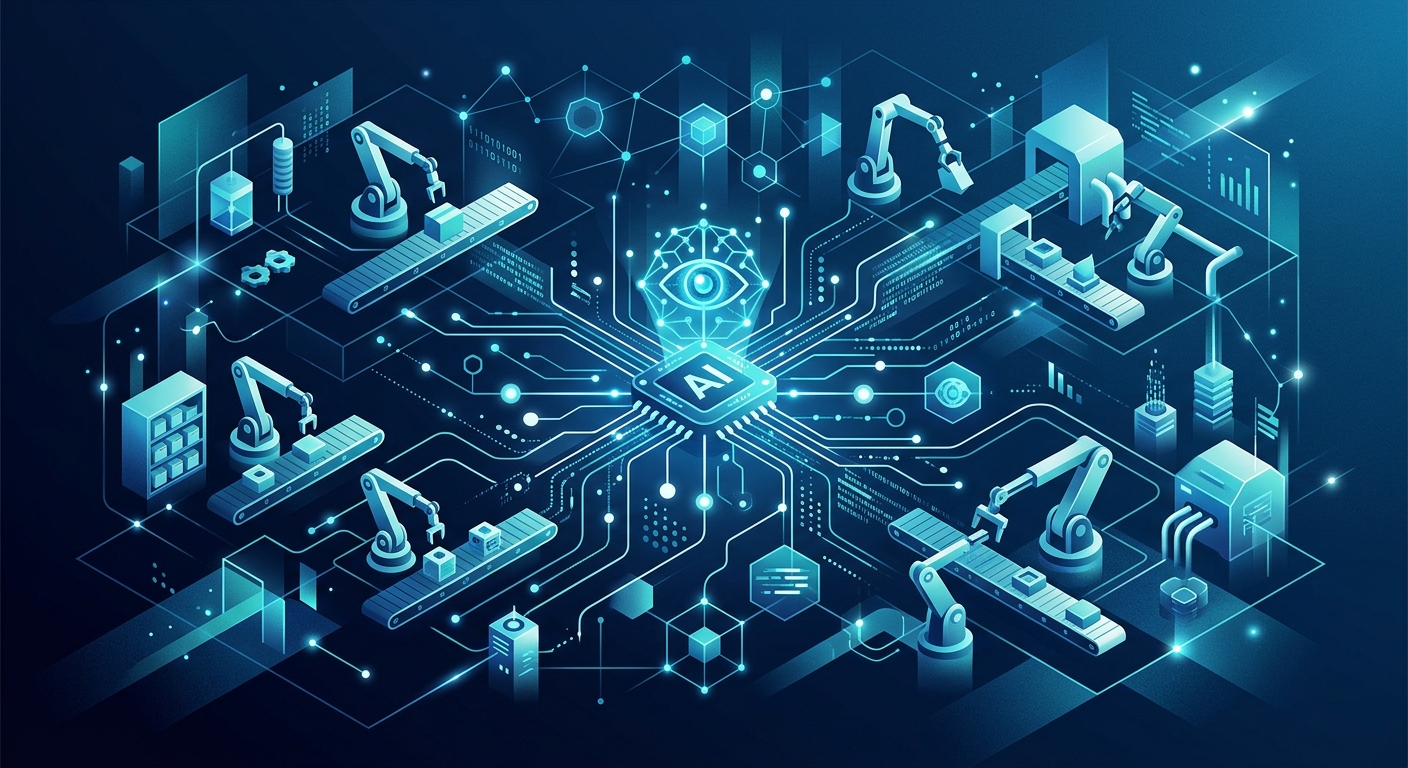
Introduction: The Shift Toward Intelligent Production
Artificial Intelligence (AI) for factory automation is the integration of machine learning algorithms, computer vision, and neural networks into industrial processes to enable systems that can perceive, reason, and act autonomously. Unlike traditional automation, which relies on fixed, pre-programmed logic (if-then statements), AI-driven systems adapt to changing variables in real time. This shift represents the transition from simple robotic repetition to "cognitive manufacturing."
In the modern industrial landscape, the convergence of traditional Programmable Logic Controllers (PLCs) and advanced AI models is no longer optional. For enterprise leaders, implementing AI is a strategic necessity to combat rising labor costs and supply chain volatility. According to Deloitte, smart factories utilizing AI can achieve a 50% reduction in unplanned downtime by identifying equipment failures before they occur.
Key Takeaways
- Predictive Maintenance: AI models reduce downtime by up to 50% compared to reactive maintenance schedules.
- Capacity Gains: Factories utilizing AI-optimized scheduling see an average 20% increase in production capacity.
- Quality Control: Computer vision systems detect defects invisible to the human eye, automating 100% of quality assurance workflows.
- ROI Horizon: Most industrial AI projects target a 3–5 year ROI, though pilot programs often require $75K–$200K in initial internal resource allocation.
What AI Industrial Automation Means for the Modern Facility
AI industrial automation is a subset of Industry 4.0 that uses data-driven models to optimize the manufacturing lifecycle. While traditional automation handles physical tasks—such as moving a pallet from point A to point B—AI handles the decision-making tasks associated with those movements. For example, an AI system might re-route that pallet based on a detected bottleneck in the assembly line.
At its core, AI for factory automation relies on three technical layers: data acquisition (IoT sensors), processing (Edge or Cloud computing), and actuation (Robotics/PLCs). By creating a closed-loop system, manufacturers can transition from "automated" facilities to "autonomous" ones. This distinction is critical: an automated factory follows a script; an autonomous factory writes its own script based on the current environment.
The Evolution of Factory Automation with AI
Historically, factory automation was synonymous with the assembly line—rigid, expensive to reconfigure, and blind to its surroundings. The 1970s brought the PLC, which allowed for digital control over mechanical processes. However, these systems remained "dumb" in the sense that they could not learn from historical data or predict future states.
The current evolution, powered by deep learning and massive datasets, allows machines to interpret complex visual and sensory input. As noted by MIT Executive Education, a forward-thinking factory can now find an AI application for every critical function, from maintenance to inventory management. This evolution has moved AI from the laboratory to the shop floor, making it a foundational component of Digital Twin Technology.
The Highest-Impact Use Cases for AI in Manufacturing
Identifying where to deploy AI first is essential for ensuring quick wins and stakeholder buy-in. While there are dozens of applications, three specific use cases consistently deliver the highest ROI:
1. AI-Driven Predictive Maintenance
Predictive maintenance is the use of machine learning algorithms to analyze sensor data (vibration, heat, acoustics) to predict when a component will fail. Traditional maintenance is either reactive (fix it when it breaks) or preventative (fix it on a schedule). AI-driven maintenance is proactive, ensuring parts are replaced only when necessary but before they cause a catastrophic halt. This is explored in depth in our Predictive Maintenance Guide.
2. Automated Quality Assurance (Computer Vision)
Computer vision is a field of AI that enables computers to derive meaningful information from digital images or videos. In a factory setting, high-speed cameras scan every product on the line. AI models, trained on thousands of examples of "good" and "bad" parts, can identify microscopic cracks or color deviations that human inspectors would miss. This ensures 100% inspection coverage without slowing down production.
3. Generative Design and Prototyping
Generative AI is not just for text; in manufacturing, it is used for "generative design." Engineers input parameters—such as weight limits, material types, and strength requirements—and the AI generates thousands of potential blueprints. Often, these designs use organic shapes that are lighter and stronger than anything a human could design, which are then produced via 3D printing or advanced CNC machining.
Benefits of AI in Industrial Automation
The primary driver for AI adoption is the measurable impact on the bottom line. Beyond simple cost-cutting, AI enables a level of agility that was previously impossible.
"A purposeful, step-by-step approach to implementing AI initiatives can help your company significantly reduce downtime and improve throughput." — MIT Executive Education
Key benefits include:
- Increased Throughput: Forbes reports that factories utilizing AI-optimized scheduling and throughput analysis have observed up to a 20% increase in production capacity.
- Labor Efficiency: AI handles repetitive data-entry and monitoring tasks, allowing human workers to focus on complex problem-solving. This is particularly relevant when considering how Architecture and Engineering Occupations are evolving to manage these AI systems.
- Waste Reduction: By optimizing raw material usage through precise AI control, manufacturers can significantly lower their scrap rates and carbon footprint.
The Role of AI and IoT in Smart Factories
The "Smart Factory" is an ecosystem where the Internet of Things (IoT) provides the nervous system and AI provides the brain. Without IoT sensors, AI has no data to analyze; without AI, IoT data is just a mountain of noise that humans cannot process in real time.
In a smart factory, every asset is connected. This connectivity allows for "closed-loop" manufacturing, where the AI system detects a slight deviation in a product's dimensions and automatically adjusts the machine's settings to correct the error on the next unit. This level of coordination requires robust Enterprise AI Agent Orchestration to ensure that data flows seamlessly between the ERP, the MES, and the shop floor equipment.
Challenges in AI Integration: Hardware and Legacy Systems
One of the most significant gaps in current manufacturing literature is the specific hardware requirements for transitioning legacy systems. Most factories still run on legacy PLCs that lack the processing power for local AI inference.
To bridge this gap, manufacturers must invest in GPU Edge Controllers. Unlike standard industrial PCs, these controllers contain specialized hardware (like NVIDIA Jetson modules) capable of running neural networks locally. This "Edge AI" approach is superior to cloud processing for factory floors because it eliminates latency—a critical factor when a robotic arm needs to stop in milliseconds to avoid a collision. Transitioning often involves installing "sidecar" edge devices that tap into the PLC's data stream via protocols like OPC-UA or MQTT without replacing the underlying controller.
Real-World Success Stories
- Automotive Sector: A leading European automaker implemented AI-powered computer vision to inspect weld points. The system identified 15% more defects than human inspectors while reducing the inspection time per vehicle by 40%.
- Electronics Manufacturing: A global semiconductor firm used AI-driven predictive maintenance on its vacuum pumps. By analyzing acoustic signatures, they reduced unplanned downtime by 60%, saving an estimated $1.2M per facility annually.
- Food & Beverage: An agricultural processing plant used AI to automate the sorting of products. This technology has a direct impact on roles like Graders and Sorters, shifting the human role from manual sorting to system oversight.
Calculating ROI and Time-to-Value
Calculating the "Time to ROI" for AI is more complex than for traditional equipment because it must account for data labeling and model training periods. A typical timeline looks like this:
| Phase | Duration | Activities | Estimated Cost (Internal) |
|---|---|---|---|
| Data Collection | 2–4 Months | Installing sensors, cleaning historical data | $30K – $50K |
| Model Training | 1–3 Months | Data labeling, algorithm selection, testing | $20K – $70K |
| Pilot Phase | 3–6 Months | Small-scale deployment on one line | $25K – $80K |
| Full Scaling | 12+ Months | Site-wide rollout and integration | Variable |
Manufacturers typically see a break-even point within 18 to 24 months, provided they focus on high-impact areas like Logistics Exception Management and predictive maintenance.
Future Trends in AI and Automation
The next frontier of AI for factory automation is Collaborative AI (Cobots) that do not just follow a path but understand human intent. Future trends include:
- Self-Healing Systems: Machines that can not only predict failure but initiate their own repair orders via Manufacturing Change Order AI Agents.
- 5G-Enabled Edge Computing: High-bandwidth, low-latency wireless networks that support thousands of connected devices per square kilometer.
- Swarm Robotics: Small, autonomous robots that work together to complete complex assembly tasks without a central controller.
Frequently Asked Questions
What is the difference between RPA and AI in manufacturing?
Robotic Process Automation (RPA) is best for repetitive, rule-based digital tasks like processing invoices. AI is required for tasks that involve unstructured data, such as recognizing defects in a photo or predicting a machine failure based on vibration patterns. For a deeper comparison, see our analysis of AI Agents vs Traditional Automation.
Can AI work with legacy machinery?
Yes, through a process called "retrofitting." By adding external IoT sensors and Edge AI gateways, you can extract data from 20-year-old machines and bring them into a modern AI analytics framework without replacing the hardware.
How does AI improve worker safety?
AI improves safety through computer vision that monitors "no-go zones" around heavy machinery. If a human enters a restricted area, the AI can trigger an emergency stop faster than a human supervisor could react.
What is the biggest barrier to AI adoption in factories?
Data quality is the number one barrier. AI models require clean, labeled, and consistent data. Many factories have data silos where different machines use different "languages," making it difficult to create a unified data lake for AI training.
Does AI replace human workers on the factory floor?
AI tends to augment rather than replace. It automates the most dangerous and monotonous tasks while creating new roles in AI system maintenance, data analysis, and robotic fleet management. We track these shifts in our AI Job Impact Analysis.
Conclusion: Future-Proofing Your Operations
AI for factory automation is no longer a futuristic concept—it is a present-day requirement for remaining competitive in a global market. By starting with a purposeful, step-by-step approach—focusing first on predictive maintenance and quality assurance—manufacturers can build the data infrastructure necessary for full autonomy. The transition requires both technical investment and a cultural shift toward data literacy. Leaders who embrace this change today will define the industrial standards of tomorrow.