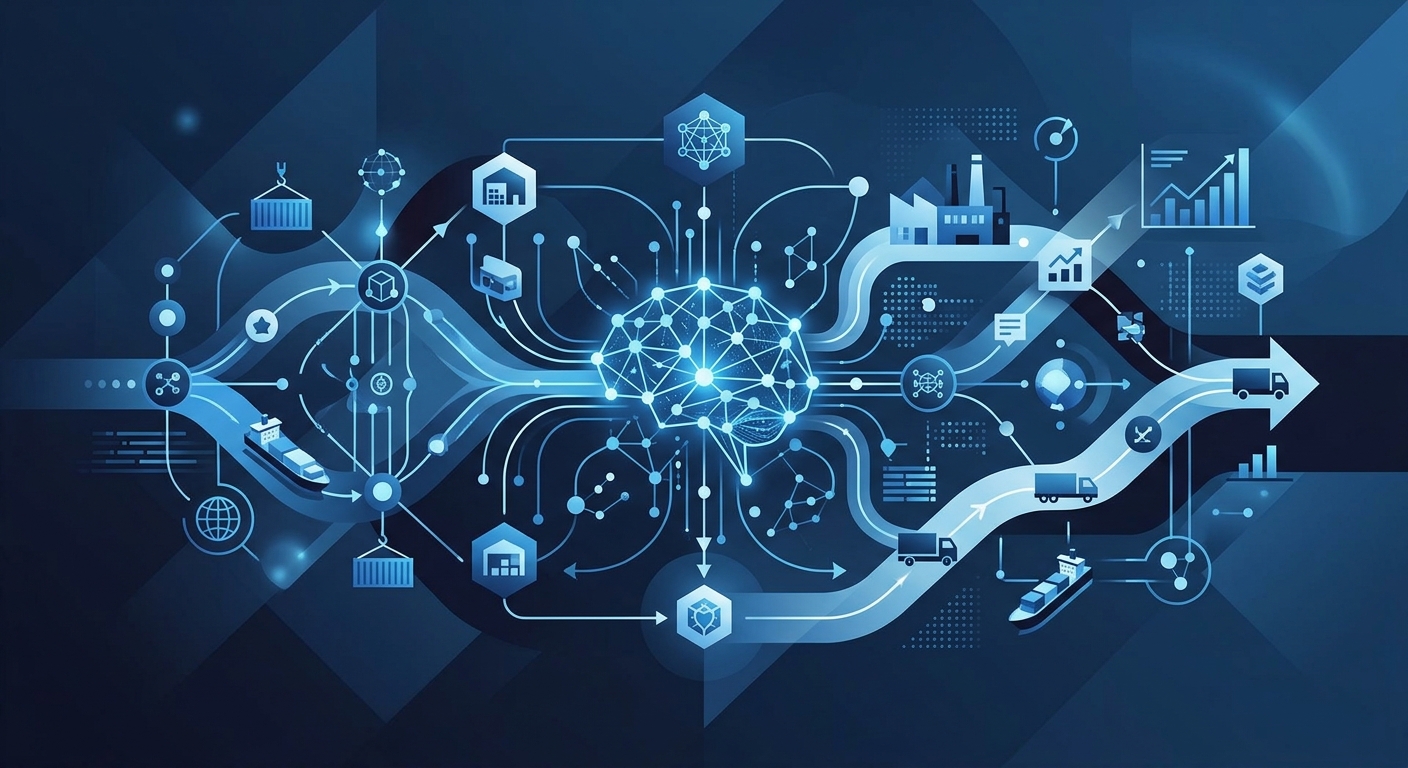
Supply chain generative AI has outgrown theoretical promise and isolated chatbot experiments. In complex, multi-echelon networks, traditional predictive tools and conversational interfaces consistently fail to scale. They lack execution authority, fracture across disconnected data architectures, and function as tactical add-ons rather than core operational engines. Gartner confirms that industry leaders are already shifting from pilot-stage experimentation to integrated, execution-ready systems. EY further emphasizes that AI’s utility is strictly bounded by data quality and partner integration, rendering standalone generative models insufficient for mission-critical logistics.
The executive mandate has shifted. Generative AI must evolve from analytical dashboards into an accountable, outcome-driven workforce. meo bridges legacy infrastructure gaps by embedding autonomous agents directly into existing operational workflows. Instead of delivering incremental insights, our architecture enforces measurable execution—converting real-time data streams into binding logistical actions governed by strict performance thresholds and continuous accountability protocols.
Architecting AI Supply Chain Workflows for Automated Logistics
Architecting a modern supply chain requires shifting from passive analytics to active, autonomous orchestration. meo deploys specialized AI agents that execute real-time dynamic routing, cross-node inventory rebalancing, and automated vendor coordination. These agents do not recommend adjustments—they execute them. Through secure API connectors and middleware translation layers, our solutions integrate directly with incumbent ERP, WMS, and TMS environments, eliminating the operational paralysis tied to multi-year system overhauls.
The decisive advantage is continuous exception handling. Traditional workflows fracture under port delays, carrier constraints, or material shortages. meo’s agentic architecture establishes closed-loop decision matrices that detect anomalies, evaluate alternative fulfillment paths, and deploy corrective actions autonomously. AWS for Industries highlights how industry leaders are replacing linear approval chains with parallel, automated resolution loops. By dynamically matching shipment attributes to optimal carrier capacity, generative AI powers intelligent freight forwarding at scale. The result is a self-correcting logistics network that scales horizontally and maintains operational continuity amid market volatility.
Replacing Fixed Labor Overhead with Scalable, Performance-Driven AI
Traditional supply chain planning is structurally inefficient. Organizations rely on large planning teams to manage forecasting, carrier negotiations, and exception triage, creating fixed labor overhead that cannot scale with demand volatility. meo replaces this rigid structure with elastic, 24/7 AI agent capacity. Transitioning tactical execution to autonomous agents eliminates the hidden costs of recruitment, training, shift coordination, and institutional knowledge loss.
This model transforms technology spend from fixed capital expenditure into a variable, outcome-aligned investment. meo’s pay-for-performance commercial structure redefines procurement: clients pay no licensing fees, implementation premiums, or per-seat costs. Investment is triggered exclusively when predefined thresholds—expedited fulfillment, optimized freight spend, or accelerated inventory turnover—are consistently achieved.
The financial model is transparent and risk-adjusted. AWS for Industries references McKinsey analysis confirming that AI-driven supply chain optimization reduces total network costs by 3–5% through improved asset utilization and reduced latency. At scale, these efficiencies compound rapidly. meo captures this value while insulating clients from implementation risk. The technology operates as a performance-contracted workforce: agents are provisioned, calibrated, and scaled strictly against verified operational output. If performance thresholds fall short, the financial liability remains with the provider. This structure aligns vendor incentives directly with enterprise P&L outcomes, guaranteeing predictable, auditable returns over speculative ROI projections.
Measuring What Matters: KPIs, SLAs, and Verifiable ROI
Executive confidence in AI deployment demands absolute transparency. meo’s platform enforces rigorous measurement protocols tracking freight cost reduction, on-time delivery rates, and exception resolution velocity in real time. Every agent action is logged, timestamped, and mapped to operational KPIs, generating an immutable audit trail. For compliance-heavy manufacturing and regulated distribution networks, this deterministic output and traceable decision logic are non-negotiable.
Unlike legacy SaaS models that obscure performance behind aggregated dashboards, meo binds deployments to strict Service Level Agreements (SLAs). EY emphasizes that successful AI integration must anchor to core operational pillars—planning, sourcing, manufacturing, and distribution—each tracked against distinct, verifiable metrics. Our framework isolates these variables, enabling clients to validate ROI prior to scaling. Funding remains strictly contingent on sustained threshold achievement. If an agent reduces expedited freight spend but misses on-time delivery targets, the commercial terms automatically adjust. This eliminates vendor misalignment and ensures capital deployment directly mirrors realized business impact.
Implementation Roadmap: Phased Deployment and Enterprise Scaling
Deployment follows a phased, risk-mitigated architecture. meo maps existing fulfillment workflows directly to agent logic, ensuring zero disruption to active order cycles. Initial pilots run within isolated logistics corridors, governed by strict success gates that validate routing accuracy, integration stability, and exception handling latency before full network rollout.
Continuous calibration is embedded into the core architecture. Adaptive AI must dynamically recalibrate in response to shifting market parameters. C3 AI underscores this necessity. meo’s agents continuously ingest real-time telemetry, adjusting routing algorithms and inventory thresholds to absorb seasonal volatility, geopolitical disruptions, and demand spikes. This structured scaling approach transforms isolated pilots into resilient, enterprise-grade infrastructure without operational friction.
Future-Proofing Operations: The Shift to Human-Led Strategy
The strategic objective of accountable AI is operational liberation. By offloading tactical execution to autonomous agents, leadership teams reclaim bandwidth for network optimization, supplier consolidation, and long-term resilience planning. Organizations must transition from reactive exception management to proactive ecosystem design. meo provides the operational bridge: audit bottlenecks, align on verifiable KPIs, and deploy accountable AI agents to secure a resilient, future-ready logistics network.