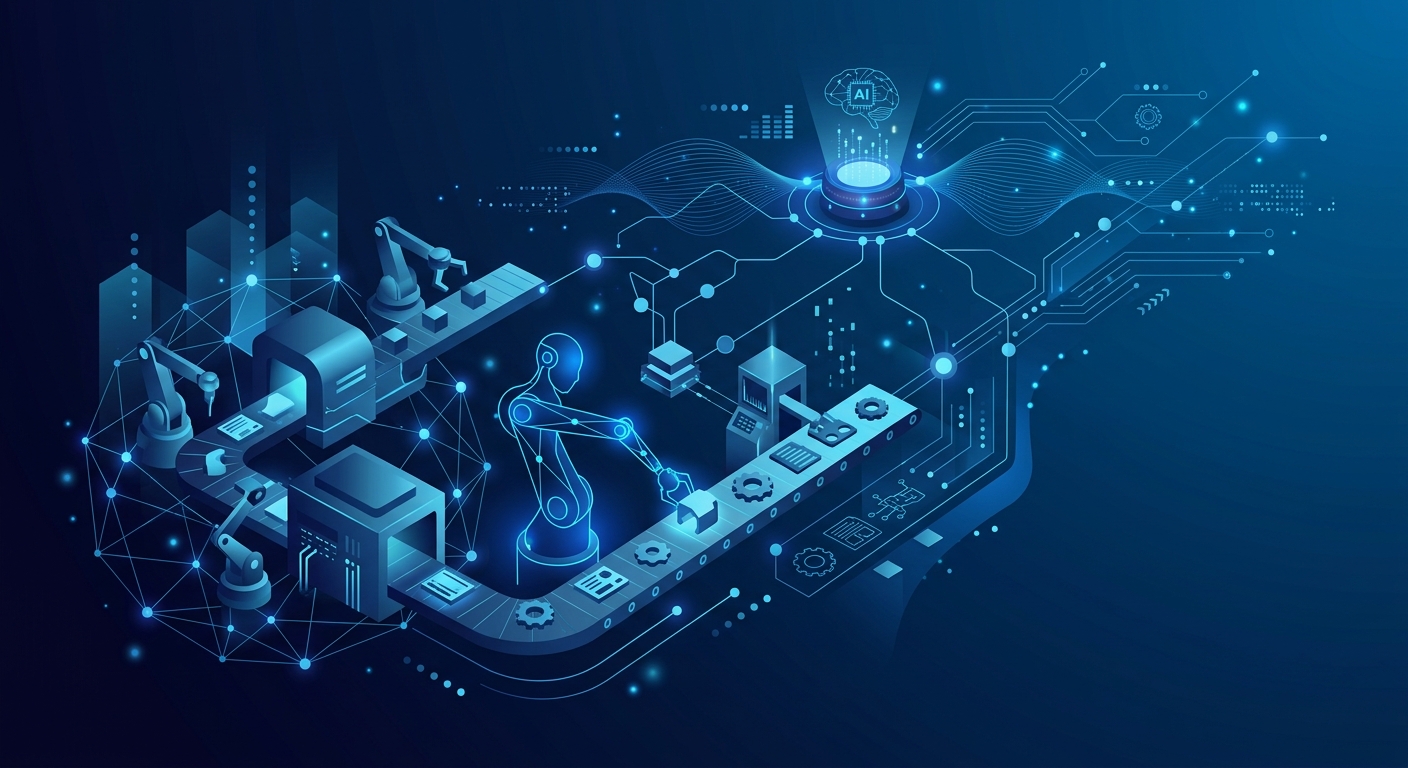
Manufacturing AI is the integration of machine learning, computer vision, and advanced analytics into the industrial production environment to optimize operations and decision-making. As the central nervous system of the Industry 4.0 movement, AI enables factories to transition from reactive models to proactive, autonomous ecosystems. By using the Industrial Internet of Things (IIoT), manufacturers can now process vast amounts of sensor data in real time, uncovering efficiencies that were previously invisible to human operators.
Key Takeaways
- Efficiency Gains: AI-driven predictive maintenance can reduce maintenance costs by up to 10% to 40% Deloitte.
- Quality Assurance: Computer vision systems identify defects invisible to the human eye, significantly reducing waste.
- Interoperability: Standards like OPC UA and MQTT are essential for connecting legacy hardware to modern AI platforms.
- ROI Focus: Small-to-medium enterprises (SMEs) can calculate ROI by benchmarking net benefits against total implementation costs.
How is AI Being Used in Manufacturing?
Manufacturing AI is currently being deployed as a core pillar of the wider Industry 4.0 movement, integrating digital breakthroughs into physical production environments. According to MIT Executive Education, these digital breakthroughs apply to a wide range of business scenarios, moving beyond simple automation to strategic intelligence.
At the shop floor level, AI algorithms analyze high-frequency data from machines to detect anomalies. This isn't just about recording data; it's about interpreting it. For instance, a vibration sensor on a CNC machine might produce millions of data points per hour. A human cannot monitor this, but an AI model can identify the specific harmonic signature that precedes a bearing failure. This capability transforms the maintenance department from a "fix-it-when-it-breaks" cost center into a strategic asset that ensures continuous uptime.
Furthermore, AI is being used to optimize energy consumption. By analyzing production schedules alongside local energy grid pricing and machine-level power draw, AI agents can suggest the most cost-effective times to run high-energy processes. This level of granular control is a hallmark of the Agentic Enterprise, where intelligent systems manage complex variables to achieve business outcomes.
Core AI Manufacturing Use Cases
The most mature use cases for AI in the manufacturing sector today include predictive maintenance, quality assurance, and generative design. Each of these applications addresses a specific operational bottleneck.
1. Predictive Maintenance
Predictive maintenance uses AI algorithms to analyze sensor data and predict equipment failure before it occurs. This is perhaps the most quantifiable use case in the industry. By moving away from calendar-based maintenance to condition-based maintenance, firms avoid unnecessary downtime and the premature replacement of expensive parts.
2. Automated Quality Control
AI-powered computer vision is used for automated quality control to detect defects invisible to the human eye. Standard inspection methods are often limited by human fatigue and the speed of the production line. AI systems, however, can inspect thousands of parts per minute with consistent accuracy, flagging even microscopic cracks or deviations in color and texture.
3. Generative Design
Generative design uses AI to explore thousands of design permutations based on material and weight constraints. Engineers input their goals—such as "make this bracket as light as possible while supporting 500 lbs"—and the AI generates optimized geometries that often look organic or unconventional. These designs are then finalized for additive manufacturing (3D printing), resulting in parts that are stronger and lighter than traditional designs.
4. Collaborative Robots (Cobots)
Cobots use AI to work safely alongside human operators by sensing environmental changes. Unlike traditional industrial robots that must be caged for safety, cobots use spatial AI to slow down or stop when a human enters their workspace, allowing for a hybrid assembly line where humans handle complex tasks and robots handle repetitive, strenuous ones. This shift is explored in detail in our analysis of Architecture and Engineering Occupations.
Benefits of Using AI in Manufacturing
The primary benefit of AI is the significant improvement of operational efficiency. Deloitte research indicates that 83% of manufacturing companies expect AI to have a significant impact on their future operations. These benefits are not merely theoretical; they are reflected in the bottom line.
- Reduced Operational Costs: By optimizing supply chains and reducing waste through better quality control, manufacturers can significantly lower their COGS (Cost of Goods Sold).
- Improved Safety: AI can monitor workplace conditions and worker movements to prevent accidents before they happen, identifying high-risk behaviors or equipment malfunctions.
- Faster Time-to-Market: Generative design and AI-driven simulation allow companies to prototype and test new products in a virtual environment, cutting months off the development cycle.
- Enhanced Demand Forecasting: AI in manufacturing extends beyond the factory floor into supply chain optimization and demand forecasting. By analyzing market trends, weather patterns, and historical sales, AI provides a more accurate picture of what to produce and when, reducing overstock and stockouts.
Challenges of Using AI in Manufacturing
Despite the clear advantages, several challenges hinder the widespread adoption of AI. The most significant is "pilot purgatory"—where companies struggle to scale AI solutions beyond a single successful test case.
Data Silos and Legacy Systems: Many factories run on legacy hardware that was never designed to export data. Connecting these machines to a modern AI platform requires specialized hardware and protocols.
The Skills Gap: There is a critical shortage of professionals who understand both manufacturing processes and data science. To bridge this, companies are increasingly turning to Enterprise AI Agent Orchestration to simplify the deployment and management of AI systems.
Data Privacy: Organizations must establish a lawful basis for processing data and implement technical and organizational measures to mitigate risks. This is especially true when using third-party LLMs to analyze proprietary shop-floor data. As noted by Fisher Phillips, businesses are held responsible for how third-party vendors handle personal data and must ensure compliance with evolving AI-specific frameworks.
Technical Interoperability: Connecting Legacy Hardware
A major technical hurdle for AI implementation is the interoperability between Operational Technology (OT) and Information Technology (IT). To connect legacy hardware to modern AI platforms like Loopr, specific communication standards are required.
| Protocol | Role in Manufacturing AI | Key Benefit |
|---|---|---|
| OPC UA | Provides rich, model-centric data organization for OT systems. | Standardized data modeling across different machine brands. |
| MQTT | A lightweight, event-driven messaging protocol. | Efficiently moves data to cloud systems and analytics platforms. |
| EtherNet/IP | Real-time industrial networking. | Enables high-speed communication on the factory floor. |
According to the OPC Foundation, OPC UA and MQTT together form the backbone of modern connected manufacturing. OPC UA handles the complexity of the data structure, while MQTT ensures that data can be transmitted over low-bandwidth or unreliable networks common in industrial settings.
Calculating ROI for SMEs
Small-to-medium enterprises (SMEs) often feel they cannot compete with large technology companies due to smaller datasets. However, ROI can still be precisely calculated without massive data lakes. SMEs should focus on specific, high-value problems rather than broad transformations.
"The specific formula for AI ROI is: ROI = (Net Benefits – Total Costs) / Total Costs × 100. Benefits are estimated through revenue growth, efficiency improvements, and cost savings." — Wingenious AI
To calculate this effectively, SMEs must:
- Establish a baseline of current performance (e.g., current downtime hours or defect rates).
- Account for total costs, including software licenses, hardware sensors, and staff training.
- Measure the net benefit over a 6-to-12 month period to account for the AI's learning curve.
For more on measuring these outcomes, see our guide on Measuring AI Agent ROI.
Latest AI Trends from Industry Experts
According to experts at NIST and MIT, the next frontier of manufacturing AI is the "Digital Twin." A Digital Twin is a virtual representation of a physical asset, process, or system. By running AI simulations on a Digital Twin, manufacturers can predict the outcome of a process change before making it in the real world.
Another emerging trend is the use of Generative AI for maintenance manuals and worker training. Instead of searching through a 500-page PDF, a technician can ask an AI agent, "How do I recalibrate the pressure sensor on the Mark II extruder?" and receive a step-by-step guide with relevant diagrams. This significantly reduces time spent on administrative tasks and speeds up the resolution of technical issues.
Frequently Asked Questions
How does AI improve quality control in manufacturing?
AI improves quality control by using computer vision to inspect products at high speeds with greater accuracy than human inspectors. It can identify patterns of defects that suggest a specific machine is drifting out of calibration, allowing for mid-process corrections.
Is AI replacing human workers in factories?
While AI automates repetitive and dangerous tasks, it often shifts human roles toward system supervision, maintenance, and complex problem-solving. For a detailed look at which roles are most affected, see our report on Production Occupations.
What is the first step in implementing AI for a manufacturer?
The first step is data readiness. Manufacturers must ensure their machines are equipped with sensors and that the data is being captured in a structured format using protocols like OPC UA.
Can AI work with legacy machinery?
Yes, through the use of "edge gateways." These devices connect to legacy machines via serial ports or basic sensors and translate the data into modern protocols like MQTT for AI analysis.
What are the risks of using AI in manufacturing?
Key risks include data privacy concerns, the potential for "hallucinations" in generative models, and the security risk of connecting previously air-gapped factory equipment to the internet.
How much does it cost to implement AI?
Costs vary widely. A small-scale predictive maintenance pilot might cost $20,000–$50,000, while a full-scale smart factory transformation for an enterprise can reach millions. The focus should always be on the ROI and Performance Metrics.