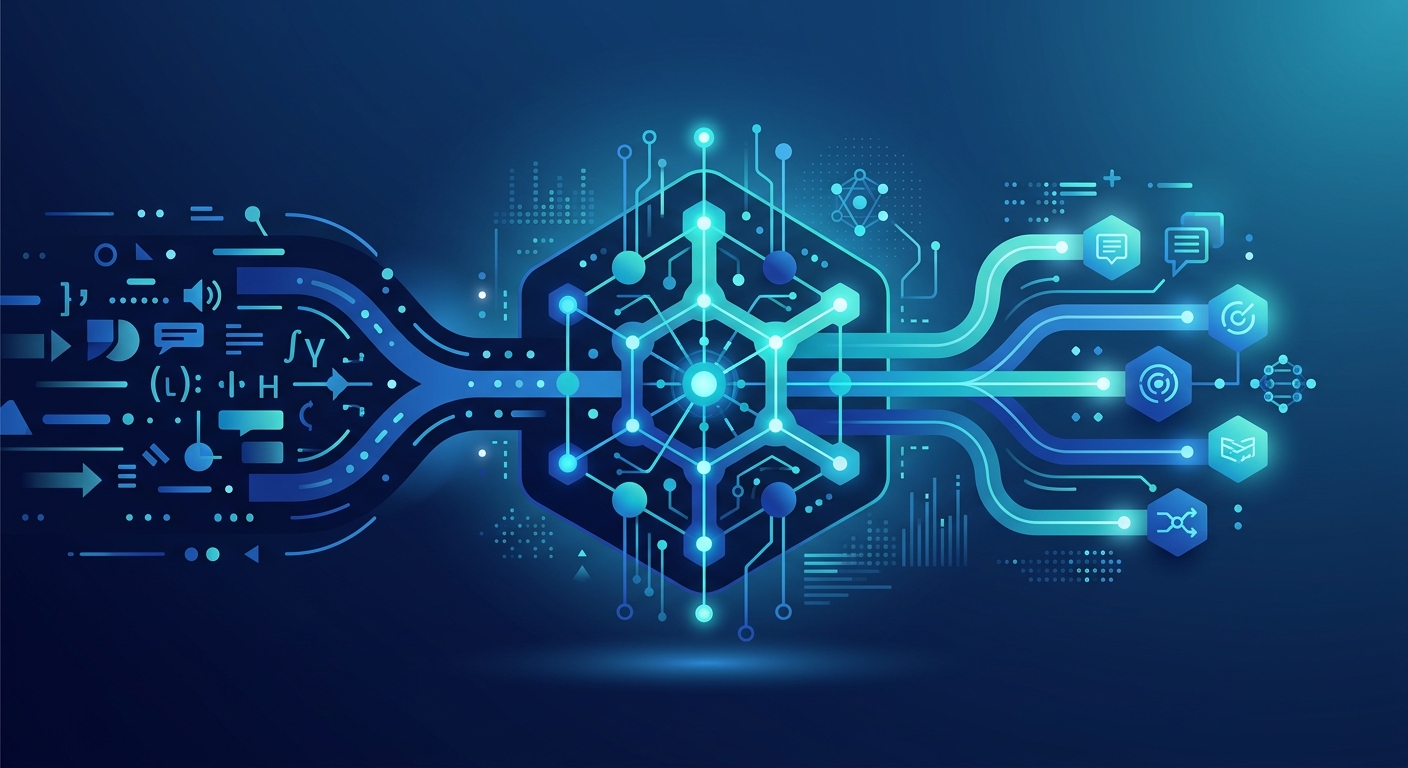
Natural Language Understanding (NLU) is a specialized subfield of Natural Language Processing (NLP) focused on machine reading comprehension and semantic analysis. While NLP acts as an umbrella term for all interactions between computers and human languages, NLU specifically addresses the challenge of determining the intended meaning behind text. For enterprise leaders, this shift from processing to understanding is critical because it allows systems to move beyond keyword matching and toward context-aware decision-making.
In the modern digital landscape, NLU requires mapping unstructured input into structured representations such as intent and entities. This process allows software to interpret nuances, irony, and complex grammatical structures that were previously inaccessible to traditional computing models. As organizations scale their AI Capabilities, NLU serves as the foundational layer that enables autonomous systems to interact with customers, analyze legal documents, and synthesize massive datasets into coherent executive summaries.
Key Takeaways
- NLU vs. NLP: NLU is the subset of NLP that focuses on semantic intent and comprehension rather than just syntactic structure.
- Model Accuracy: Modern NLU systems, such as GPT-4, have achieved scores as high as 86.4% on the Massive Multitask Language Understanding (MMLU) benchmark Sparks of AGI.
- Enterprise Utility: Over 70% of educators and a growing percentage of corporate trainers use NLU-based chatbots to generate content and lecture notes AI Launch Pad.
- Strategic Requirement: Effective NLU implementation requires a combination of Transformer architectures and rigorous prompt engineering to ensure reliability.
Core Mechanics: How Language Understanding Differs from NLP
Natural Language Processing (NLP) is the broad science of how machines interact with human language, encompassing everything from speech-to-text to spell-checkers. Natural Language Understanding (NLU) is the specific functional component of NLP that deals with the "why" and "what" of a sentence. While an NLP system might recognize that a sentence contains a noun and a verb, an NLU system identifies the user's goal—their intent—and the specific objects—the entities—they are referring to.
Key Insight: Natural Language Understanding (NLU) is defined as the process of mapping unstructured human language into a structured, machine-readable format that captures semantic intent and contextual meaning.
The mechanics of NLU involve several sophisticated layers. First, the system must perform lexical analysis, breaking down words into their root forms. Next, it engages in syntactic analysis to understand the grammatical structure. However, the true power of NLU lies in semantic analysis, where the system interprets the relationship between words to derive meaning. For example, in the phrase "deposit the check in the bank," NLU distinguishes whether "bank" refers to a financial institution or the side of a river based on the surrounding context of "deposit" and "check."
Modern NLU systems use Transformer architectures to handle long-range dependencies in text. This allows models to maintain the relationship between a subject at the beginning of a paragraph and a pronoun at the end. Without this architectural innovation, machines would struggle with the ambiguity inherent in human communication.
How NLU Works: A Step-by-Step Breakdown
To understand how NLU functions in an enterprise environment, it is helpful to view the process as a pipeline that transforms unstructured, human-generated data into a clean, actionable format. This pipeline typically follows these steps:
- Preprocessing and Tokenization: The raw text is cleaned of noise (such as HTML tags) and broken into smaller units called tokens.
- Intent Recognition: The system analyzes the tokens to determine what the user wants to achieve. For instance, in a customer support scenario, the intent might be "Refund Request" or "Technical Troubleshooting."
- Entity Extraction: The model identifies key pieces of information, such as dates, names, product IDs, or locations. These are the "variables" that the system needs to fulfill the intent.
- Contextual Mapping: The system looks at previous interactions or external data to resolve ambiguities. This is where AI Models outperform traditional rule-based scripts.
- Output Generation: Finally, the structured data is passed to an application (such as a database or a generative AI engine) to produce a response or trigger a workflow.
This structured approach is why NLU is essential for Enterprise AI Agent Orchestration. Without the ability to accurately categorize intent, an autonomous agent cannot reliably select the correct tool or API to complete a task.
Key Models and Techniques in NLU
The evolution of NLU has been defined by the transition from symbolic logic to statistical models and, eventually, to deep learning.
The Transformer Architecture
The introduction of the Transformer architecture (the "T" in GPT) changed NLU by allowing models to process all words in a sentence simultaneously rather than sequentially. This "self-attention" mechanism enables the model to weigh the importance of different words regardless of their position. For example, in the sentence "The animal didn't cross the street because it was too tired," the model uses self-attention to link "it" to "animal."
Benchmarking Performance
To measure progress, the industry relies on standardized benchmarks like GLUE (General Language Understanding Evaluation) and SuperGLUE. These benchmarks test a model's ability to perform tasks like sentiment analysis, question answering, and logical entailment. According to research from Microsoft and OpenAI, GPT-4 achieved 86.4% on the Massive Multitask Language Understanding (MMLU) benchmark, signaling a near-human level of linguistic reasoning in many domains Sparks of AGI.
Prompt Engineering
In professional settings, particularly education, prompt engineering has emerged as a critical skill. Educators use iterative prompting to refine NLU outputs for classroom use, ensuring that AI-generated lecture notes align with specific curriculum standards AI Launch Pad.
Strategic Applications of NLU Across Industries
NLU is no longer a niche technology; it is a driver of efficiency across diverse sectors. By automating the comprehension of text, organizations can scale operations that previously required thousands of human hours.
| Industry | NLU Application | Business Value |
|---|---|---|
| Finance | Automated Regulatory Tracking | Reduces compliance risk by identifying changes in law Regulatory Agents |
| Healthcare | Clinical Note Summarization | Allows doctors to spend more time with patients by automating documentation |
| Retail | Sentiment Analysis | Real-time monitoring of social media to adjust marketing strategies |
| Legal | Contract Analysis | Rapidly identifies high-risk clauses in thousands of documents |
In the legal and compliance sectors, NLU-driven Autonomous Regulatory Change Monitoring allows firms to ingest thousands of pages of new legislation and automatically flag relevant sections for human review. This is a significant improvement over traditional keyword alerts, which often generate too many false positives.
Content Types and Resources for NLU Development
Developing robust NLU capabilities requires a variety of content types and data resources. For an enterprise, the quality of understanding is directly proportional to the quality of the training data.
- Labeled Datasets: These consist of text samples where humans have manually identified the intent and entities. They are used to teach the model what to look for.
- Unstructured Data Lakes: Modern LLMs can also learn from unstructured data, such as old emails, support tickets, and internal wikis, to understand company-specific jargon.
- Knowledge Graphs: These are structured databases that represent relationships between entities (e.g., "Product A is a type of Software"). NLU systems use knowledge graphs to provide factual grounding to their interpretations.
Resources for NLU are widely available through cloud providers. Tools like AWS Comprehend, Google Cloud Natural Language, and Azure AI Language provide pre-trained models that can be customized for specific Industries. Furthermore, academic institutions like National Louis University provide resources for educators to integrate these tools into their teaching workflows AI Launch Pad.
Overcoming Implementation Challenges: Context and Hardware
Despite these advancements, NLU faces significant hurdles, particularly regarding long-form context and hardware constraints.
Maintaining Long-Form Context
One of the most frequent questions from enterprise architects is: How do NLU models maintain context and state during long-form, multi-turn dialogues compared to single-query interactions?
Research indicates that NLU models maintain coherence in multi-turn dialogues through model-centric strategies such as in-context learning and architectural innovations like "sliding windows" for attention. External integration approaches, including memory-augmented systems and retrieval-based methods (RAG), allow models to access a "long-term memory" of previous turns. In contrast, single-turn interactions are often stateless, treating every query as a new event without historical context.
Edge vs. Cloud Deployment
Another challenge is the trade-off between latency and processing power. Deploying NLU at the edge (on local devices like smartphones or factory sensors) offers deterministic response times as low as 5–100 milliseconds. This is vital for time-critical tasks. However, edge devices have limited memory. Cloud deployment allows for much larger, more capable models but introduces variable latencies of 30–500+ milliseconds due to network travel time.
Key Insight: Choosing between edge and cloud for NLU depends on where the data lives and how complex the task is, not only on speed.
The Latest AI Trends: Expert Perspectives on NLU
As we look toward 2025, several trends are reshaping the NLU landscape. Experts are moving away from "bigger is better" and toward "smarter and more efficient."
- Multimodal NLU: Understanding is no longer limited to text. Modern systems analyze text alongside images and audio. This is particularly useful for Multimodal Sentiment Analysis, which can detect sarcasm by identifying "contextual incongruities"—such as when a user's text is positive but their tone of voice is frustrated.
- Small Language Models (SLMs): For many enterprise tasks, a 175-billion parameter model is unnecessary. Highly optimized SLMs are trained on specific domains (such as medical or legal) to provide NLU that is faster and cheaper than general-purpose models.
- Human-in-the-loop (HITL): As NLU is used for critical tasks like Invoice Exception Handling, the focus is shifting toward systems that recognize uncertainty and proactively request human intervention.
Frequently Asked Questions
What is the difference between NLP and NLU?
NLP is the broad field of computer-human language interaction, while NLU is a specific subset focused on machine reading comprehension, intent detection, and semantic analysis.
How does NLU handle sarcasm?
Modern NLU handles sarcasm through multimodal analysis, comparing the literal text against tonal cues or historical context to identify incongruities that signal the speaker means the opposite of what they said.
Is prompt engineering necessary for NLU?
Yes. Prompt engineering is a critical skill for refining NLU outputs, especially in specialized fields like education or medicine, to ensure the model's interpretation remains accurate and grounded.
What are entities in NLU?
Entities are the specific pieces of information extracted from a sentence, such as names, dates, locations, or product numbers, which provide the "who, what, and where" for the identified intent.
Can NLU run on local hardware?
Yes, NLU can be deployed on edge devices for low-latency tasks, though these models are typically smaller and less complex than those hosted in the cloud.
How is NLU performance measured?
NLU is typically measured using benchmarks like GLUE, SuperGLUE, and MMLU, which test the model's ability to reason, summarize, and categorize language across thousands of different tasks.