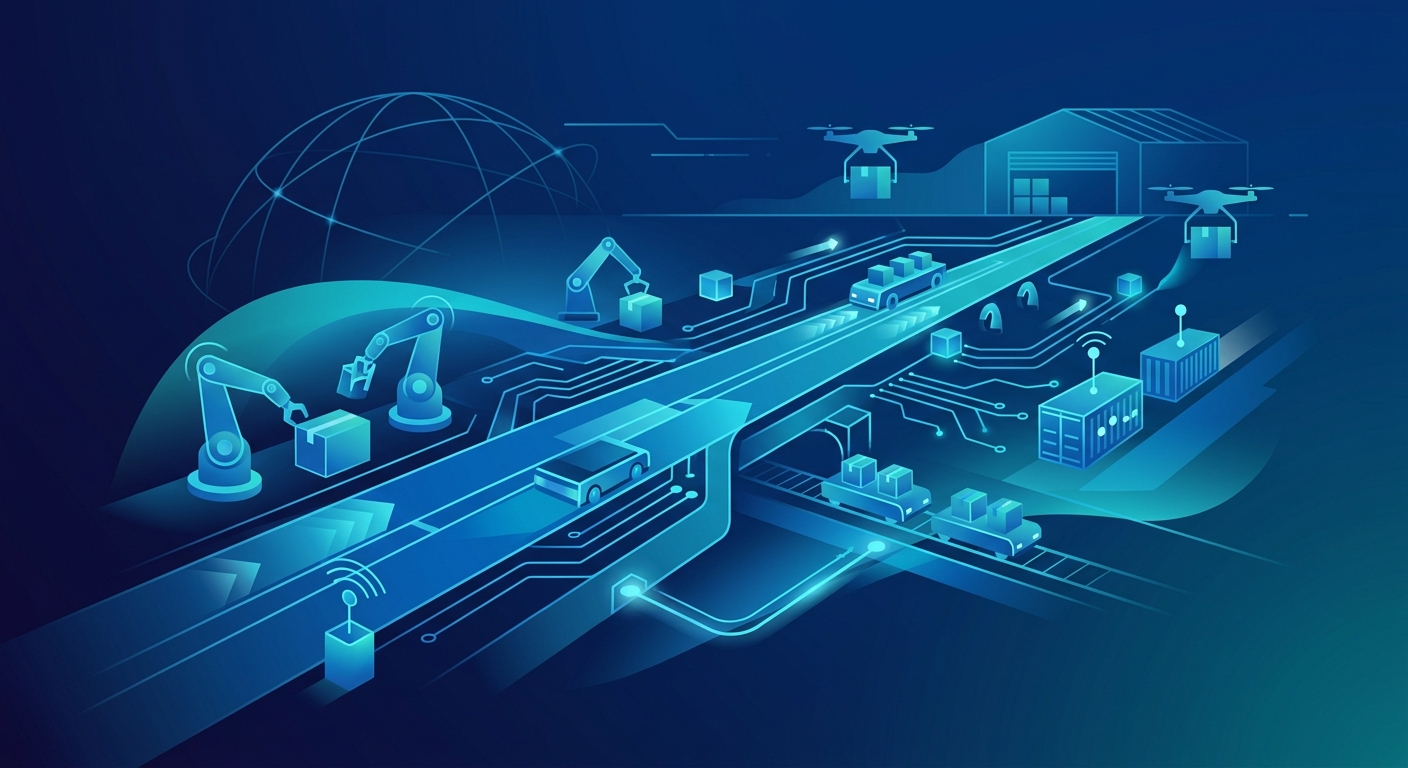
Automation in logistics and supply chain management is the application of technology, software, and robotics to perform tasks traditionally handled by human labor, aiming to increase speed, accuracy, and cost-efficiency. In the modern global economy, where supply shocks are frequent and consumer expectations for rapid delivery are at an all-time high, automation is no longer a luxury—it is a survival requirement for the enterprise. Today's logistics leaders are shifting from localized warehouse improvements toward an end-to-end autonomous ecosystem where hardware and software synchronize to predict and react to market changes in real time.
Key Takeaways
- Last-Mile Efficiency: Last-mile delivery is the most expensive segment, often accounting for over 50% of total shipping costs; drone implementation can potentially reduce these costs by 50% Deloitte.
- Warehouse Throughput: Integrating Automated Guided Vehicles (AGVs) can result in a 20-30% increase in warehouse throughput NIST.
- Resilience: AI-driven digital twins allow supply chains to self-correct during global disruptions by simulating thousands of "what-if" scenarios.
- Sustainability: AI-driven route optimization significantly reduces carbon footprints by minimizing idle time and fuel consumption.
Understanding Supply Chain Automation
Supply chain automation is a comprehensive framework that integrates physical robotics with digital intelligence to streamline the flow of goods from raw material sourcing to final delivery. It represents a fundamental shift from manual data entry and physical labor to a system where AI in Supply Chain and Logistics manages the complexity of global trade.
At its core, this automation involves two primary layers: the physical layer (robotics, drones, AGVs) and the cognitive layer (AI, machine learning, and predictive analytics). The physical layer handles the movement of goods, while the cognitive layer processes the vast amounts of data generated by these movements to optimize future performance.
"Automation in the 'last mile' is the most expensive segment of the supply chain, often accounting for over 50% of total shipping costs. Drones designed for vertical takeoff and landing can provide a 50% reduction in these delivery costs compared to traditional van delivery." — Deloitte Research, Last-Mile Drone Delivery Strategies (Deloitte US)
Applications of Supply Chain Automation
The practical applications of automation span every node of the modern supply chain. In the warehouse, Automated Guided Vehicles (AGVs) have transitioned from simple, fixed-path navigation to dynamic obstacle avoidance, allowing them to operate safely alongside human workers. According to the National Institute of Standards and Technology (NIST), these systems can increase throughput by up to 30% by eliminating human downtime and reducing picking errors.
Beyond the warehouse, last-mile delivery is being transformed by drone technology. Drones used in logistics are designed for high maneuverability, often mimicking helicopter flight patterns for vertical takeoff and landing (VTOL). This capability allows them to bypass urban traffic, delivering small parcels directly to consumers' doorsteps in minutes rather than hours. This is particularly critical for high-value or time-sensitive goods like medical supplies or perishables.
| Technology | Primary Benefit | Key Metric |
|---|---|---|
| AGVs/AMRs | Warehouse Throughput | 20-30% Efficiency Gain |
| Drones | Last-Mile Delivery | 50% Cost Reduction |
| Digital Twins | Risk Management | Real-time Self-Correction |
| AI Agents | Exception Handling | Automated Exception Management |
Data Challenges in Supply Chain Automation
One of the most significant hurdles to successful automation is the "data silo" problem. Most legacy logistics systems were not designed for the high-velocity data exchange required by modern AI. When an enterprise attempts to layer advanced Supply Chain Generative AI over legacy ERP (Enterprise Resource Planning) systems, the lack of standardized data formats can lead to "hallucinations" or incorrect forecasting.
Data integrity is the foundation of any autonomous system. If the input data regarding inventory levels, transit times, or port congestion is inaccurate, the automated response will be equally flawed. For example, a digital twin relies on high-fidelity data to simulate supply chain disruptions. If the data is stale by even a few hours, the simulation may suggest a rerouting strategy that is no longer viable, leading to increased costs and delays.
Improving Data for Effective Supply Chain Automation
To overcome data challenges, organizations must implement robust data governance and integration protocols. This involves moving away from batch processing toward real-time data streaming. By utilizing IoT (Internet of Things) sensors across the fleet and warehouse, companies can feed live data into their Predictive Maintenance AI systems to prevent equipment failure before it disrupts operations.
Key Insight: Digital twins and AI frameworks are being developed to allow supply chains to self-correct during global disruptions, moving from reactive to proactive resilience. Texas A&M Engineering found that new frameworks allow for autonomous management that adapts to unforeseen events without human intervention.
Effective data improvement strategies include:
- Standardization: Adopting industry-standard protocols for API integrations between carriers, warehouses, and retailers.
- Cleaning: Implementing automated data cleansing tools to remove duplicates and correct errors in real time.
- Enrichment: Augmenting internal data with external signals such as weather patterns, geopolitical news, and fuel price fluctuations.
Addressing the Mid-Market ROI Gap
A common concern for mid-sized logistics firms is the Return on Investment (ROI) timeline. While large enterprises like Amazon can afford decades of R&D, mid-market firms require faster time-to-value. Research suggests that while specific ROI timelines vary, the shift toward "Automation-as-a-Service" (AaaS) models is lowering the barrier to entry. Instead of a massive upfront capital expenditure (CAPEX), firms can now treat automation as an operational expense (OPEX), paying for the number of picks or miles completed by automated systems.
For a mid-sized firm transitioning from manual to automated warehouse management, the expected ROI typically manifests through labor savings and error reduction. While the snippets do not provide a universal number of months, industry benchmarks for AaaS models often target a 12-to-24 month break-even point by focusing on high-volume, repetitive tasks first.
Regulatory and Labor Considerations
The deployment of automation is not merely a technical challenge; it is a regulatory and social one. In North America and Europe, the rise of 24-hour autonomous trucking fleets faces significant scrutiny from labor unions and safety regulators. While current hours-of-service (HOS) rules do not yet fully account for autonomous operations, the evolving regulatory environment is a critical factor for fleet managers to monitor.
Furthermore, the impact on the workforce is significant. While automation creates new roles in system maintenance and AI supervision, it displaces traditional roles. For instance, Graders and Sorters of Agricultural Products and Log Graders are seeing significant shifts as AI-driven vision systems take over quality control tasks. Managing this transition requires a focus on upskilling and clear communication with labor representatives.
Getting the Data Right: The Foundation of AI Success
Before deploying sophisticated AI agents, an organization must ensure its data architecture is ready. This means moving beyond the "Abstract" phase and into concrete implementation patterns. A successful deployment often follows a five-phase migration plan that begins with data auditing and ends with full-scale autonomous orchestration.
Ensuring AI Agent Data Privacy Compliance is also paramount. As automated systems handle sensitive shipping manifests and customer information, the risk of data breaches increases. Organizations must implement Continuous AI Agent Monitoring to ensure that automated decisions remain within ethical and legal boundaries.
Conclusion: The Path to the Agentic Enterprise
The future of logistics lies in the Agentic Enterprise—an organization where AI agents don't just suggest actions but execute them autonomously. From managing Manufacturing Change Orders to optimizing international freight routes, the integration of automation is the only way to achieve the scale and speed required by the 2025 market.
By focusing on high-impact areas like last-mile delivery and warehouse throughput, and by building a solid foundation of clean, integrated data, logistics providers can transform their operations from a cost center into a competitive advantage. The transition will be challenging, but the cost of inaction—characterized by rising delivery expenses and decreased resilience—is far higher.
Frequently Asked Questions
1. What is the most expensive part of the supply chain to automate?
Last-mile delivery is generally the most expensive segment, often accounting for over 50% of total shipping costs. However, it also offers the highest potential for savings through technologies like autonomous drones and delivery robots.
2. Can automation help with supply chain sustainability?
Yes. AI-driven route optimization reduces fuel consumption and carbon emissions. By minimizing empty miles and optimizing vehicle loads, automation directly contributes to more sustainable logistics outcomes.
3. How do AGVs differ from traditional forklifts?
Unlike traditional forklifts that require a human operator, Automated Guided Vehicles (AGVs) use sensors and software to navigate. Modern AGVs have evolved from following fixed floor markers to using dynamic mapping to avoid obstacles in real time.
4. What are digital twins in logistics?
Digital twins are virtual replicas of physical supply chains. They use real-time data to simulate various scenarios, allowing managers to test the impact of potential disruptions (like port strikes or weather) before they occur.
5. Will automation replace all warehouse jobs?
While automation replaces repetitive physical tasks, it also creates new high-skill roles. The focus is shifting toward human-machine collaboration, where humans oversee the AI systems and handle complex problem-solving that machines cannot yet replicate.
6. What is the first step in implementing supply chain automation?
The first step is data consolidation and cleaning. Automation requires high-quality, real-time data to function. Without a unified data layer, automated systems will produce inaccurate results and fail to deliver ROI.