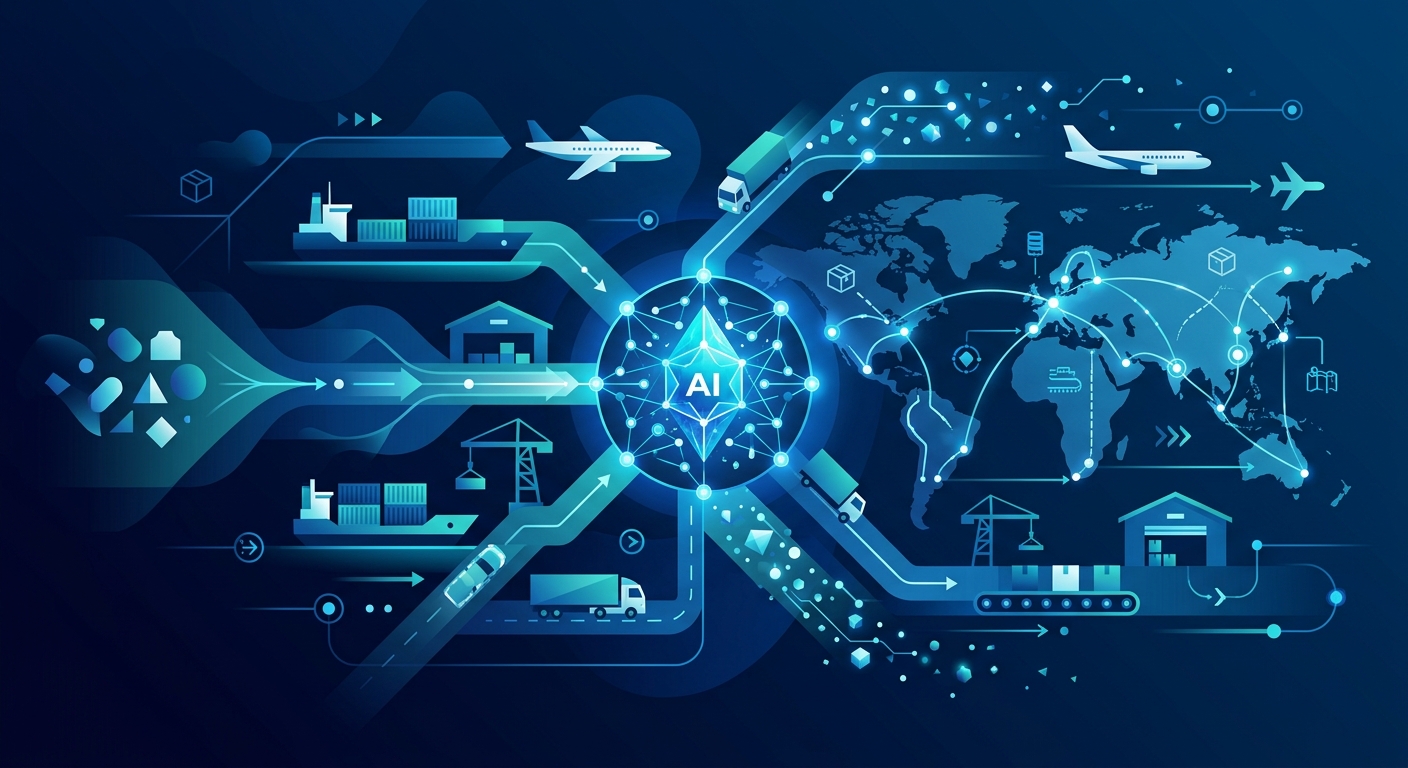
Artificial intelligence for supply chain management is the application of machine learning, neural networks, and automated decision-making to optimize the flow of goods and services from raw material sourcing to final delivery. In today's volatile global market, AI is no longer a luxury but a fundamental necessity for operational survival. By processing vast datasets that exceed human cognitive capacity, AI systems identify patterns, predict disruptions, and execute real-time adjustments that traditional rule-based systems cannot match.
Key Takeaways
- Resilience through Detection: AI-driven supply chains are defined by their ability to detect, design solutions for, and respond to disruptions rapidly.
- Operational Efficiency: Integrating IoT with machine learning can drastically reduce transportation delays through real-time route optimization.
- Warehouse Evolution: Modern frameworks like the Warehouse Management and Handling System (WMHS) address collision risks and scheduling in robotic logistics.
- Data Governance: Protecting proprietary data requires secure enterprise gateways and "no-training" protocols for Large Language Models (LLMs).
Understanding the AI Supply Chain Landscape
Artificial intelligence for supply chain represents a fundamental shift from reactive to proactive management. Historically, supply chains operated on historical averages and linear forecasting. However, an AI-enabled supply chain uses real-time data streams to create a "digital twin" of the entire logistics network. This allows for simulation-based planning where variables like weather, geopolitical shifts, and port congestion are factored into every decision.
At its core, an AI supply chain applies predictive analytics to anticipate demand surges before they occur. According to research published in the Global Journal of International Affairs, building a resilient supply chain requires three specific capabilities: detecting a disruption quickly, designing an effective solution in response, and executing that response to minimize economic impact The Role of AI in Developing Resilient Supply Chains. AI is the only technology capable of performing these three steps at the speed required by modern commerce.
Business Drivers for AI in Supply Chains
The primary drivers for adopting artificial intelligence for supply chain operations are volatility, complexity, and the need for cost reduction. As global trade routes become more susceptible to climate events and political instability, the cost of "being wrong" in inventory planning has skyrocketed.
- Volatility Management: AI can process non-traditional data—such as social media trends or satellite imagery of shipping lanes—to provide early warning signals for supply shocks.
- Complexity Reduction: Modern enterprises often manage tens of thousands of SKUs across hundreds of suppliers. AI manages this complexity by automating routine replenishment and flagging only the exceptions for human intervention.
- Labor Scarcity: With a shrinking workforce in logistics and warehousing, autonomous systems are filling the gap. AI-driven robotics allow facilities to maintain 24/7 operations without the traditional constraints of human labor availability.
Key Insight: Georgetown University researchers identify detection, design, and response as the three pillars of AI-enhanced resilience, noting that AI's ability to simulate thousands of "what-if" scenarios is what separates leaders from laggards in crisis management.
High-Impact Use Cases of AI in the Supply Chain
The practical application of AI spans the entire value chain. One of the most significant advancements is in Smart Logistics Route Optimization. By combining Internet of Things (IoT) sensors with machine learning algorithms, companies can achieve real-time transportation performance enhancement. This technology reduces fuel consumption and delivery delays by dynamically rerouting vehicles based on live traffic and weather data AI-Driven Smart Logistics Route Optimization.
Another critical use case is Autonomous Warehouse Management. Traditional robotic systems often struggle with real-time learning flexibility and task scheduling. However, the Warehouse Management and Handling System (WMHS) framework integrates bull-optimized enhancement to solve these issues, reducing collision risks and improving the handling of dynamic order quantities Robot-assisted automated warehouse management and handling systems.
Use Case Matrix: AI Applications
| Supply Chain Function | AI Technology | Primary Benefit |
|---|---|---|
| Demand Forecasting | Deep Learning / RNNs | Reduction in overstock and stockouts |
| Last-Mile Delivery | Genetic Algorithms / IoT | Optimized routing and lower carbon footprint |
| Warehouse Ops | Computer Vision / WMHS | Automated sorting and collision avoidance |
| Procurement | Natural Language Processing | Automated contract analysis and risk scoring |
| Quality Control | Machine Vision | Real-time defect detection on production lines |
How to Build an AI-Enabled Supply Chain
Transitioning to an AI-driven model requires more than just buying software; it requires a structural overhaul of data architecture. For many organizations, the journey begins with an "AI Readiness Assessment" to identify high-value, low-implementation-time opportunities. This is particularly important for SMEs that may lack the massive datasets of global giants.
To build a functional AI supply chain, follow these phases:
- Data Centralization: Break down silos between procurement, sales, and logistics. AI requires a "single source of truth" to provide accurate insights.
- IoT Integration: Deploy sensors across the fleet and warehouse. As noted in recent IEEE research, the combination of IoT and machine learning is the foundation for real-time efficiency AI-Driven Smart Logistics Route Optimization.
- Model Selection: Choose between "off-the-shelf" SaaS solutions for standard tasks (like invoice processing) and custom-built models for proprietary competitive advantages (like custom routing logic).
Avoid These Challenges and Pitfalls
Despite the promise, many AI initiatives fail due to poor data hygiene or a lack of governance. One major risk is Data Leakage. When using Large Language Models (LLMs) for supply chain analysis, proprietary data—such as supplier pricing or trade secrets—can inadvertently be used to train public models. Organizations must implement secure enterprise gateways with "no-training/no-retention" terms to mitigate this risk.
Another pitfall is Over-Reliance on Historical Data. If an AI model is trained only on pre-pandemic data, it will fail to predict the "new normal" of supply chain disruptions. Continuous monitoring and model retraining are essential. We recommend reviewing Continuous AI Agent Monitoring Protocols to ensure your systems remain accurate over time.
"Modern warehouse operations need rapid, reliable, and adaptable systems to respond to the dynamic order quantity and scarce resources. Current robotic systems are often prone to collisions and inefficient scheduling without AI optimization." — Discover Computing (Springer Nature)
KPIs and Metrics to Measure Success
To justify the investment in artificial intelligence for supply chain, leaders must track specific performance indicators. Traditional metrics like "On-Time In-Full" (OTIF) remain relevant, but AI-specific KPIs provide deeper insight into the system's health.
- Forecast Accuracy Improvement: The percentage reduction in MAPE (Mean Absolute Percentage Error) compared to legacy forecasting.
- Autonomous Decision Rate: The ratio of decisions made by AI without human intervention (e.g., automated reordering).
- Exception Resolution Time: How quickly the AI identifies and suggests a fix for a freight exception or supply delay.
- Carbon Footprint Reduction: Measuring the fuel saved through AI-driven route optimization.
For more on calculating the financial impact of these technologies, see our guide on Measuring AI Agent ROI.
Using AI to Improve Your Purchasing Experience
Artificial intelligence for supply chain doesn't just benefit the logistics provider; it transforms the experience for the end purchaser. AI-driven procurement systems can offer personalized pricing, predictive shipping dates, and automated replenishment. By analyzing a buyer's historical patterns, the AI can suggest orders before the buyer even realizes they are low on stock, creating a frictionless purchasing cycle.
Furthermore, AI agents can handle complex invoice exceptions, comparing billed amounts against contract terms in seconds. This eliminates the friction of billing disputes and ensures that purchasing departments operate with maximum transparency. For a comparison of how this differs from older methods, read about AI Agents vs Traditional Rule-based Workflows.
Addressing the SME Gap: AI on a Budget
A common misconception is that AI is only for the "Fortune 500." Small-to-medium enterprises (SMEs) can justify AI costs by using cloud-based, scalable solutions. Instead of building a private data center, SMEs can use API-based AI services that charge based on usage. This allows smaller firms to access the same predictive power as global leaders without the massive upfront capital expenditure. By focusing on high-impact, narrow use cases—such as Automation in Logistics—SMEs can see an immediate ROI that funds further expansion.
Legal Liability and AI Governance
As AI takes more autonomous actions, the question of legal liability arises. If an AI-driven route optimization system causes a fleet-wide delay, who is responsible? Current legal frameworks generally hold the company deploying the AI liable, particularly if it failed to maintain adequate oversight. To protect the organization, leaders must implement strict AI Agent Data Privacy Compliance and clear audit trails for every autonomous decision.
Frequently Asked Questions
How does AI improve supply chain resilience?
AI improves resilience by providing three specific capabilities: rapid detection of global disruptions, the ability to design alternative solutions through simulation, and the execution of response strategies to minimize economic impact.
What is the difference between RPA and AI in supply chains?
Robotic Process Automation (RPA) follows fixed rules to handle repetitive tasks like data entry. AI, however, can handle ambiguity, learn from new data, and make complex predictions or decisions where no fixed rule exists.
Can AI work with poor-quality data?
AI is highly sensitive to data quality. "Garbage in, garbage out" applies here. However, some AI models can be used to identify and clean data errors, eventually improving the overall data hygiene of the organization.
What are the risks of using LLMs in supply chain management?
The primary risk is the leakage of proprietary data into public models. To prevent this, enterprises should use private instances of LLMs and enforce strict data governance protocols that prevent sensitive information from being used for model training.
How long does it take to see ROI from AI supply chain integration?
While complex integrations can take 12–18 months, narrow use cases like automated route optimization or invoice exception handling often show measurable ROI within 3 to 6 months.
Make Your AI Supply Chain a Reality
The transition to an AI-enabled supply chain is an iterative process. Start by identifying the most significant bottleneck in your current operations—whether it's inaccurate demand forecasting or warehouse inefficiencies—and apply a targeted AI solution. As you build confidence and data maturity, you can expand into more autonomous, agent-led operations.
At Meo Advisors, we specialize in helping enterprises navigate this transition, from strategic planning to Enterprise AI Agent Orchestration. The future of the supply chain is autonomous, resilient, and intelligent. The only question is how quickly your organization will adapt.