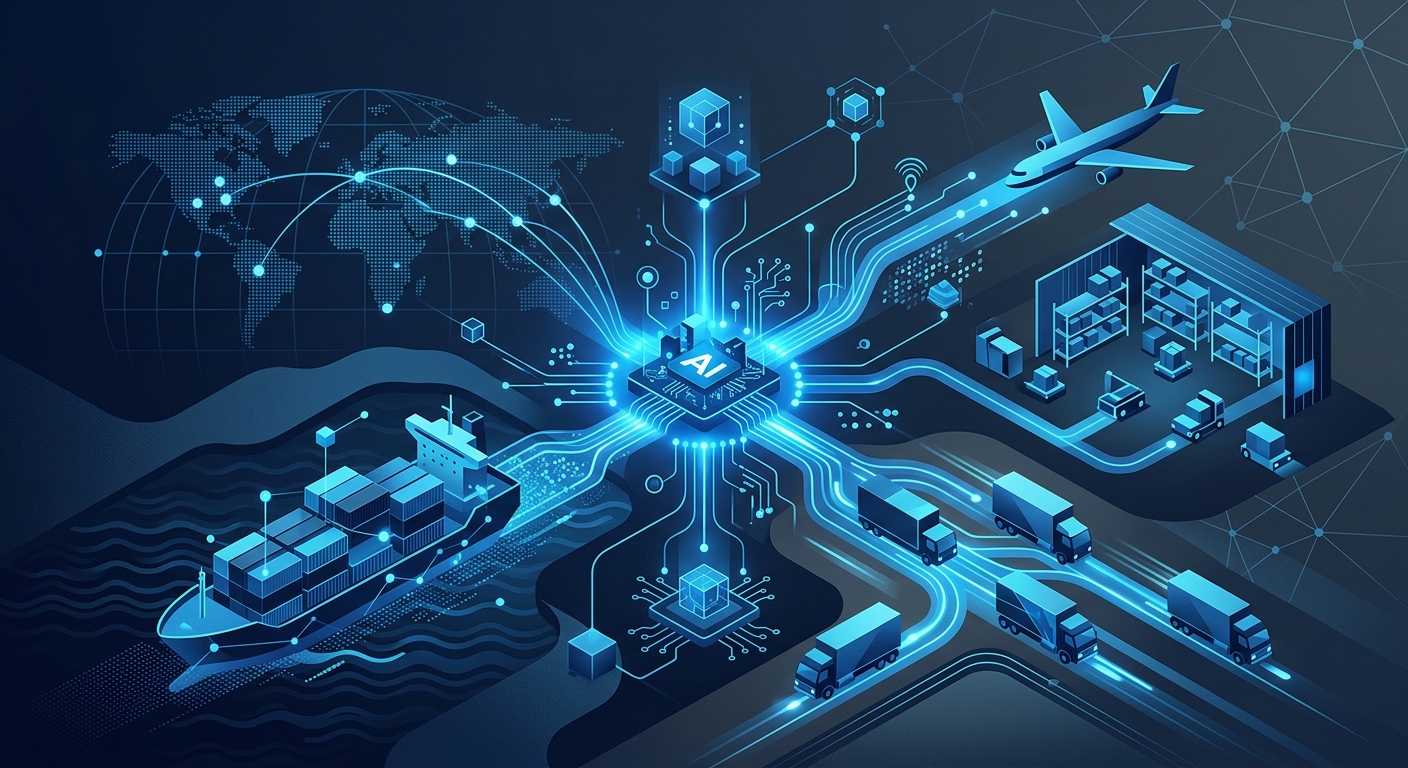
Artificial intelligence (AI) in supply chain and logistics is the application of advanced machine learning algorithms, predictive analytics, and automated systems to optimize the movement of goods, management of inventory, and coordination of global trade networks. As global markets face increasing volatility from geopolitical shifts and climate events, AI has transitioned from a competitive advantage to a foundational requirement for operational resilience.
Key Takeaways
- Efficiency Gains: AI implementations in supply chain management often result in the highest cost savings across all enterprise AI use cases.
- Forecasting Accuracy: Using AI for demand forecasting can reduce errors by 20% to 50%.
- Market Growth: The market value for AI in logistics is projected to reach up to $41 billion by 2030.
- Route Optimization: Real-time analysis of traffic, weather, and networks allows for immediate cost reduction in last-mile delivery.
Current State of the AI Supply Chain Market
The adoption of artificial intelligence within the logistics sector is accelerating at an unprecedented rate. According to industry data, the market value for artificial intelligence in the logistics and supply chain sector is projected to reach between $22.7 billion and $41 billion by 2030 Global Supply Chain Institute. This growth is fueled by a shift toward the "Agentic Enterprise," where autonomous systems do not just present data but execute decisions across the value chain.
For enterprise leaders, this investment is justified by immediate bottom-line impact. A 2022 McKinsey survey highlighted that respondents reported the highest cost savings from AI are found specifically in supply chain management Georgetown Journal of International Affairs. These savings appear through reduced carrying costs, optimized labor allocation, and minimized waste in production cycles.
Forecasting Accurately with AI
Demand forecasting is the process of predicting future customer demand over a defined period using historical data and external variables. Traditional statistical models often fail during "black swan" events because they rely too heavily on historical linear trends. In contrast, AI-driven forecasting uses deep learning to ingest thousands of disparate data points—from social media trends to local weather patterns.
Key Insight: Artificial intelligence forecasting helps businesses significantly improve demand accuracy, reducing forecasting errors by 20% to 50% Global Supply Chain Institute.
By narrowing the gap between predicted and actual demand, companies can maintain leaner inventory levels. This reduces the capital tied up in "safety stock" while ensuring that high-demand items remain available, effectively solving the classic inventory-service level trade-off. This level of precision is critical when measuring AI agent ROI for enterprise customer support automation and broader operational investments.
Using AI to Optimize Routes
Route optimization is the mathematical process of determining the most cost-effective path for a vehicle to take, accounting for distance, time, and external constraints. AI has use cases across the entire supply chain, including at the delivery level. Transportation and logistics companies use AI technology and predictive analytics to help with route planning to enhance productivity and decrease costs Global Supply Chain Institute.
Modern AI systems go beyond simple GPS mapping. They analyze:
- Real-time Traffic: Dynamically rerouting vehicles to avoid congestion.
- Weather Patterns: Adjusting transit times for snow, rain, or extreme heat.
- Transportation Networks: Coordinating multi-modal shifts between ship, rail, and truck seamlessly.
This optimization is particularly vital for last-mile delivery, which typically accounts for over 50% of total shipping costs. By identifying the fastest routes and minimizing idle time, companies significantly reduce fuel consumption and carbon emissions, aligning operational efficiency with sustainability goals.
Implementing AI for Supply Chain Automation
Automation in the supply chain involves the use of technology to perform tasks with minimal human intervention. While traditional RPA (Robotic Process Automation) handled repetitive data entry, modern AI agents manage complex exceptions. For instance, AI agents for invoice exception handling can now resolve billing discrepancies that previously required human intervention.
In the warehouse, AI-driven fleet optimization and Large Language Model (LLM) assistants are transforming operations. Research indicates that the integration of Mixed Reality (MR) tools in commercial delivery solutions reduces the likelihood of errors during several phases of last-mile delivery NCBI. Systems like Amazon's Vision-Assisted Package Retrieval (VAPR) use computer vision to help operators identify the correct package instantly, reducing the cognitive load on workers and speeding up the delivery cycle.
Getting Real-Time Insights with AI
Real-time insights refer to data that is processed and made available for decision-making immediately upon collection. In a global supply chain, delays in information are as costly as delays in physical goods. AI provides a "glass pipeline" view of operations, allowing managers to see not just where a shipment is, but its predicted arrival time based on current port congestion levels.
These insights allow for proactive management. If an AI system detects a delay at a primary manufacturing hub, it can automatically trigger a search for alternative suppliers or adjust production schedules at downstream facilities. This level of agility is a core component of predictive maintenance, where AI predicts equipment failures before they cause downtime in the logistics chain.
Assessing Supplier Risks with AI
Supplier risk management is the process of identifying, assessing, and mitigating risks in the upstream supply chain. AI excels here by monitoring global news, financial reports, and even satellite imagery to detect signs of supplier distress.
Key Insight: AI-enabled supply chain planning has the potential to transform operations by improving decision-making and efficiency, particularly in production and inventory management Georgetown Journal of International Affairs.
By quantifying risk scores for thousands of suppliers simultaneously, AI allows procurement teams to diversify their sourcing strategies before a crisis occurs. This is essential for maintaining compliance and security, as detailed in our guide on AI agent data privacy compliance.
Offering Transparency with AI
Transparency in the supply chain is the ability of all stakeholders to access accurate, timely information regarding the movement and origin of products. AI enhances transparency by synthesizing data from IoT sensors, blockchain ledgers, and shipping manifests into a single source of truth.
For consumers, this means verifiable proof of ethical sourcing or carbon footprint data. For enterprise leaders, transparency means the ability to conduct an AI agent audit trail to understand why a specific logistics decision was made. This transparency builds trust with partners and ensures regulatory compliance in an increasingly scrutinized global market.
Managing the 'Black Box' and Legal Liability Gaps
As AI takes a more active role in logistics, two major challenges emerge: the "black box" problem and legal liability.
The Black Box Problem: When an AI demand forecast deviates sharply from human intuition during unexpected geopolitical events, companies often struggle to trust the machine. Managing this requires "Explainable AI" (XAI) frameworks that provide the rationale behind a prediction. Leaders must integrate AI's probabilistic models with human strategic oversight to ensure that AI does not ignore qualitative geopolitical risks that historical data cannot capture.
Legal Liabilities: When an AI-optimized route or autonomous warehouse system causes an accident, the legal landscape is complex. Current tort law typically applies negligence, but identifying the "operator" of an algorithm is difficult. Legal responsibility depends on identifying who was responsible for the AI's decision-making and how specific jurisdictions define vehicle operation. Companies must work closely with insurers to develop new coverage models that account for algorithmic error rather than just human negligence.
Overcoming Data Sanitization Costs for Mid-Sized Firms
Small to mid-sized logistics firms often face a significant barrier: the high cost of data sanitization. AI is only as good as the data it consumes, and legacy logistics data is often fragmented and "dirty." To overcome this, mid-sized firms should:
- Focus on Data Foundations: Before deploying complex AI, invest in cloud-based ERP systems that centralize data.
- Incremental Implementation: Start with high-impact, low-complexity use cases like automated freight exception management.
- Partner for Scale: Use third-party AI platforms that offer pre-trained models, reducing the need for large internal data science teams.
Frequently Asked Questions
How does AI improve demand forecasting accuracy?
AI improves accuracy by analyzing non-linear relationships between variables like weather, social trends, and historical sales, reducing errors by up to 50% compared to traditional methods.
What is the role of computer vision in logistics?
Computer vision is used in warehouses for sorting, damage inspection, and systems like Amazon's VAPR, which helps drivers find packages in their vehicles more quickly.
Is AI in the supply chain only for large corporations?
No. While large firms lead in R&D, mid-sized firms can use AI through SaaS platforms to optimize routes and manage warehouse inventory without building custom models.
How does AI contribute to supply chain sustainability?
By optimizing routes to reduce mileage and predicting inventory needs to minimize waste, AI directly lowers the carbon footprint of logistics operations.
What are the risks of using AI in logistics?
Key risks include data privacy concerns, the "black box" lack of transparency in decision-making, and emerging legal liabilities regarding autonomous system accidents.