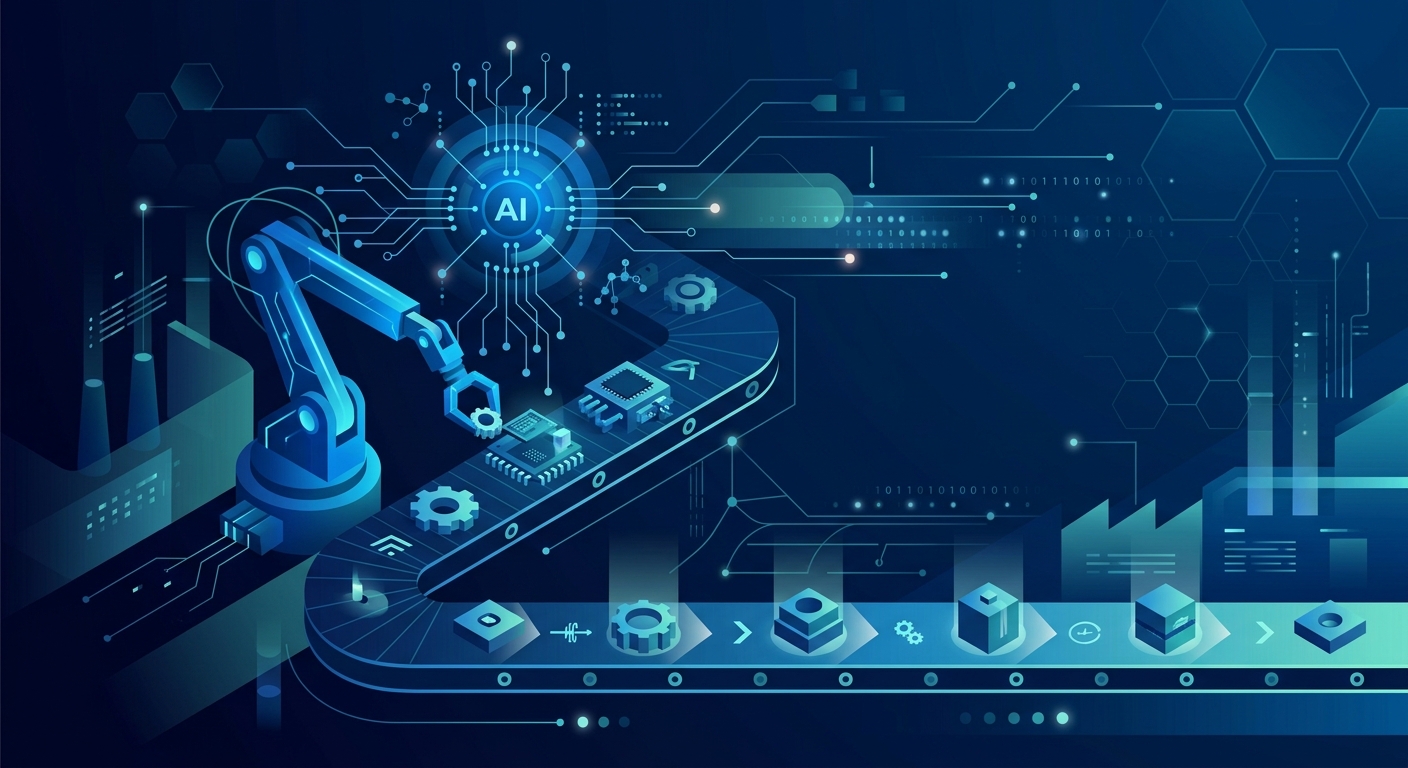
Artificial Intelligence (AI) in manufacturing is a core component of the Industry 4.0 movement, integrating digital breakthroughs with physical production to create autonomous, self-correcting systems. As global competition intensifies and labor markets tighten, the transition from traditional automation to AI-driven intelligence has become a non-negotiable requirement for enterprise resilience. AI manufacturing refers to the application of machine learning (ML), computer vision, and neural networks to industrial data to optimize production, reduce waste, and improve safety.
Key Takeaways
- Predictive Maintenance: AI reduces machine downtime by 30-50% by forecasting failures before they occur.
- Production Capacity: AI-driven optimization can improve factory throughput by up to 20% while lowering material consumption.
- Quality Assurance: Computer vision systems identify defects with higher accuracy than human inspectors, reducing rework costs.
- Legacy Integration: Modernizing legacy equipment (20+ years old) requires retrofitting with IoT sensors and edge computing gateways.
How is AI Being Used in Manufacturing? Core Use Cases
AI technology in the manufacturing sector is being deployed as part of the wider Industry 4.0 movement, touching several types of solutions across the production lifecycle. Unlike traditional rule-based automation, AI systems learn from environmental changes and historical data to make real-time decisions. In the modern factory, AI in Manufacturing Industry is primarily used in the following capacities:
1. Predictive Maintenance and Asset Health
Predictive maintenance uses AI algorithms to analyze sensor data—such as vibration, temperature, and acoustics—to forecast equipment failures before they occur. By identifying subtle anomalies that precede a breakdown, manufacturers can schedule repairs during planned downtime. According to McKinsey, this shift from reactive to predictive models can lead to a 30-50% reduction in machine downtime [McKinsey Industry 4.0].
2. Computer Vision for Quality Assurance
Automated quality control is one of the most mature applications of AI. High-speed cameras capture images of parts on the assembly line, and deep learning models compare them against a "golden standard." These computer vision systems identify microscopic defects—such as hairline cracks or solder bridges—more accurately than human inspectors. This technology is particularly vital in industries like electronics and aerospace where precision is paramount.
3. Generative Design and R&D
Engineers are increasingly using AI to accelerate the research and development phase. Generative design software uses AI to explore thousands of design permutations based on specific constraints like weight, strength, and material cost. This often results in organic, high-performance shapes that would be impossible for a human to conceptualize, which can then be produced through additive manufacturing.
Benefits of Using AI in Manufacturing
The adoption of AI in the manufacturing industry provides a measurable competitive advantage by shifting operations from reactive to proactive. When implemented at scale, the benefits extend beyond the factory floor into the entire corporate P&L.
- Increased Throughput: AI can improve production capacity by up to 20% by optimizing machine speeds and reducing bottlenecks [Deloitte Smart Manufacturing].
- Material Efficiency: AI-driven optimization lowers material consumption by approximately 4%, directly impacting the bottom line and sustainability goals.
- Labor Optimization: By automating repetitive inspection and data entry tasks, manufacturers can reallocate human talent to higher-value roles, such as process engineering and strategic planning. This is critical as Architecture and Engineering Occupations evolve to manage AI systems rather than perform manual calculations.
- Safety and Compliance: AI-powered monitoring systems can detect whether workers are wearing proper PPE or entering hazardous zones, triggering an immediate stop to machinery to prevent accidents.
"AI technology in the manufacturing sector, which is being deployed as part of the wider Industry 4.0 movement, has already touched several types of solutions, applying digital breakthroughs to a wide range of business scenarios." — MIT Sloan Executive Education (Source: MIT Sloan)
Challenges of Using AI in Manufacturing
Despite the clear ROI, many enterprises struggle with the "pilot purgatory" phase. The primary challenges are rarely about the AI models themselves, but rather the infrastructure and culture surrounding them.
Data Silos and Fragmentation
Manufacturing data is notoriously fragmented. Information from Programmable Logic Controllers (PLCs), Enterprise Resource Planning (ERP) systems, and Manufacturing Execution Systems (MES) often lives in separate silos. AI requires a "single source of truth" to be effective. Without a unified data lake, algorithms cannot find the correlations necessary for predictive insights.
The Skills Gap
There is a significant shortage of professionals who understand both industrial processes and data science. Manufacturers must either invest in substantial upskilling programs or partner with specialized AI firms to bridge this gap. This shift is also reflected in how Computer and Mathematical Occupations are becoming more integrated into the industrial sector.
Cybersecurity Risks
As factories become more connected, the attack surface for cyber threats expands. Protecting proprietary chemical formulas or assembly processes is a major concern. Manufacturers address data ownership and security by implementing strict AI usage policies and security controls to maintain regulatory compliance. Some organizations turn to managed IT providers to help navigate the intersection of AI tools and data privacy, including monitoring usage and circulating IP ownership guidelines.
Modernizing Legacy Equipment for AI Compatibility
A common question among enterprise leaders is: What specific hardware upgrades are required to make legacy 20-year-old machinery compatible with modern AI models?
To make legacy machinery compatible with modern AI, manufacturers must retrofit equipment with sensors to capture real-time data and IoT-enabled devices to facilitate communication with newer systems. These sensors—measuring vibration, heat, and power consumption—transmit gathered data to IoT gateways or edge computing devices, which serve as the bridge to smart systems. Additionally, modernizing specific electrical and digital components, such as replacing old relays with modern PLCs that support standard communication protocols like MQTT or OPC-UA, is essential for a successful Predictive Maintenance strategy.
| Upgrade Type | Hardware Required | Purpose |
|---|---|---|
| Sensing | Accelerometers, Thermocouples | Capture raw physical data from moving parts |
| Connectivity | IoT Gateways, Edge Nodes | Process data locally before sending to the cloud |
| Control | Modern PLCs | Allow AI to send feedback loops back to the machine |
| Security | Hardware Security Modules (HSM) | Encrypt data at the point of origin |
Latest AI Trends from Industry Experts
The next frontier of AI manufacturing is defined by "Agentic" workflows and Collaborative Robots (cobots). Unlike traditional robots that operate behind safety cages, cobots use AI to safely work alongside humans by sensing and responding to human movements in real time. This allows for a hybrid assembly line where the robot handles heavy lifting or high-precision tasks while the human handles complex assembly decisions.
Furthermore, the rise of The Agentic Enterprise is seeing AI agents take over administrative and logistics burdens. For instance, Supply Chain Generative AI is now being used to autonomously negotiate with suppliers when the AI predicts a raw material shortage based on global shipping data. This level of autonomy moves manufacturing from a "just-in-time" model to a "predictive-and-resilient" model.
Industries Leading AI Adoption in Manufacturing
While AI is applicable across the board, three specific industries are currently seeing the highest levels of adoption and ROI:
- Automotive: The automotive sector uses AI for everything from autonomous assembly lines to the generative design of lightweight chassis components. The scale of production makes even a 1% efficiency gain worth millions of dollars.
- Pharmaceuticals: In chemical and drug manufacturing, AI monitors complex batch processes and ensures that environmental variables remain within strict tolerances, preventing the loss of multimillion-dollar batches.
- Electronics: Given the microscopic nature of modern semiconductors, AI-driven computer vision is the only way to achieve the necessary quality yields. AI agents also help manage Manufacturing Change Order AI Agents to handle the rapid lifecycle of electronic components.
Resources for Implementation
To begin an AI transformation, leadership teams should review a range of resources to understand the technical and strategic requirements. Implementation usually follows a structured path of content and research:
- Feasibility Studies: Technical documents exploring whether current data streams are sufficient for ML models.
- ROI Frameworks: Financial models that calculate the payback period based on reduced downtime and waste. You can explore Measuring AI Agent ROI for similar methodologies.
- Pilot Documentation: Detailed protocols for testing AI on a single production line before a global rollout.
- Ethical AI Guidelines: Frameworks for ensuring AI decisions are transparent and do not introduce bias into the workforce management process.
Frequently Asked Questions
How does AI improve safety in a manufacturing plant?
AI improves safety by using computer vision to monitor the floor for hazards, ensuring workers wear PPE, and deploying cobots that automatically stop when they detect a human presence within their operating radius.
Is AI in manufacturing only for large enterprises?
While large enterprises led the way, the cost of sensors and cloud computing has dropped significantly. Small to mid-sized manufacturers can now use "AI-as-a-Service" platforms to implement predictive maintenance without building their own data centers.
What is the difference between AI and traditional automation?
Traditional automation follows a fixed set of instructions (if-this-then-that). AI can learn from data, recognize patterns, and make decisions in situations it was not explicitly programmed for.
How long does it take to see ROI from an AI manufacturing project?
Most manufacturers report a positive ROI within 12 to 18 months, primarily driven by the immediate reduction in unplanned downtime and the decrease in scrap rates.
Can AI work with legacy machines that are 20+ years old?
Yes. By retrofitting legacy machines with external sensors and IoT gateways, you can extract the data necessary to feed AI models without replacing the entire machine.
What is 'Human-in-the-Loop' (HITL) in AI manufacturing?
HITL is a strategy where AI handles data processing and anomaly detection, but a human expert makes the final decision on high-stakes actions, such as shutting down a production line or approving a new chemical formula.