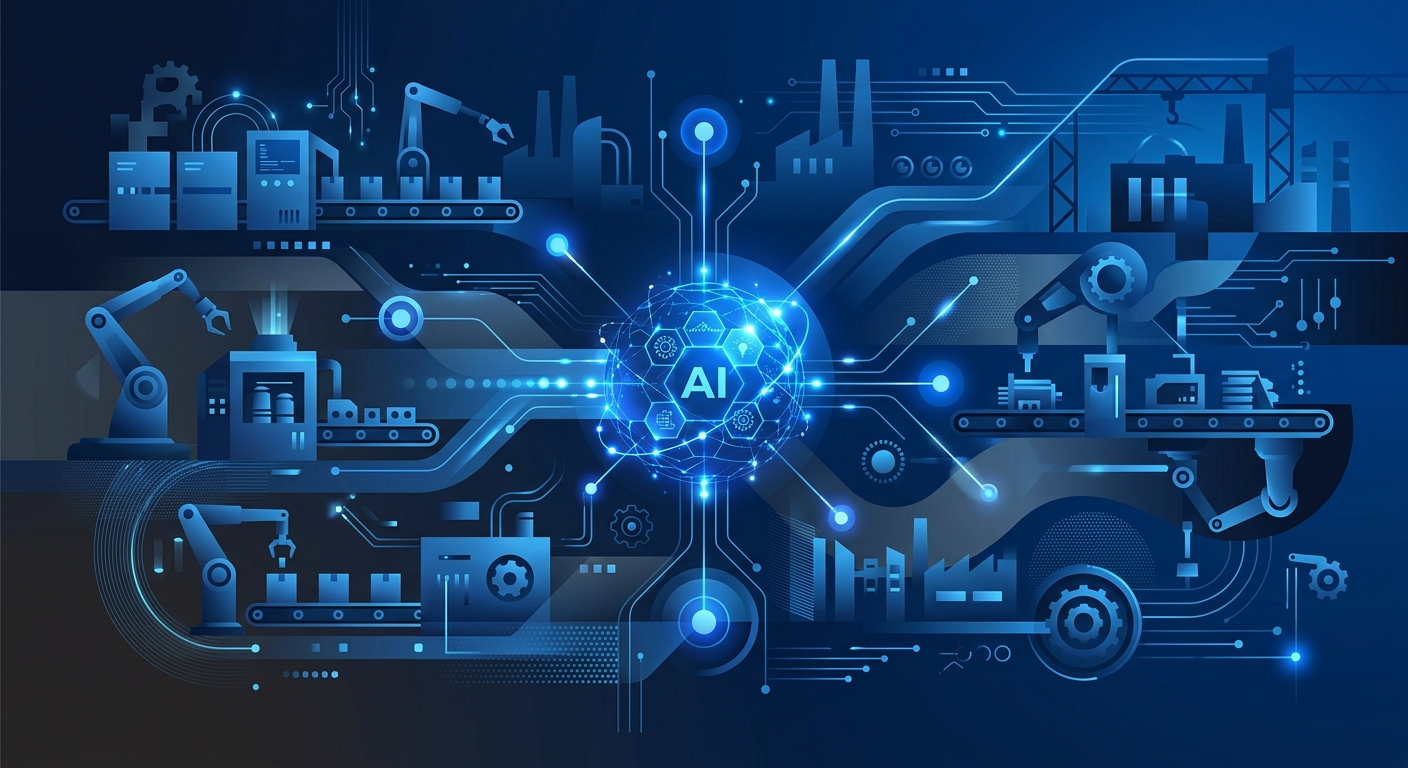
Artificial Intelligence (AI) in the manufacturing sector is the foundational technology driving the Industry 4.0 movement, enabling factories to transition from reactive operations to proactive, self-optimizing systems. AI in manufacturing refers to the application of machine learning (ML), computer vision, and neural networks to industrial data to improve production yields, reduce downtime, and optimize supply chains. According to MIT Executive Education, these digital breakthroughs apply to a wide range of business scenarios, fundamentally changing how physical goods are produced and distributed.
For enterprise leaders, the value proposition of AI is no longer theoretical. McKinsey reports that 70% of manufacturers have already started pilots for AI use cases McKinsey. However, the challenge has shifted from proving the technology works to scaling these solutions across global production footprints. This guide explores the core applications, benefits, and technical requirements for successful AI deployment in modern manufacturing.
Key Takeaways
- Predictive Maintenance: AI reduces manufacturing costs by up to 20% by forecasting equipment failure before it occurs.
- Quality Assurance: Computer vision identifies defects significantly faster and more accurately than human inspectors.
- Scale Challenges: Transitioning from "pilot purgatory" requires unified data pipelines and leadership alignment.
- Infrastructure: Moving to edge AI requires modern PLC architectures capable of high-speed processing and cybersecurity.
How is AI Being Used in Manufacturing? Core Use Cases
AI is being deployed across the entire value chain, from the design phase to the delivery of finished goods. The primary applications involve processing vast amounts of data generated by the Industrial Internet of Things (IIoT).
- Predictive Maintenance: This is perhaps the most mature use case. By using AI algorithms to analyze sensor data—such as vibration, temperature, and pressure—manufacturers can forecast when a machine is likely to fail. This allows maintenance to be scheduled during planned downtime, preventing catastrophic failures.
- Automated Quality Control: Computer vision systems, powered by deep learning, inspect products on high-speed assembly lines. These systems can detect microscopic cracks or deviations that the human eye might miss, ensuring 100% inspection rates without slowing production.
- Generative Design: Engineers use AI to input design goals (such as weight, strength, and material constraints) into software that generates thousands of potential design iterations. This often results in organic, high-performance shapes that are lighter and stronger than traditional designs.
- Demand Forecasting: AI-driven demand forecasting helps manufacturers optimize inventory levels. By analyzing historical sales, market trends, and even weather patterns, AI reduces waste and ensures that production aligns with actual market needs Deloitte.
Benefits of Using AI in Manufacturing
The integration of AI provides quantifiable improvements in Operational Excellence (OEE). The primary benefit is cost reduction. Research from Deloitte suggests that AI can reduce manufacturing costs by up to 20% through operational efficiency improvements Deloitte.
Beyond cost, AI enhances worker safety. By applying Predictive Maintenance, manufacturers can prevent accidents caused by equipment malfunction. Furthermore, AI-driven Digital Twin Technology allows operators to simulate changes in a virtual environment before implementing them on the physical floor, reducing the risk of production errors.
| Benefit Category | Impact Metric | Source |
|---|---|---|
| Cost Reduction | Up to 20% reduction in total costs | Deloitte |
| Inspection Speed | 5x - 10x faster than manual inspection | MIT |
| Equipment Uptime | 10-15% increase in OEE | McKinsey |
| Inventory Waste | 20-50% reduction in stockouts | Industry Benchmark |
Topics and Content Types in Industrial AI
When discussing AI in the manufacturing sector, several sub-topics emerge as critical for executive understanding. These include the distinction between "Narrow AI" (used for specific tasks like sorting) and "General AI" (which remains largely theoretical in a factory setting).
Content types commonly used to train these models include:
- Time-Series Data: Sensor readings from machines (RPM, heat, voltage).
- Image Data: High-resolution photos from the assembly line for defect detection.
- Textual Data: Maintenance logs and operator notes used for Natural Language Processing (NLP) to identify recurring issues.
- CAD Files: Used in generative design to understand geometric constraints.
Industries Leading AI Adoption
While AI is applicable across all manufacturing, certain industries have seen faster adoption due to high precision requirements or high-volume output:
- Automotive: Leading in the use of Autonomous Mobile Robots (AMRs) and Manufacturing Change Order AI Agents.
- Semiconductors: Applying AI for yield optimization where even a 1% improvement results in millions of dollars in savings.
- Aerospace: Focusing on generative design and complex Architecture and Engineering Occupations impact.
- Food & Beverage: Using AI for Graders and Sorters and supply chain freshness tracking.
Authors and Experts: The Latest AI Trends
Leading experts from institutions like MIT and consultancies like Deloitte emphasize that the next frontier is "Agentic AI." This involves AI systems that do not just provide insights but take autonomous actions within defined guardrails.
"AI technology in the manufacturing sector, which is being deployed as part of the wider Industry 4.0 movement, has already touched several types of solutions... translating raw data into strategic insights." — MIT Executive Education (How is AI Used in the Manufacturing Industry)
Experts predict that the rise of the Agentic Enterprise will lead to factories that can reconfigure themselves in real time based on supply chain disruptions or changing customer orders.
Challenges: Bridging the 'Pilot Purgatory' Gap
A significant hurdle for Small-to-Medium Enterprises (SMEs) is "pilot purgatory," where AI projects fail to scale beyond a single production line. Success requires more than just technology; it requires a shift in Enterprise AI Agent Orchestration.
To bridge this gap, SMEs must:
- Align Leadership: AI goals must match business KPIs, not just IT experiments.
- Unified Data Pipelines: Break down silos between the shop floor (OT) and the office (IT).
- Enforce Governance: Establish clear AI Agent Data Privacy Compliance protocols early in the process.
Technical Infrastructure: From Legacy PLC to Edge AI
Transitioning from a legacy Programmable Logic Controller (PLC) system to an AI-driven edge computing model is a significant technical undertaking. Legacy PLCs often lack the processing power to run complex ML models locally.
The Required Technical Stack:
- High-Speed Hardware: Modern PLC architectures with built-in safety and integrated cybersecurity are essential.
- Industrial Connectivity: Solutions that bridge proprietary legacy protocols (like Modbus or Profibus) to modern MQTT or OPC-UA frameworks.
- Edge Computing: Deploying AI models on-site to reduce latency and ensure the factory stays operational even if the cloud connection is lost.
Legal and Liability Frameworks for AI Robotics
As manufacturers deploy autonomous mobile robots (AMRs) and cobots, the legal landscape is evolving. Currently, American legal frameworks primarily treat AI-driven robotics as products, holding manufacturers liable for defects. However, in Europe, the proposed AI Liability Directive seeks to clarify who is responsible when an autonomous system makes a "decision" that leads to an accident. Companies must maintain rigorous AI Agent Audit Trails to demonstrate compliance and safety protocols in the event of a failure.
Frequently Asked Questions
1. What is the difference between AI and traditional automation in manufacturing?
Traditional automation follows pre-programmed, "if-this-then-that" rules. AI, however, can learn from data, recognize patterns, and make decisions in novel situations, such as identifying a defect it has never seen before.
2. How much does it cost to implement AI in a factory?
Costs vary widely depending on the scale. Small pilots can start at $50,000, while enterprise-wide deployments involving infrastructure upgrades can exceed $1 million. However, the ROI is often realized within 12-18 months through waste reduction.
3. Will AI replace human workers in manufacturing?
AI is reshaping roles rather than eliminating them. While tasks like Potters, Manufacturing may see automation, demand is growing for workers who can manage and maintain AI systems.
4. What is Edge AI and why is it important for factories?
Edge AI involves running AI models locally on the factory floor rather than in the cloud. This is critical for manufacturing because it provides the low latency needed for real-time safety and ensures production continues during internet outages.
5. Can AI work with old machinery?
Yes, through "retrofitting." Sensors can be added to legacy equipment to collect data, which is then sent to an AI gateway for analysis, effectively bringing old machines into the Industry 4.0 ecosystem.
6. How do I start an AI project in my plant?
Start with a specific problem, such as a high-value machine that frequently breaks down. Focus on a "Proof of Value" rather than a "Proof of Concept" to ensure the project has clear financial benefits.