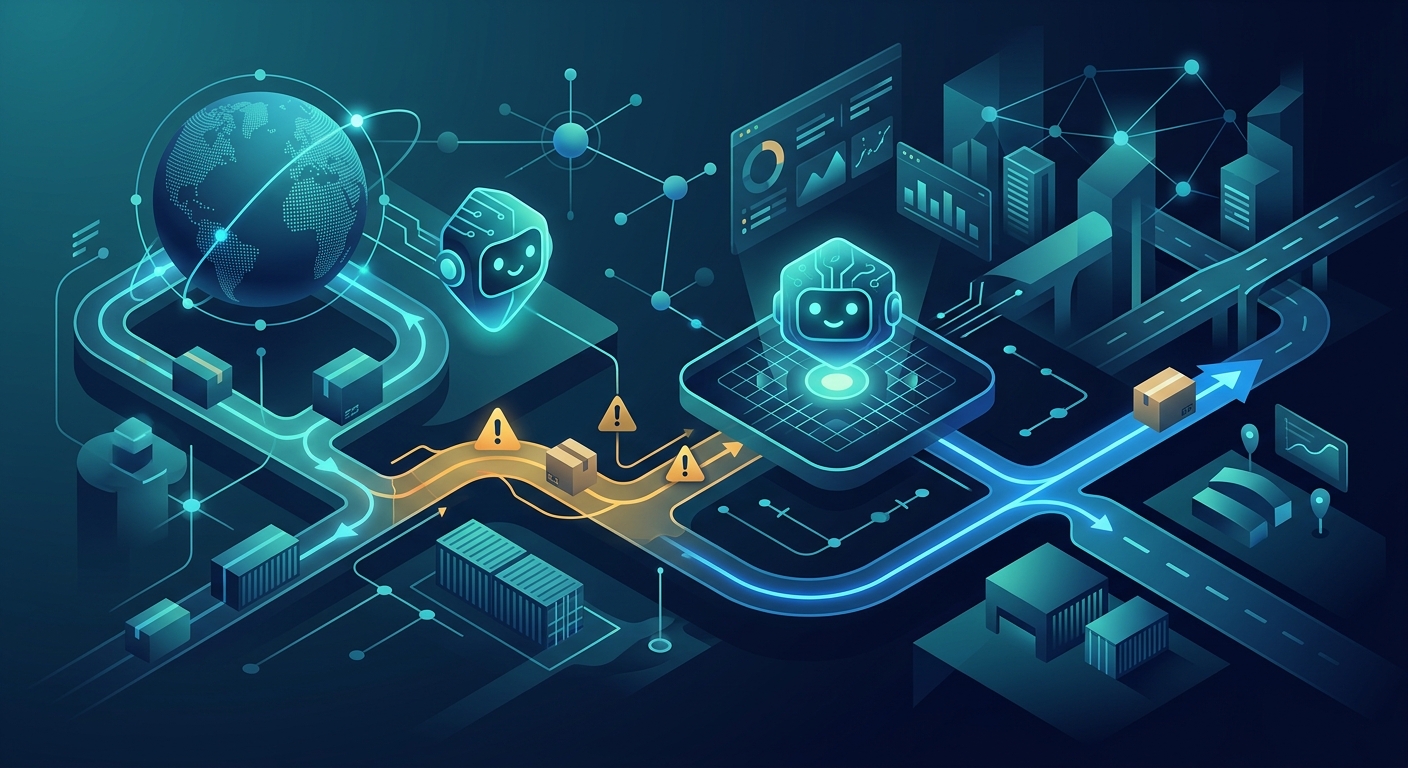
Freight disruptions are no longer anomalies; they are operational constants. For logistics leaders in manufacturing, the traditional response—reactive tracking, manual escalations, and cross-functional firefighting—systematically erodes margins and exhausts operational capacity. Transitioning from manual exception handling to an autonomous, accountable workforce is no longer a tactical upgrade. It is a strategic imperative for preserving working capital and guaranteeing delivery performance in volatile markets.
The Margin Drain of Reactive Freight Exception Handling
Unmanaged freight exceptions compound into seven-figure margin leaks. Beyond visible penalties such as detention and demurrage, organizations absorb substantial hidden costs: expedited freight premiums, overtime labor for manual tracking, and the cascading impact of production line stoppages. Industry data reveals that 73% of shipping data still enters enterprise systems manually, while 40% of transit delays remain undetected until customers initiate status inquiries How AI Agents Automate Logistics Data.
Legacy Transportation Management Systems (TMS) and static rule-based alerts lack the contextual intelligence required to interpret unstructured carrier communications, weather anomalies, or port congestion signals at scale. Human-dependent workflows elongate response times across shifts, turning resolution into a systemic bottleneck. In modern manufacturing logistics, proactive exception resolution is non-negotiable for margin preservation. Organizations that continue relying on reactive tracking effectively subsidize carrier inefficiencies with internal overhead, sacrificing profitability for predictability.
How a Supply Chain AI Workforce Operates Autonomously
A supply chain AI workforce eliminates monitoring latency by maintaining continuous, multi-modal oversight across the logistics data fabric. Rather than relying on batch polling or fragmented email digests, automation agents ingest real-time signals from EDI feeds, telematics, carrier portals, and ERP systems concurrently. This continuous data stream enables autonomous triage. Agents instantly classify disruption events, cross-reference historical lane performance, and perform root-cause analysis—without custom APIs or dedicated IT support.
When delays or capacity mismatches occur, the system bypasses passive alerting. It evaluates contractual SLAs, quantifies downstream impacts, and either escalates decisions to designated stakeholders or executes pre-authorized remediation steps. Operating continuously, this architecture eliminates the shift-handoff bottlenecks that traditionally constrain freight control towers and dispatch teams. Eliminating manual handoffs across logistics, IT, and carrier teams ensures near-instantaneous resolution across all lanes. This autonomous framework transforms exception management from a reactive cost center into a continuously optimized function. Establishing this operational architecture is foundational for enterprises transitioning from fragmented oversight to a cohesive digital workforce Building an Agentic Operating Model.
Core Capabilities of Modern Logistics Automation Agents
Modern logistics AI agents transcend basic shipment tracking to deliver predictive, self-executing workflows. Predictive delay modeling serves as the core engine, synthesizing historical lane performance, meteorological data, port congestion indices, and macroeconomic capacity signals. By identifying high-probability risk corridors pre-departure, agents preemptively optimize routing and secure alternative capacity before service levels degrade.
When exceptions occur, the system autonomously initiates carrier communications, enforces contractual penalty clauses, and executes dynamic rerouting—eliminating manual negotiation. This autonomous execution is critical for synchronizing transportation and fulfillment. Native integration with WMS platforms and warehouse AI solutions ensures end-to-end visibility from dock door to final delivery AI Supply Chain Agents. The result is a closed-loop management system that resolves in-transit disruptions while dynamically synchronizing inventory replenishment, dock scheduling, and order fulfillment dates. Industry analysis confirms that advanced AI implementations reduce exception handling time by over 60% while significantly improving cross-system data accuracy How AI Handles Freight Exceptions Before They Become Problems.
Shifting from Labor Headcount to Measurable Outcomes
Scaling freight operations through incremental headcount is misaligned with modern financial optimization goals. Executive leadership must shift from tracking operational activity to measuring verified outcomes. Meo’s framework replaces vanity metrics like hours logged or tickets processed with board-level KPIs: exception resolution rate, time-to-remediation, and quantified avoided penalty costs.
By anchoring operational spend directly to verified results, organizations replace rigid payroll structures with a variable, performance-tied expense model that scales precisely with shipment volume and complexity. This outcome-driven approach enables precise budget forecasting and eliminates the sunk costs associated with idle monitoring teams or underutilized BPO contracts. When deployed capital correlates directly to resolved disruptions and preserved SLAs, finance and operations leadership achieve strategic alignment. Transparent outcome tracking also enables rapid resource reallocation, freeing logistics teams to focus on high-value network design, carrier strategy, and continuous process improvement. For leaders evaluating the financial impact of agentic deployment, establishing a rigorous, audit-ready measurement baseline is essential ROI & Performance Metrics.
Risk-Free Deployment: The Pay-for-Performance AI Model
Deploying autonomous agents into mission-critical logistics networks requires a methodology that eliminates upfront capital risk while delivering measurable, defensible returns. Meo’s deployment process follows a structured, phased rollout. An initial baseline audit maps existing exception patterns and data readiness, followed by a targeted pilot that validates performance against live, high-volume freight lanes. Upon successful validation, the solution scales to enterprise-level coverage without operational disruption.
Central to this approach is a pay-per-resolved-exception framework that directly aligns vendor incentives with client ROI. Organizations only invest when agents successfully execute verified resolutions, removing the financial risk typically associated with experimental AI or traditional software licensing. This performance-based structure is backed by rigorous data security protocols, enterprise-grade compliance frameworks, and transparent audit trails designed specifically for manufacturing environments Security, Compliance & Governance. Change management is prioritized. Rather than displacing existing teams, the AI workforce operates as an extension of your logistics function, automating high-volume, repetitive decisions while preserving human oversight for complex, strategic exceptions. By decoupling capability from capital expenditure, enterprises can modernize freight operations without disrupting ongoing cash flow.
Strategic Next Steps for Freight Operations Leaders
Transitioning to an AI-driven exception model delivers immediate competitive advantages: reduced transit costs, enforceable carrier accountability, and consistent delivery performance. The path forward begins with a zero-capital pilot targeting high-impact exception categories, such as detention disputes, appointment failures, or cross-border documentation delays. Isolating these high-friction workflows allows operations leaders to validate performance under real-world conditions before scaling network-wide.
This phased, outcome-verified approach ensures continuous margin optimization while building institutional confidence in autonomous execution. As supply chains become increasingly volatile and capacity-constrained, operational resilience will favor organizations that replace reactive overhead with proactive, measurable execution. The future of logistics is not about adding more monitors or scaling control towers; it is about deploying an accountable workforce that delivers verified, bottom-line results.