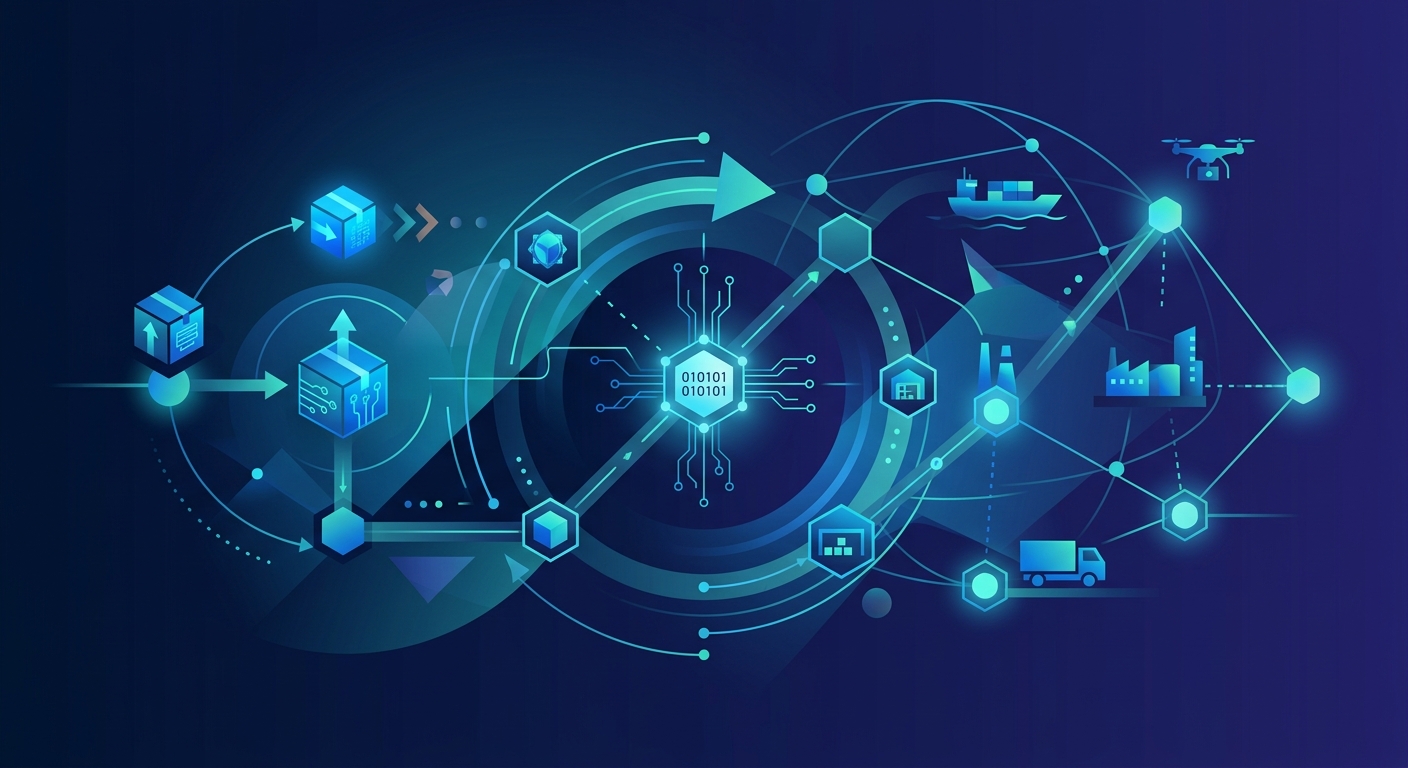
The modern enterprise supply chain no longer competes on volume; it competes on intelligence, speed, and adaptability. As global networks face compounding disruptions, experimental technology pilots are no longer sufficient. The industry demands scalable, accountable execution. Organizations that replace fixed labor overhead with outcome-driven AI deployment consistently outperform peers anchored to traditional staffing models. This transcends task automation. It requires building a resilient, self-optimizing logistics workforce that scales precisely with business demand.
The Current State of AI in Supply Chain Operations
The market has decisively shifted from exploratory AI experiments to enterprise-grade deployment across procurement, warehousing, and distribution. Organizations are accelerating adoption, driven by AI’s proven capacity to strengthen decision-making and operational resilience in volatile environments AI and the Future of Supply Chains - Logistics News. Yet, an execution gap persists between automation promises and realized throughput. Many companies deploy isolated tools that optimize single-point metrics but fail to drive systemic efficiency. Meanwhile, fixed fulfillment and transportation labor costs continue to compress margins, forcing leadership to seek scalable alternatives. The industry has reached an inflection point: automated logistics is an operational necessity. Capturing these gains requires moving beyond static software toward dynamic, outcome-driven systems that adapt to real-world complexity without inflating overhead.
Why Legacy Tools Fail Modern Logistics Demands
Traditional supply chain management relies on architectures engineered for predictable, linear environments. Static, rule-based systems operate on predefined thresholds, rendering them incapable of autonomously navigating real-time disruptions like port congestion, capacity shortages, or demand volatility. When exceptions occur, manual intervention introduces latency and increases error rates, negating the speed advantages of digital transformation. Fragmented technology stacks compound these inefficiencies. Procurement, warehouse management, and transportation platforms rarely communicate seamlessly, forcing teams to manually reconcile disconnected data streams. This architectural siloing prevents holistic orchestration and delays corrective action. Furthermore, the implementation and maintenance overhead of legacy upgrades is staggering. Custom integrations, continuous patching, and specialized IT support drive operational expenditures without guaranteeing ROI Industry Insights: AI in Logistics | Reshaping How Goods Move. Rigid, maintenance-heavy platforms are structurally incapable of supporting modern logistics agility.
How Autonomous AI Agents Power Next-Gen Automated Logistics
Autonomous AI agents represent a fundamental shift from passive software to active, decision-making workforce members. Operating with contextual awareness, they execute complex workflows across procurement, fulfillment, and distribution with minimal human oversight. Predictive AI continuously analyzes historical demand, seasonal trends, and real-time market signals to dynamically balance inventory, drastically reducing overstock waste and stockouts. During disruptions, agents autonomously reroute shipments, adjust carrier assignments, and recalibrate schedules in milliseconds. Their value compounds through continuous machine learning: every resolved exception and fulfilled order refines future decision-making, systematically eliminating bottlenecks. Crucially, these agents integrate seamlessly. Rather than requiring disruptive rip-and-replace implementations, they embed directly into existing ERP, WMS, and TMS environments via secure APIs, leveraging legacy infrastructure while upgrading operational intelligence. As industry analysis confirms, agentic AI will centralize supply chain decision-making, enabling dynamic resource allocation, real-time fleet monitoring, and unprecedented demand forecasting accuracy How AI and Automation Are Transforming Logistics - IT Supply Chain. By managing routine coordination and complex exceptions, AI agents transform logistics from a reactive cost center into a responsive, self-optimizing network.
Deploying with Accountability: The Pay-for-Performance Model
The traditional enterprise software model—heavy upfront licensing, lengthy implementation cycles, and uncertain ROI—misaligns with modern operational financials. Executives increasingly demand outcome-based automation that ties technology investment directly to verified business impact. meo structures AI deployments around a strict pay-for-performance framework: clients invest only when agents deliver measurable, audited results. This eliminates the financial risk of speculative adoption and aligns vendor incentives directly with operational targets. Instead of funding software seats or compute hours, organizations pay for verified freight cost reductions, improved fulfillment accuracy, and accelerated cycle times. Agents deploy against specific KPIs, with transparent dashboards tracking performance in real time. Capacity scales only after baseline efficiency metrics are consistently exceeded, effectively replacing fixed labor overhead with variable, performance-driven compute power. This model transforms technology procurement from a capital expenditure gamble into a predictable, margin-accretive operational expense. By treating AI agents as a scalable, accountable workforce, organizations can rapidly expand automated logistics capacity during peak demand without inflating headcount. Accountability is not an add-on; it is the commercial foundation of deployment.
Executive Roadmap for Scaling AI Agents Across the Supply Chain
Scaling AI across complex logistics networks requires disciplined, phased execution rather than disruptive overhauls. Executives should begin by mapping high-impact, low-complexity workflows—such as carrier rate shopping, freight invoice reconciliation, or exception routing—where agents can demonstrate rapid, verifiable ROI. Deployment must begin with rigorous baseline metrics across unit cost, order cycle time, and fulfillment accuracy, explicitly tying agent targets to financial outcomes. Once agents prove efficacy in isolated processes, gradually expand their scope to cross-functional orchestration, linking procurement, warehousing, and last-mile delivery into a unified network. Successful deployment also requires redefining workforce strategy. Forward-thinking leaders position AI agents as force multipliers, not blunt replacements for human capital. This approach frees skilled personnel to focus on strategic planning, supplier relationship management, and continuous process improvement. A structured, metric-driven rollout minimizes operational risk while building a resilient, future-ready logistics infrastructure.
Conclusion
Advancing supply chain operations is no longer about adopting new software. It requires deploying an accountable, self-optimizing workforce that scales with demand and funds its own expansion. Organizations that adopt outcome-based AI deployment will consistently outpace competitors constrained by legacy inefficiencies and fixed overhead. meo partners with traditional enterprises to implement AI supply chain agents that deliver measurable business results, aligned strictly with financial targets and deployed on a verified performance basis. Prioritize outcomes over overhead. Schedule a strategic deployment assessment to evaluate how pay-for-performance AI can optimize your logistics operations.