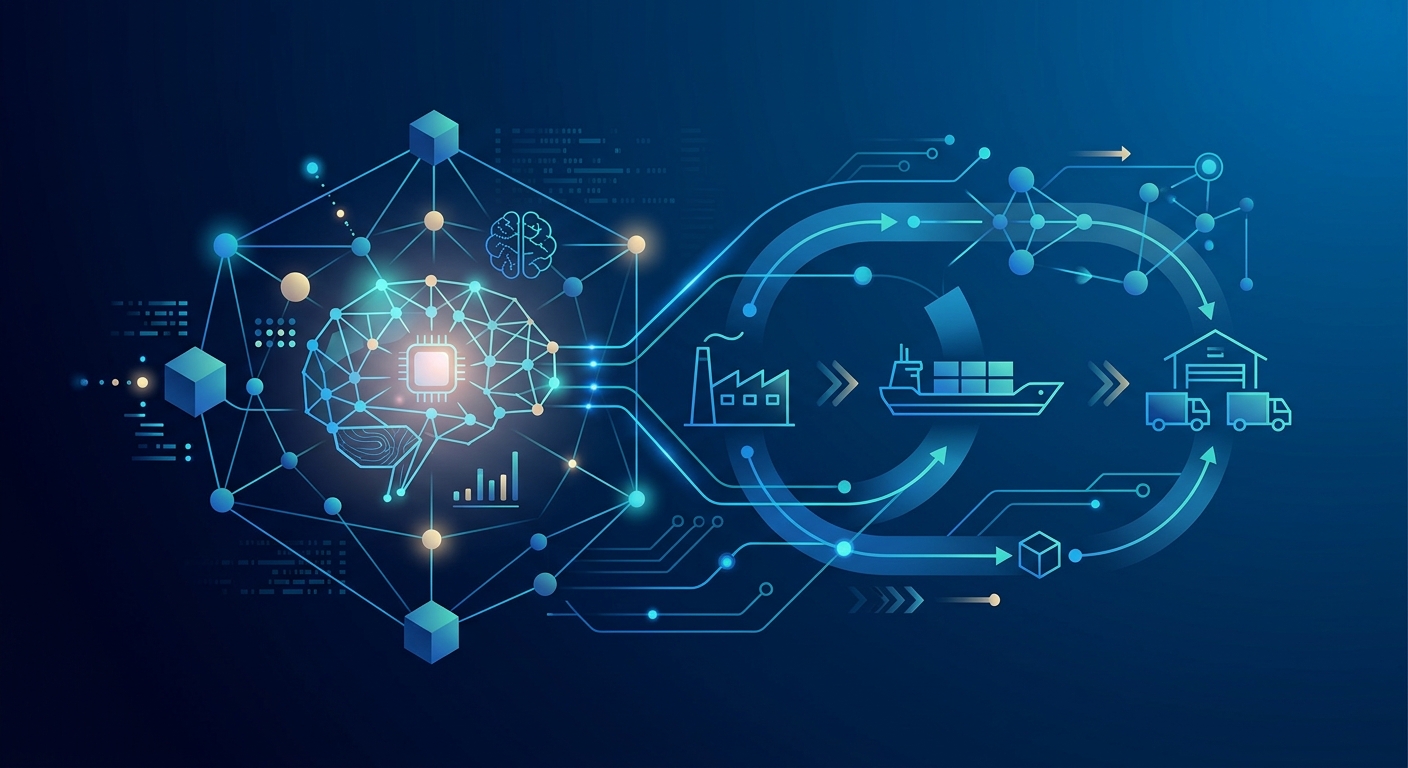
Artificial intelligence (AI) is a mature technology capable of catalyzing transformative changes in business and society. In the modern era, where supply chain disruptions are increasingly common, global, and complex, the integration of artificial intelligence and supply chain management has moved from an aspirational goal to a competitive necessity. Organizations are no longer asking if they should adopt AI, but how they can deploy it to solve the "Scattered Data Problem" and mitigate real-time risks.
Recent research indicates that AI adoption in supply chain management significantly impacts operational performance, with 72% of research articles highlighting performance benefits and 54% specifically focusing on operational improvements ScienceDirect. By using machine learning (ML), natural language processing (NLP), and the Internet of Things (IoT), enterprises can transform reactive logistics into proactive, autonomous networks.
Key Takeaways
- Efficiency Gains: 72% of academic research confirms significant performance benefits from AI in SCM.
- Cost Leadership: A 2022 McKinsey survey found that the highest cost savings from AI across all business functions occur in supply chain management GJIA.
- Resilience: AI-enabled planning improves decision-making in production, inventory management, and product distribution.
- Maturity: AI is no longer a "moving target" but a stable framework for managing global complexity.
Core Applications of Artificial Intelligence and Supply Chain Optimization
The application of artificial intelligence and supply chain management spans the entire value chain, from raw material procurement to last-mile delivery. The primary value drivers are predictive accuracy and the ability to process unstructured data at scale.
Demand Forecasting and Planning
Traditional forecasting relies on historical sales data. AI-driven models, however, incorporate external variables such as weather patterns, geopolitical shifts, and social media sentiment. This allows for "sensing" demand rather than just predicting it. According to MIT Sloan, AI creates unparalleled new opportunities for logistics by turning these vast data sets into actionable insights.
Autonomous Inventory Management
AI systems can dynamically adjust safety stock levels based on lead-time variability. When integrated with Predictive Maintenance, these systems ensure that warehouse machinery is operational when demand spikes, preventing bottlenecks. This creates a self-healing supply chain that minimizes carrying costs while maximizing service levels.
Warehouse Robotics and Computer Vision
Computer vision, a subset of AI, is now used to automate quality inspections and inventory counting. High-speed cameras and AI models can identify defects in products or discrepancies in pallet counts faster and more accurately than human operators. This is particularly relevant for high-volume Computer and Mathematical Occupations where data accuracy is paramount.
1. Introduction: The Evolution of AI in Logistics
The field of supply chain management (SCM) has undergone three distinct waves of digital transformation. The first was the digitization of records via ERP systems. The second was the connectivity wave provided by the Internet of Things (IoT). We are currently in the third wave: the intelligence wave.
As noted by Chris Caplice, executive director of the MIT Center for Transportation and Logistics, "AI is a moving target... what was considered AI 30 years ago" is now standard practice MIT Sloan. Today's AI involves deep learning and neural networks that can simulate millions of supply chain scenarios in seconds. This capability is essential for managing the "Scattered Data Problem," where information is siloed across different vendors, regions, and platforms.
2. Methodology: How AI Synthesizes Supply Chain Data
To understand the impact of artificial intelligence and supply chain management, one must look at the methodology of data synthesis. AI does not merely "clean" data; it finds signals within the noise.
| AI Capability | Supply Chain Function | Impact Metric |
|---|---|---|
| Machine Learning | Demand Sensing | 20-30% reduction in under-stocking |
| Natural Language Processing | Contract Analysis | 50% faster procurement cycles |
| Computer Vision | Quality Control | 99.9% defect detection accuracy |
| Reinforcement Learning | Route Optimization | 10-15% reduction in fuel consumption |
By applying these methodologies, firms can bridge the gap between planning and execution. For instance, AI Agents for Invoice Exception Handling allow for the autonomous resolution of billing discrepancies that would otherwise stall a supply chain for days.
3. Findings: Operational and Financial ROI
The empirical findings regarding artificial intelligence and supply chain management are conclusive. A systematic literature review of empirical studies shows that AI catalyzes transformative changes by optimizing the flow of goods and information ScienceDirect.
"AI has the potential to revolutionize supply chain operations by improving decision-making and efficiency. According to a 2022 McKinsey survey, respondents reported that the highest cost savings from AI are in supply chain management." – Georgetown Journal of International Affairs (GJIA)
These savings are realized through:
- Reduced Labor Costs: Automation of repetitive tasks in the back office and warehouse.
- Inventory Optimization: Reducing the capital tied up in "just-in-case" inventory.
- Enhanced Resilience: The ability to pivot suppliers instantly when a disruption occurs in a specific geographic region.
Overcoming Implementation Barriers in AI-Driven Logistics
Despite the clear benefits, many organizations remain uncertain about implementation. The "talent gap" is a significant hurdle; according to Deloitte US, combatting complexity requires a shift in organizational culture, not just a software update.
The Data Cleaning Gap for SMEs
Small and Medium-sized Enterprises (SMEs) often face a 50-80% data cleaning time gap. Unlike large enterprises with dedicated data engineering departments, SMEs must rely on AI tools that can find structure in messy, "scattered" data. Instead of spending years building a perfect data lake, SMEs are increasingly using The Agentic Enterprise models to deploy specialized agents that clean and verify data on the fly.
Legacy System Integration
Most supply chains run on legacy ERP systems that were never designed for real-time AI API calls. Bridging this gap requires a middleware layer—often powered by Enterprise AI Agent Orchestration—that can read from legacy databases and feed into modern AI models without requiring a total system overhaul.
Legal and Liability Frameworks in Autonomous Supply Chains
As supply chains become more autonomous, the question of liability becomes critical. What happens when an AI-driven decision—such as an autonomous procurement bot over-ordering raw materials—results in a significant financial loss?
Under current legal frameworks, AI systems are not considered "legal persons." This means they cannot be held liable for breaches of contract or negligence. Instead, liability is typically addressed through hybrid models where contractual obligations are shared among the human or corporate parties based on their specific roles and the level of control they exert over the system. Organizations must ensure that their AI Agent Audit Trails are robust enough to provide evidence in the event of a dispute.
Future Outlook: Predictive Analytics and Autonomous Networks
The next decade of artificial intelligence and supply chain management will be defined by the shift from "Predictive" to "Prescriptive" and finally "Autonomous" operations.
- Prescriptive Analytics: The system doesn't just tell you a delay is coming; it suggests three alternate routes and calculates the cost-benefit of each.
- Generative AI in Procurement: AI will draft and negotiate supplier contracts based on historical performance data and real-time risk assessments.
- Sustainability and ESG: AI will be the primary tool for tracking Scope 3 emissions across the supply chain, as highlighted by Yale SOM.
By integrating AI with IoT, companies can build resilience and sustainability at the same time. For example, optimizing a truck's route doesn't just save money; it significantly reduces the carbon footprint, aligning operational goals with environmental mandates.
Frequently Asked Questions
1. How does AI improve supply chain resilience?
AI improves resilience by providing real-time visibility into global risks. It can analyze news, weather, and port data to predict disruptions before they happen, allowing managers to pivot to alternative suppliers or logistics providers immediately.
2. Is AI adoption in the supply chain only for large enterprises?
No. While large firms have more resources, cloud-based AI tools and Outcome-based AI Pricing Models have made the technology accessible to SMEs. SMEs can focus on specific use cases like demand forecasting or automated invoicing to see immediate ROI.
3. What is the role of IoT in AI-driven supply chains?
IoT devices act as the "sensors" of the supply chain, providing the raw data (location, temperature, vibration) that AI models need to make informed decisions. AI and IoT together create a digital twin of the physical supply chain.
4. Will AI replace human supply chain managers?
AI is more likely to augment human roles by automating repetitive data entry and basic analysis. This allows managers to focus on strategic relationship building and complex problem-solving. For more on this, see our guide on Jobs Replaced by AI.
5. What are the first steps to implementing AI in SCM?
Start by identifying a specific pain point—such as high inventory carrying costs or frequent stockouts. Ensure your data is accessible, and then deploy a pilot AI project to prove the ROI & Performance Metrics before scaling.
6. How does AI impact sustainability in logistics?
AI reduces waste by optimizing routes (less fuel) and improving demand forecasting (less overproduction). It also helps in tracking the environmental impact of every node in the supply chain.