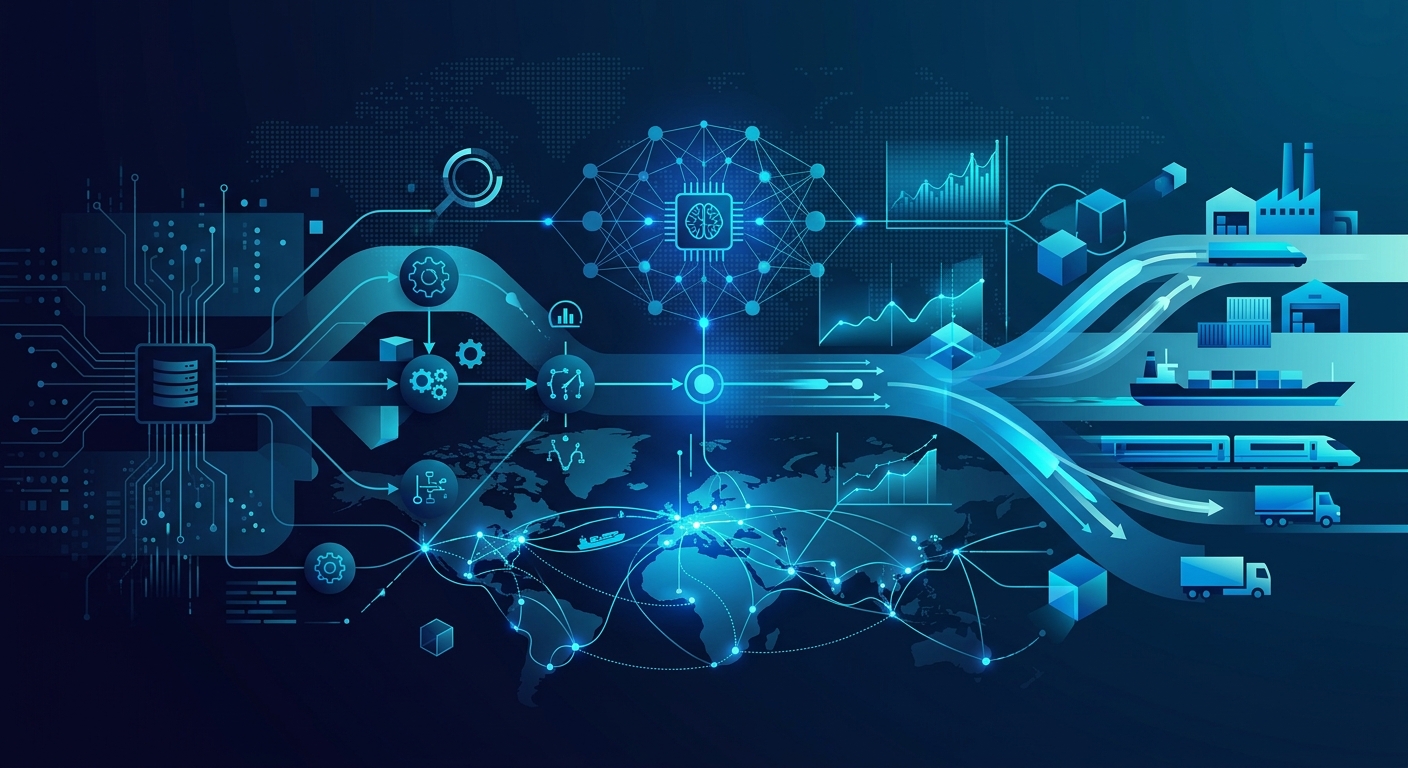
Artificial intelligence in supply chain management (SCM) is a transformative suite of technologies that uses machine learning, predictive analytics, and automated decision-making to optimize the flow of goods and services. In today's volatile global market, supply chain disruptions are increasingly common, global, and complex. Organizations are turning to AI not just for incremental gains, but as a fundamental tool to combat modern management challenges and build systemic resilience.
Key Takeaways
- Efficiency Gains: AI significantly improves decision-making speed and overall operational efficiency across the value chain.
- Cost Reduction: According to McKinsey, the highest cost savings from AI are reported in supply chain management.
- Implementation Reality: Data collection and cleaning tasks consume between 50% and 80% of the total time dedicated to AI project development.
- Resilience: AI-enabled planning provides the visibility needed to navigate global disruptions and complex logistics networks.
1. Introduction: The Maturity of AI in Supply Chain
Artificial intelligence has moved from a theoretical concept to a mature, transformative tool in supply chain management. Over the past decade, AI technologies have developed rapidly, reaching a level of maturity sufficient to drive transformative changes in business and society. This evolution is particularly evident in how firms handle massive datasets that were previously unmanageable.
As noted by ScienceDirect, within the SCM community, there are high expectations regarding AI's ability to automate routine tasks and provide deep insights into logistical bottlenecks. However, implementing AI is not a static achievement. As Chris Caplice of the MIT Center for Transportation and Logistics explains, AI is a "moving target" because what was considered advanced three decades ago is now standard software functionality MIT Sloan.
2. Methodology: How AI Extracts Value from SCM Data
To understand the impact of artificial intelligence and supply chain integration, one must examine the methodology of data processing. AI adds specific value to supply chain planning, including production, inventory management, and product distribution. The process typically involves three layers: descriptive (what happened), predictive (what will happen), and prescriptive (what should we do).
However, the technical methodology faces a significant hurdle: data quality. It is a well-documented industry standard that data collection and cleaning tasks consume between 50% and 80% of the total time dedicated to AI project development ScienceDirect. Without clean, normalized data, AI models suffer from "garbage in, garbage out" problems, leading to inaccurate forecasting and inventory imbalances.
3. Findings: The Economic Reality of AI Integration
Findings from recent global surveys suggest that the financial incentives for adopting artificial intelligence supply chain tools are unparalleled. According to a 2022 McKinsey survey, respondents reported that the highest cost savings from AI are in supply chain management Georgetown GJIA.
Table 1: AI Impact Areas in SCM
| Application Area | Primary Benefit | Data Requirement |
|---|---|---|
| Demand Forecasting | Reduced stockouts | Historical sales, weather, trends |
| Inventory Optimization | Lowered carrying costs | Real-time SKU tracking |
| Route Optimization | Fuel and time savings | GPS data, traffic patterns |
| Predictive Maintenance | Reduced downtime | IoT sensor data |
These findings highlight that while the technology is ready to handle increasingly complex global disruptions, the primary hurdle for firms is no longer the technology's capability, but the strategic framework for its integration. Organizations that treat AI as a plug-and-play solution often fail; success requires a fundamental shift in how data is governed and how teams interact with automated suggestions.
4. Figures and Highlights: Visualizing Resilience
When we examine the "Figures" of modern logistics—specifically the 4 key pillars of AI resilience—we see a shift toward autonomous operations. These pillars include:
- Visibility: Real-time tracking across all tiers of the supply chain.
- Agility: The ability to reroute shipments instantly based on predictive weather or political data.
- Scalability: Managing millions of SKUs without a proportional increase in headcount.
- Sustainability: Optimizing loads to reduce carbon footprints.
"AI is a moving target. It's not sitting still; it's aspirational because what was considered AI 30 years ago ... is not considered cutting-edge AI anymore." – Chris Caplice, Executive Director, MIT Center for Transportation and Logistics (MIT Sloan)
5. Overcoming the SME Capital Expenditure Gap
A critical question often missed by high-level reports is: How do small-to-medium enterprises (SMEs) overcome the high initial capital expenditure of AI? While 23% of large organizations have formal AI strategies, SMEs often lack the scale to absorb massive upfront costs.
To solve this, SMEs are increasingly adopting "Operational Lever" strategies. Instead of building proprietary models, they use SaaS-based AI tools integrated into existing ERP systems. By using AI agents for invoice exception handling, for example, SMEs can achieve immediate ROI without the need for a dedicated data science team. This allows them to scale autonomous outreach and operational efficiency at a fraction of the cost of enterprise-grade custom builds.
6. Privacy, Legal Frameworks, and the EU AI Act
As supply chains become more interconnected, sharing data with third-party generative AI models introduces significant risks. What specific data privacy protocols are required? Organizations must now adhere to the EU AI Act's risk-based requirements. This includes:
- Risk Management: Documenting how AI decisions impact safety and human rights.
- Data Minimization: Ensuring that only the necessary data is shared with third-party models to prevent IP leakage.
- Cybersecurity: Protecting the data pipelines that feed real-time AI forecasting tools.
For more information on navigating these complexities, see our guide on AI Agent Data Privacy Compliance.
7. Computers in Industry: The Shift to Cloud-Native AI
The journal Computers in Industry has highlighted a significant shift toward cloud-native platforms in SCM. Traditional on-premise legacy systems often act as "data graveyards." Modern AI-driven forecasting tools require high-speed interoperability. While specific universal standards are still evolving, the industry is gravitating toward RESTful APIs and GraphQL to layer AI intelligence on top of legacy ERP systems. This "layering" approach removes the need for a total system overhaul, allowing companies to maintain their Predictive Maintenance schedules while upgrading their intelligence capabilities.
8. Frequently Asked Questions
What is the most common use of AI in supply chains today?
The most common use is demand forecasting. By analyzing historical data and external variables like market trends and weather, AI helps companies predict exactly how much stock they need, reducing waste and stockouts.
How long does it take to implement an AI supply chain project?
While small pilots can launch in weeks, full-scale enterprise integration typically takes 6 to 18 months. A large portion of this time—often up to 80%—is spent on data cleaning and preparation.
Will AI replace supply chain managers?
AI is more likely to augment the role of supply chain managers than to replace them. It automates repetitive data entry and basic analysis, allowing managers to focus on strategic relationship building and crisis management. For more on this, see Jobs Replaced by AI.
Is AI in supply chain only for large corporations?
No. While large firms were early adopters, the rise of cloud-based AI tools has made these technologies accessible to SMEs. Smaller firms can now use plug-and-play AI modules for specific tasks like logistics routing or invoice handling.
What is the biggest risk of using AI in SCM?
The biggest risks are data privacy breaches and "algorithmic bias," where an AI makes poor decisions based on flawed historical data. Robust AI Agent Audit Trails are essential to mitigate these risks.
How does AI improve sustainability in logistics?
AI reduces carbon emissions by optimizing delivery routes to use less fuel and ensuring that trucks are always carrying full loads, thereby reducing the number of trips required.
9. Conclusion: Building a Resilient, AI-First Strategy
To stay competitive, enterprise leaders must move beyond viewing AI as a technical experiment and start treating it as a core strategic pillar. The complexity of modern global trade means that human-only management is no longer sufficient. By integrating AI into supply chain planning, organizations can achieve the decision-making speed required to handle the next global disruption.
Implementing AI requires a commitment to data integrity, a clear understanding of legal frameworks like the EU AI Act, and a willingness to adapt as the technology continues to evolve. The future of the Agentic Enterprise lies in the seamless orchestration of human expertise and machine intelligence.