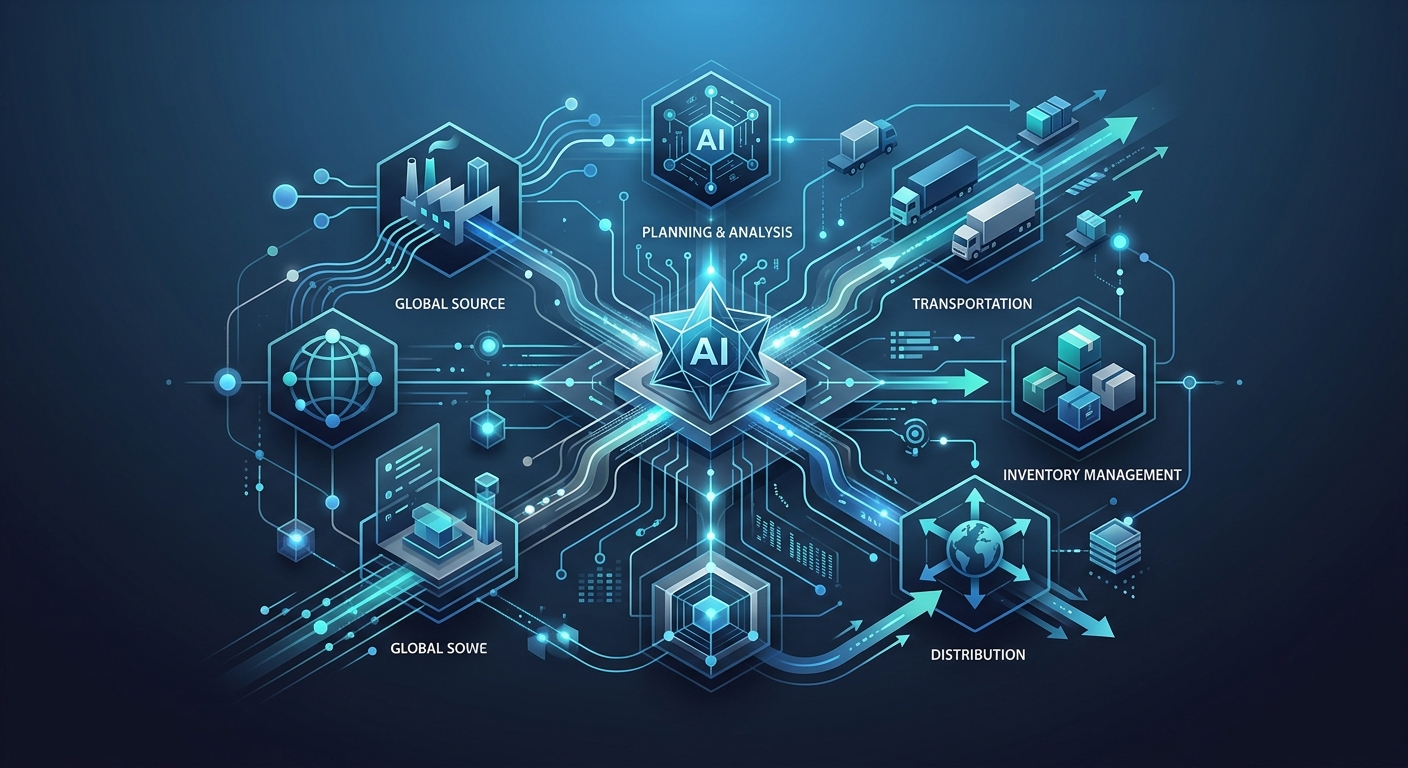
AI supply chain planning is a strategic framework that uses advanced algorithms, machine learning, and generative models to optimize the flow of goods, information, and capital across a global network. In an era defined by volatility, traditional linear planning models are no longer sufficient. Modern enterprises are transitioning toward cognitive supply chains that can predict disruptions before they occur and prescribe optimal responses in real time.
According to a 2022 McKinsey survey, respondents reported that the highest cost savings from AI are found specifically in supply chain management The Role of AI in Developing Resilient Supply Chains. This shift marks the move from reactive logistics to proactive, data-driven orchestration.
Key Takeaways
- Primary Value Driver: AI delivers its highest enterprise cost savings within supply chain functions, particularly in production and inventory management.
- Generative AI Frontier: Generative AI is currently being deployed to enhance sourcing and planning, though it requires high-quality data to be effective.
- Resilience via Prediction: AI-enabled planning allows firms to navigate global complexities by improving decision-making speed and accuracy.
- Implementation Gap: While the technology is mature, the primary hurdle remains data governance and the integration of legacy ERP systems.
1 Introduction to AI Supply Chain Planning
The integration of artificial intelligence and supply chain management represents a fundamental shift in how businesses approach demand and supply balancing. For decades, supply chain planning relied on historical averages and static spreadsheets. However, the modern global market is far too complex for these manual methods.
AI supply chain planning involves applying machine learning (ML) to process vast datasets—including weather patterns, geopolitical shifts, and consumer sentiment—to generate highly accurate forecasts. This is not merely about automation; it is about augmentation. By using Artificial intelligence in supply chain management, organizations can drive transformative changes that allow them to remain competitive in a landscape where disruptions are the new normal.
2 Methodology: How AI Transforms Planning Engines
To understand how AI functions within the supply chain, one must look at the methodology behind the models. Unlike traditional software that follows rigid "if-then" logic, AI models learn from data patterns.
- Data Ingestion: Aggregating structured data from ERP systems and unstructured data from IoT sensors or news feeds.
- Pattern Recognition: Identifying correlations between external variables and internal performance.
- Scenario Simulation: Using Digital Twin Technology to run thousands of "what-if" scenarios.
- Continuous Optimization: Adjusting parameters in real time as new data points enter the system.
This methodology ensures that the supply chain is not just efficient, but resilient. As noted by MIT Sloan, AI is a "moving target" because what was considered advanced AI decades ago is now standard automation How artificial intelligence is transforming logistics.
3 Findings: The Impact of AI on Operational Efficiency
The empirical findings on AI adoption are clear: organizations that implement AI supply chain strategies outperform their peers. Research indicates that AI adds significant value to production, inventory management, and product distribution.
| Function | AI Impact Area | Primary Benefit |
|---|---|---|
| Demand Forecasting | Predictive Analytics | Reduction in safety stock and stockouts |
| Sourcing | Generative AI | Automated vendor negotiation and contract analysis |
| Production | ML Scheduling | Optimized machine utilization and energy savings |
| Logistics | Route Optimization | Lower fuel costs and faster delivery times |
These findings suggest that AI has matured to the point where it is no longer an experimental tool but a core component of the The Agentic Enterprise.
Highlights of Generative AI in the Supply Chain
Generative AI (GenAI) is the latest evolution in the AI supply chain toolkit. While traditional AI excels at predicting numbers, GenAI excels at processing and generating natural language and complex code.
"Whether you win or lose in the market may soon depend on having the best generative AI tools and the data quality to match them." — How supply chains benefit from using generative AI | EY - US
In supply chain planning, GenAI is being used to summarize complex supplier risks, generate procurement contracts, and provide conversational interfaces for planners to query their data. However, the success of these initiatives depends heavily on data quality. Without a clean data foundation, GenAI can produce "hallucinations" that lead to poor planning decisions.
Overcoming the Data Governance Gap for Tier-N Visibility
A significant challenge in AI supply chain planning is achieving "Tier-N" visibility—transparency not just into direct suppliers, but into the suppliers of those suppliers. Currently, many firms have only 2% visibility into their deep-tier networks.
Moving to full visibility requires a robust data governance framework. While specific universal standards are still emerging, leading firms are adopting "Data Mesh" architectures where data is treated as a product. This involves decentralized data ownership combined with centralized governance to ensure that AI agents can access clean, real-time information across the entire value chain. For more on managing these complex systems, see our guide on Continuous AI Agent Monitoring Protocols.
Reconciling AI Autonomy with Legal Accountability
As companies move toward autonomous AI negotiation—where 65% of vendors now express a preference for AI-led interactions—they face a "liability squeeze." This occurs when a business is held legally responsible for AI outcomes that it cannot fully audit or control.
To mitigate this, enterprises must implement AI Agent Audit Trails. These systems record every decision-making step the AI takes, providing a "black box" recorder for legal and compliance teams. This ensures that while the AI has the autonomy to plan and negotiate, there is a clear line of human oversight and accountability.
Integrating AI with Legacy ERP Systems
One of the greatest technical hurdles in AI supply chain planning is the presence of legacy ERP systems. These systems were often built before the era of cloud computing and are not designed for the high-frequency data exchange that AI requires.
Integration strategies typically involve:
- APIs and Middleware: Creating a translation layer between the ERP and the AI engine.
- The Strangler Fig Pattern: Gradually replacing legacy components with modern microservices.
- Data Virtualization: Allowing AI tools to query data across multiple sources without requiring a massive, unified data migration.
This technical interoperability is essential for moving from static planning to the Enterprise AI Agent Orchestration models used by industry leaders.
Frequently Asked Questions
What is AI supply chain planning?
AI supply chain planning is the use of artificial intelligence and machine learning algorithms to forecast demand, optimize inventory levels, and schedule production more accurately than traditional manual methods.
How does AI reduce supply chain costs?
AI reduces costs by minimizing excess inventory, preventing stockouts, optimizing transportation routes to save fuel, and automating repetitive tasks like invoice processing or vendor communication.
Can AI work with existing ERP systems?
Yes, AI can be integrated with legacy ERP systems through APIs, middleware, and data virtualization layers that allow the AI to extract and analyze data without needing to replace the underlying infrastructure.
What is the role of Generative AI in planning?
Generative AI assists in planning by summarizing risk reports, automating the creation of procurement documents, and providing a natural language interface for planners to interact with complex datasets.
Is data quality important for AI in the supply chain?
Data quality is the most critical factor. AI models require clean, consistent, and timely data to produce accurate forecasts; poor data quality leads to unreliable planning outcomes.
Can AI help with supply chain sustainability?
Yes, by optimizing routes and reducing waste in production and inventory, AI directly contributes to lowering the carbon footprint and improving the overall sustainability of supply chain operations.