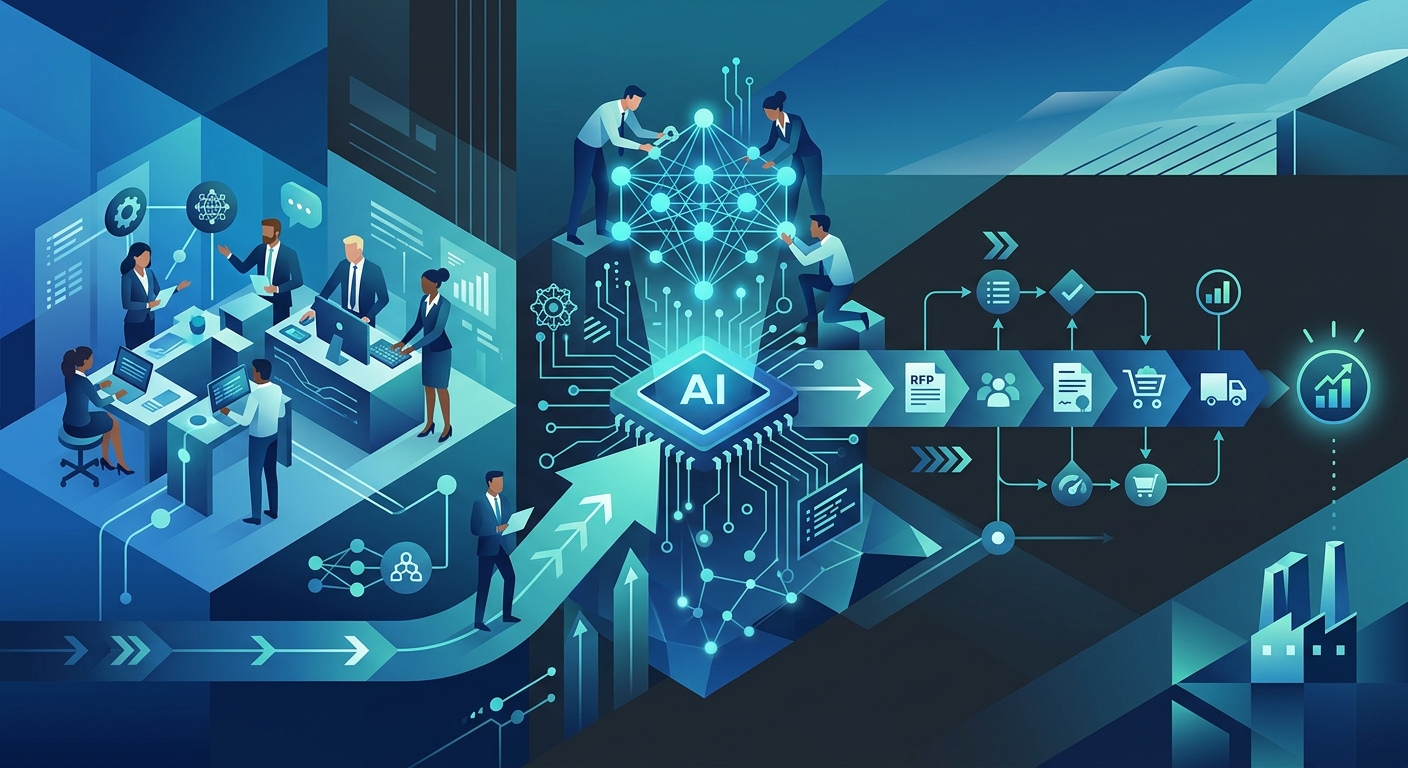
Procurement is at an inflection point. Despite heavy digital transformation investments, teams remain bottlenecked by manual reconciliation, delayed vendor onboarding, and compliance audits that drain strategic capacity. The traditional software playbook—layering static rules over legacy ERPs—no longer yields compounding returns. Procurement leaders must pivot from licensing speculative software to deploying an accountable, decision-capable AI workforce.
At meo, we replace fixed labor overhead with autonomous agents operating on a strict pay-for-performance model. This guide provides an executive framework to build a rigorous AI workforce business case, quantify transparent AI agent total cost of ownership, and secure guaranteed AI agent ROI across the source-to-pay lifecycle.
The Procurement Efficiency Gap: Why Legacy Automation Fails
Manual procurement workflows silently erode enterprise value. Beyond visible processing delays, organizations absorb hidden costs through cycle time drag, maverick spend leakage, and compliance exposure that routinely inflates operational overhead by 15–20% annually. Traditional RPA and static ERP rules engines excel at predictable, linear tasks but fracture when confronted with dynamic vendor negotiations, ambiguous invoice exceptions, or real-time regulatory shifts. These rigid systems lack contextual reasoning, forcing human intervention whenever data deviates from pre-programmed thresholds.
The strategic imperative is clear: procurement must transition from brittle software to an autonomous, decision-capable AI workforce. Industry analysis confirms AI will fundamentally transform procurement’s operational mandate, requiring a shift toward higher-value strategic execution [1]. By embedding reasoning engines directly into procurement workflows, enterprises gain continuous learning capabilities that adapt to market volatility, enforce policy compliance in real time, and eliminate the operational friction legacy automation leaves behind.
Mapping High-Impact Workflows to the AI Workforce
Deploying an AI workforce requires surgical precision, not blanket automation. High-impact candidates include purchase order reconciliation, three-way invoice matching, vendor onboarding and risk vetting, and continuous contract compliance auditing. Each process maps to specialized agent roles: reconciliation agents autonomously resolve line-item discrepancies, onboarding agents execute KYC/AML checks and contract ingestion, and compliance auditors continuously monitor spend against negotiated terms.
Crucially, agents operate within defined human-in-the-loop governance boundaries, triggering structured escalation protocols only for threshold anomalies or strategic vendor exceptions. Integration architecture prioritizes non-disruptive interoperability with existing SRM, ERP, and procurement tech stacks. Rather than pursuing costly rip-and-replace initiatives, meo’s agents connect via secure APIs and middleware, reading and writing directly to master data repositories. This ensures immediate workflow continuity while layering autonomous execution over legacy infrastructure. The result is a modular, scalable workforce that augments existing technology investments without introducing operational downtime, data silos, or vendor lock-in.
Calculating AI Agent TCO vs. Labor Overhead
To justify an AI workforce business case, leaders must deconstruct the true burden of traditional full-time equivalent (FTE) staffing. Base salary represents only a fraction of the actual cost. When factoring in benefits, onboarding, continuous training, management overhead, turnover, and associated software licensing, the fully loaded cost of a single procurement analyst typically exceeds $90,000–$120,000 annually. Scaling headcount linearly to match volume growth creates unsustainable fixed overhead that directly compresses operating margins.
In contrast, an AI agent total cost of ownership is transparent, variable, and directly tied to execution volume. Compute, orchestration, enterprise-grade security, regulatory compliance guardrails, and continuous model optimization form the foundational cost structure. Unlike human labor, AI agents scale elastically, maintaining consistent unit economics regardless of transaction spikes or seasonal demand. Industry analysis confirms that AI-driven procurement workflows can reduce overall operational costs by 15–45% [2]. The most significant AI automation cost savings materialize at the inflection point where transaction volume exceeds 5,000–7,500 monthly documents and complexity requires multi-system data synthesis. Beyond this threshold, unit economics permanently favor autonomous execution.
Furthermore, enterprises leveraging AI for strategic sourcing consistently report 7–12% annual cost reductions by eliminating leakage and optimizing vendor terms [2]. The financial logic is direct: shifting from fixed labor overhead to a transparent, outcome-aligned AI workforce converts unpredictable OpEx into scalable unit economics that protect gross margins.
Quantifying AI Agent ROI Through Measurable Outcomes
An AI agent ROI framework must anchor to verified financial outcomes, not theoretical efficiency gains. The foundation is establishing rigorous baseline KPIs prior to deployment: processing time per PO, invoice exception rates, early-payment discount capture, and audit readiness scores. Once operational, leadership tracks hard financial results against efficiency gains across the source-to-pay lifecycle.
For example, autonomous three-way matching reduces processing time from days to minutes while cutting exception rates by over 60%. More critically, AI agents continuously scan contract terms and payment windows to capture early-payment discounts and avoid late-fee penalties, directly converting process efficiency into working capital optimization. To maintain executive visibility, organizations must implement continuous ROI dashboards that tie agent execution to tangible financial metrics. These dashboards should track cost avoidance through maverick spend prevention, vendor performance scorecards, and compliance audit pass rates in real time [3].
By aligning AI outputs directly to procurement’s financial mandate, enterprises transform automation from an IT initiative into a profit center. As industry research indicates, AI-driven workflows significantly enhance decision-making agility and resilience, allowing teams to redirect human capital toward strategic supplier development, risk mitigation, and category innovation [4]. The result is a self-reinforcing cycle: faster cycle times strengthen vendor relationships, tighter compliance reduces regulatory exposure, and optimized working capital funds further operational scaling.
De-Risking Deployment: The Pay-for-Performance Model
Traditional enterprise software procurement demands heavy upfront CapEx with speculative implementation timelines. The pay-for-performance model eliminates this financial exposure by shifting commercial terms to outcome-based agreements aligned with verified results. Under this framework, enterprises invest only when AI agents demonstrably deliver measurable business outcomes, guaranteeing alignment between technology deployment and procurement KPIs.
Accountability is enforced through SLA-backed frameworks that mandate strict uptime thresholds, accuracy benchmarks, and defined escalation response metrics. If performance deviates from agreed parameters, financial liability remains with the provider, not the enterprise. Deployment follows a phased pilot-to-scale methodology, beginning with a contained, high-volume workflow where agent performance can be rapidly validated. Once baseline ROI is proven, the workforce expands progressively across adjacent procurement processes. This risk-mitigated approach ensures capital preservation, accelerates stakeholder confidence, and transforms AI adoption from a speculative capital allocation into a guaranteed operational upgrade.
Executive Action Plan: From Business Case to Deployment
Executing this transition requires disciplined leadership and a structured 30-60-90 day rollout:
- Days 1–30: Data preparation, cross-functional alignment (Finance, IT, Procurement), and compliance clearance.
- Days 31–60: Performance baselining, agent configuration, and secure sandbox integration.
- Days 61–90: Controlled pilot launch, real-time ROI tracking activation, and SLA validation.
Procurement leadership must champion this AI workforce business case across cross-functional teams, positioning autonomous agents as strategic capacity multipliers rather than headcount replacements [5].
To initiate deployment with outcome fees tied to agreed metrics, schedule a workflow assessment with meo. We will map your highest-friction procurement processes, deploy a risk-free pilot, and deliver verified AI agent ROI before enterprise-wide scaling.