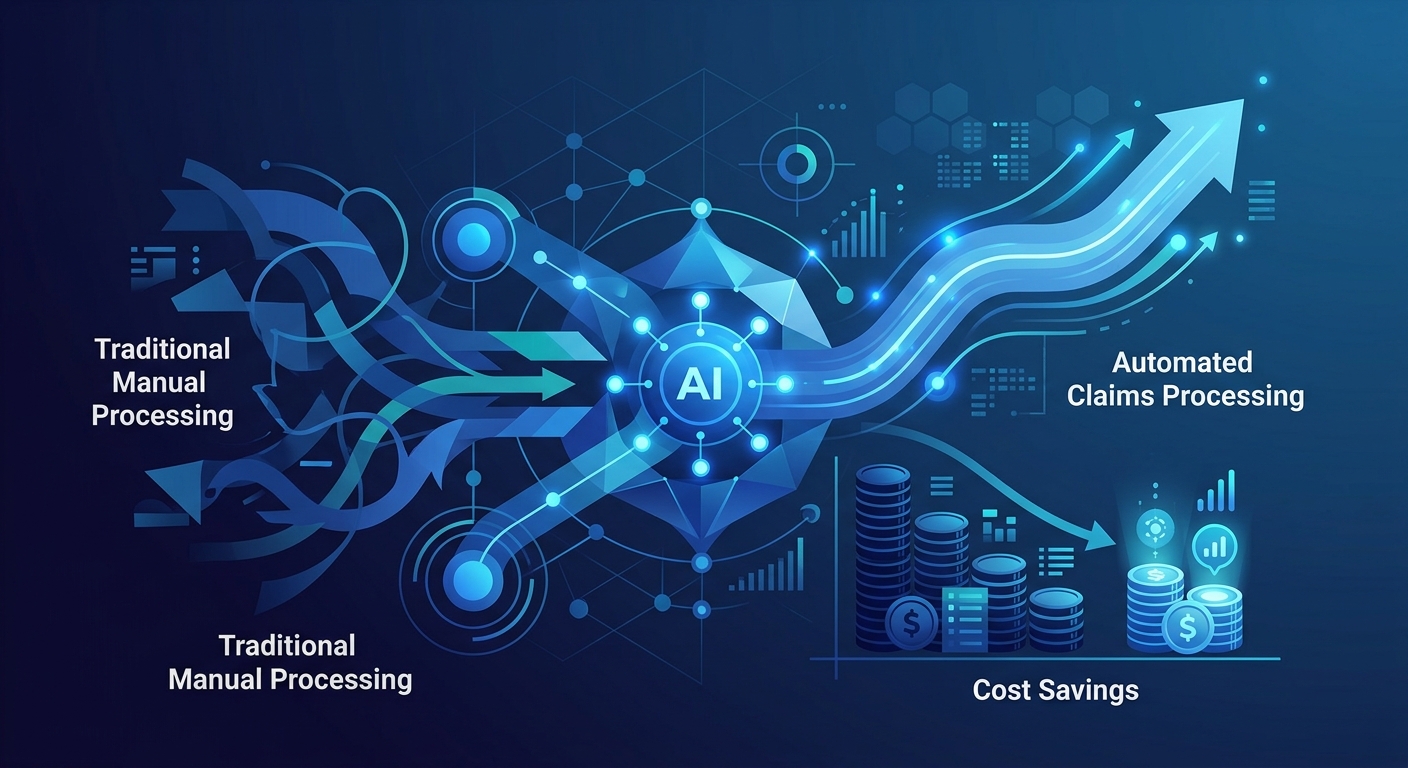
The insurance sector has reached a definitive inflection point. Artificial intelligence has moved beyond experimental sandboxes, and the mandate has shifted from exploration to execution. Insurers no longer ask whether AI can process claims; they demand auditable cost reductions and scalable throughput. At Meo, we deploy AI agents as an accountable workforce—replacing rigid labor overhead with dynamic, outcome-driven execution. This blueprint outlines how carriers can bypass pilot fatigue and implement an AI workforce business case that targets financial returns from day one.
The Economic Inefficiency of Legacy Claims Operations
Legacy claims infrastructure operates on a broken economic model. Carriers absorb escalating fixed labor costs while manual triage bottlenecks systematically drain operating margins. Every handoff between adjusters, document reviewers, and compliance officers introduces latency that directly impacts policyholder satisfaction and combined ratios. Beyond visible payroll, organizations hemorrhage capital through hidden expenditures: manual data entry errors, costly compliance rework, and delayed indemnity payouts that trigger bad-faith litigation. Despite these pressures, traditional approaches have stalled. While 83% of carriers allocate at least $5 million annually to AI investments, fewer than 15% report measurable improvements to combined ratio, cycle time, or loss ratios (Source: ADVISOR Magazine).
The primary bottleneck is legacy rule-based automation. RPA handles structured, repetitive tasks efficiently but fractures when processing unstructured documentation, ambiguous liability scenarios, or nuanced policy language. As claim complexity rises, brittle scripts require constant maintenance, eroding initial efficiency gains and compounding technical debt. The industry recognizes 2026 as the definitive transition from AI experimentation to enterprise production (Source: Insurance Thought Leadership), requiring architectures built for cognitive complexity—not simple task repetition.
Quantifying AI Automation Cost Savings Across the Claims Lifecycle
Real cost savings emerge when intelligent agents assume end-to-end ownership of high-friction workflows. At First Notice of Loss (FNOL), AI agents instantly parse multi-modal intake data—voice recordings, photos, police reports, and claimant statements—eliminating manual transcription and routing delays. In document processing, agentic systems extract, validate, and cross-reference coverage limits, medical invoices, and repair estimates with near-zero latency. Subrogation flagging, historically dependent on senior adjuster intuition, is now managed by agents that continuously analyze historical settlement patterns to identify high-probability recovery opportunities.
The financial impact compounds quickly. Compressing cycle times directly reduces Loss Adjustment Expenses (LAE) by curbing administrative overhead and mitigating inflationary repair costs. Early adopters resolve claims 75% faster while cutting overall processing expenses by 30–40% (Source: Vantage Point). Critically, AI architectures decouple processing volume from headcount expansion. Traditional operations require linear staffing increases during catastrophe events or seasonal spikes; intelligent agents scale elastically. By achieving up to 99% straight-through processing for standard claims, insurers transform claims departments from cost centers into predictable, high-velocity operational engines (Source: Roots AI).
AI Agent Total Cost of Ownership vs. Traditional Workforce Models
Calculating AI agent total cost of ownership requires shifting from traditional HR accounting to infrastructure economics. Legacy workforce scaling demands heavy upfront capital: recruitment fees, onboarding, continuous compliance training, and recurring benefits. These fixed costs persist regardless of claim volume, creating severe margin compression during low-activity periods. AI agents invert this model by converting static payroll liabilities into variable compute expenditures. Organizations pay strictly for the processing power required to execute specific tasks, with infrastructure costs scaling directly to transaction volume.
This structure eliminates turnover drag. The 18–24 month ramp-up for new adjusters disappears when digital workers are deployed instantly, fully trained, and operationally consistent. Agents operate continuously without fatigue, shift differentials, or seasonal attrition, maintaining uniform decision quality across all time zones. Predictable infrastructure spend aligns directly with claim complexity and throughput. Instead of forecasting annual headcount and absorbing the risk of inaccurate projections, carriers gain granular visibility into per-claim compute costs. This transparency enables precise margin modeling and ensures processing efficiency correlates directly with technological investment. Moving from pilot to production demands a complete rethinking of cost structures to capture the full value of agentic AI (Source: Blott).
Structuring the AI Workforce Business Case: Pay-for-Performance
The primary barrier to enterprise AI adoption is risk allocation. Traditional software procurement forces carriers to absorb all financial exposure: upfront licensing, implementation costs, and internal resource allocation, regardless of performance. At Meo, we dismantle this speculative model by structuring the AI workforce business case on a strict pay-for-performance framework. Clients transition from purchasing software licenses to acquiring measurable operational outcomes.
Under our contractual model, investment is tied exclusively to successfully processed, accuracy-verified claims. If an agent fails to deliver the defined output, the client incurs zero financial liability for that transaction. This risk-mitigated approach targets ROI by aligning vendor incentives directly with carrier profitability. We agree executive-level outcome thresholds in the statement of work: minimum accuracy rates, strict regulatory compliance, and target cost-per-claim reductions. These are contractual obligations backed by continuous agent monitoring and quality assurance protocols, not aspirational targets. By shifting capital expenditure to performance-based operating expenditure, CFOs and COOs can model AI deployment with absolute financial predictability. This structure transforms AI from an experimental IT initiative into an accountable, self-funding operational asset. For carriers seeking to eliminate vendor risk while securing measurable efficiency gains, our pay-for-performance model provides the contractual architecture required to scale confidently.
Executing the AI Agent ROI Blueprint in Enterprise Environments
Deploying autonomous claims agents in mature enterprise environments requires architectural discipline, not disruptive overhauls. Execution begins with phased integration that connects seamlessly with existing core systems, including legacy policy administration platforms, CRMs, and claims management software. Rather than rip-and-replace, AI agents function as interoperable layers, consuming APIs and routing structured outputs directly back into established workflows.
Initial deployment centers on executive dashboards that provide real-time visibility into agent productivity, decision transparency, and direct financial impact. These control centers allow leadership to track straight-through processing rates, exception volumes, and cumulative LAE reductions against baseline metrics. Once confidence and accuracy thresholds are validated, operations scale from controlled pilots to fully autonomous, self-optimizing workflows. Advanced agents continuously ingest settlement data, regulatory updates, and adjuster feedback to refine decision logic without manual reprogramming. This iterative optimization ensures operational velocity and financial returns compound over time. By anchoring deployment in rigorous implementation standards and maintaining strict compliance guardrails, carriers achieve enterprise-grade reliability. Organizations prepared to transition from legacy friction to automated precision can leverage our proven implementation methodology to ensure seamless integration, deploying specialized claims processing agents engineered for complex insurance workflows.
Conclusion
The era of speculative AI pilots is over. Carriers that continue treating automation as an experimental IT project will lose market share to competitors deploying AI as an accountable, scalable workforce. By adopting an outcome-driven, pay-for-performance structure, Meo eliminates deployment risk while tying fees to measurable reductions in claims overhead and loss adjustment expenses. The financial blueprint is proven, the infrastructure is enterprise-ready, and the ROI is contractually secured. Assess your operational readiness and deploy a risk-free AI workforce that delivers immediate, auditable financial returns.