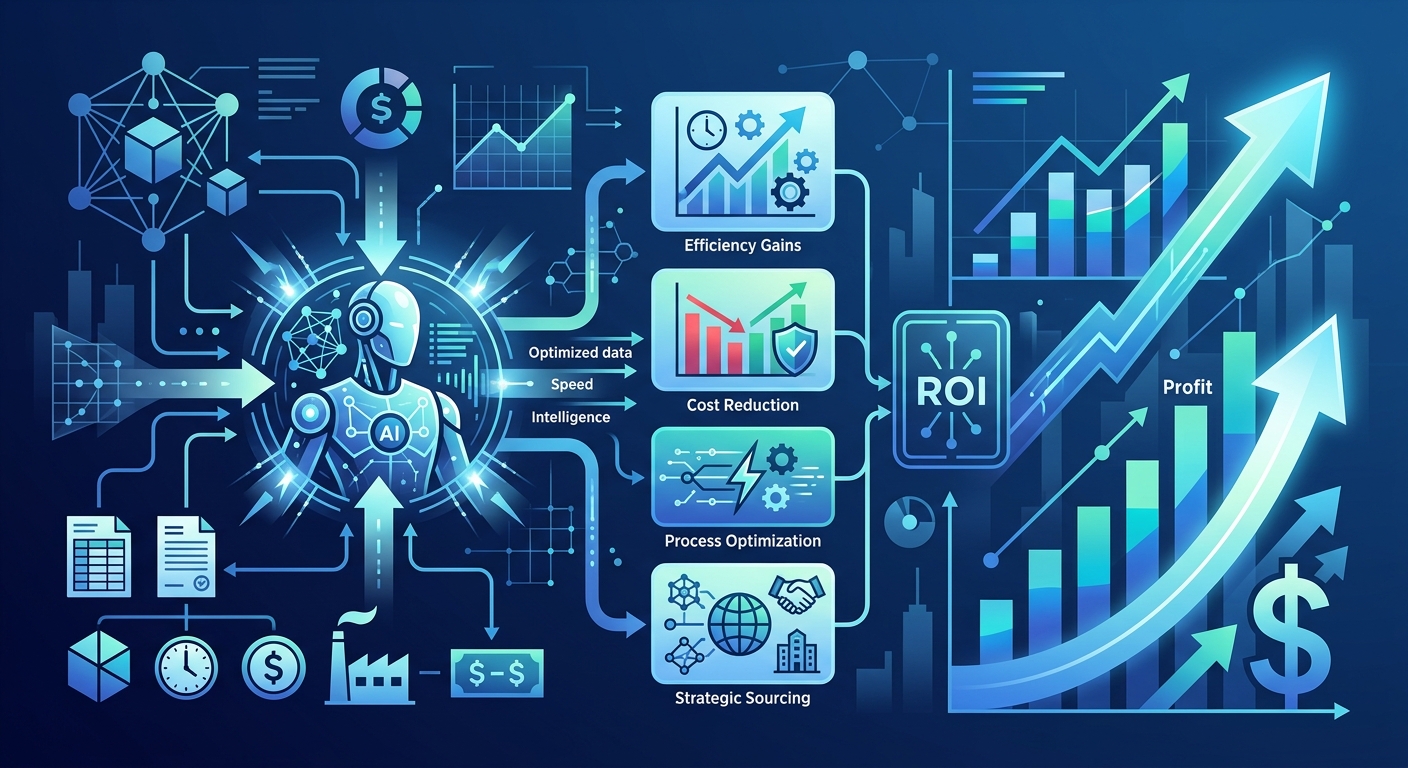
Enterprise procurement is shifting from static automation to autonomous AI agents that function as a scalable, accountable workforce. For CFOs and procurement executives, the priority is no longer justifying software subscriptions. It is quantifying how AI agents replace labor overhead and target measurable financial outcomes. This framework replaces speculative IT spending with a pay-for-performance operating model. By treating AI agents as measurable capital, organizations can accurately calculate ROI, capture automation savings, and build a workforce business case aligned with board-level financial targets.
Why Traditional Procurement Metrics Fail AI Workforce Evaluation
Legacy procurement tools rely on per-seat licensing and robotic process automation (RPA) that track activity volume rather than business impact. Counting processed purchase orders or automated approvals fails to capture how autonomous AI agents operate. Unlike static software, agents make contextual decisions, adapt to policy shifts, and directly influence financial outcomes. Evaluating them through legacy metrics obscures their true value. Executive teams must transition to outcome-based KPIs: cycle-time compression, exception-resolution rates, and direct labor displacement. Modern CFOs do not measure clicks saved; they measure fully burdened payroll replaced and working capital accelerated. Aligning ROI calculations with labor-overhead replacement eliminates speculative productivity claims and focuses exclusively on financial leverage. This positions AI as a strategic capital lever, not an operational cost center.
Deconstructing AI Agent Total Cost of Ownership
Accurate TCO calculations require moving beyond headline model-inference costs. Direct expenses include compute, orchestration, system integration, and enterprise security controls. However, indirect costs determine scalability: adoption curves, human-in-the-loop oversight, continuous monitoring, workflow redesign, and vendor governance. Many ROI models fail by omitting these variables. To establish a true baseline, total AI costs must be benchmarked against fully loaded FTE expenses. A fully burdened employee costs significantly more than base salary when factoring recruitment, onboarding, benefits, training, turnover, and management overhead. When deployed with clear operational boundaries, AI agents eliminate the variable costs and scaling friction of human labor. At meo, we map TCO directly against displaced payroll, ensuring every deployed dollar yields predictable returns rather than operational drag.
Quantifying AI Automation Cost Savings & Value Capture
The financial impact of autonomous procurement agents extends well beyond headcount reduction. Direct savings emerge from compressing high-volume workflows: contract review cycles accelerate by 60–80%, while purchase-order routing and invoice exception handling see immediate throughput gains LeahAI. These efficiencies reallocate procurement professionals to strategic supplier negotiations. Beyond direct savings, value capture accelerates through maverick-spend elimination, early-payment discount optimization, and dynamic working-capital management. AI agents continuously audit pipelines, flagging policy violations before financial leakage occurs. Risk mitigation delivers hard-dollar preservation. Automated compliance tracking helps teams avoid penalty costs averaging $15,000–$50,000 per incident LeahAI. Automating routine vendor inquiries and internal procurement support yields approximately $36,000 in annual labor savings per workflow Darwin AI. When agents proactively optimize spend categories and flag supply-chain disruptions, organizations routinely achieve up to 75% operational cost reduction across targeted processes Agentra. Quantifying both direct labor displacement and indirect leakage prevention delivers a holistic value assessment that legacy automation cannot match.
The Calculation Framework: AI Agent ROI Formula
Financial modeling requires disciplined application of a standardized ROI formula adapted for autonomous workforces:
ROI = [(Net Value Realized − Total Agent Cost) ÷ Total Agent Cost] × 100
Accuracy depends on a rigorous pre-deployment baseline. Organizations must document current task completion times, error rates, and the fully loaded salary of personnel managing each workflow before introducing AI agents StackAI. Post-deployment, track the performance delta to isolate agent-driven impact. This methodology removes estimation bias and anchors ROI to auditable operational shifts. meo’s pay-for-performance pricing model eliminates upfront capital risk by tying investment directly to verified outcomes. Clients fund deployments only after agents deliver measurable reductions in cycle time, error rates, or labor spend. This structure ties payback to verified results while aligning vendor incentives with client profitability. The formula transforms from a retrospective accounting exercise into a real-time performance dashboard, enabling procurement leaders to defend capital deployment with board-ready financial returns.
Structuring a Board-Ready AI Workforce Business Case
Securing executive approval requires framing autonomous procurement agents as operational leverage, not experimental IT. A defensible business case begins with a phased deployment strategy. Enterprise-wide rollouts obscure attribution and increase integration risk. Targeted pilot workflows, by contrast, deliver rapid wins and establish verifiable baselines. Each phase must operate under strict accountability SLAs, with defined success thresholds, rollback protocols, and continuous optimization cycles. Financial narratives should explicitly contrast the predictability of pay-for-performance AI deployment against the volatility and fixed overhead of traditional hiring. By positioning agents as scalable, outcome-priced capital, procurement leaders shift the discussion from cost-center expansion to margin protection. Grounding the business case in hard-dollar savings, risk mitigation, and working-capital acceleration aligns procurement automation with broader corporate financial strategy. When the narrative centers on transparent TCO, verified outcomes, and direct labor replacement, scaling from pilot to enterprise becomes a matter of financial logic, not technological speculation.
Conclusion
Calculating AI agent ROI is no longer an academic exercise; it is a financial imperative. By replacing legacy software metrics with a pay-for-performance operating model, procurement organizations can trade unpredictable labor overhead for accountable, measurable outcomes. At meo, we tie every deployment to delivered business results, eliminating capital risk and ensuring continuous value capture. Ready to transform procurement into a high-leverage, outcome-driven function? Contact our executive solutions team to build a customized AI workforce business case aligned with your financial targets.