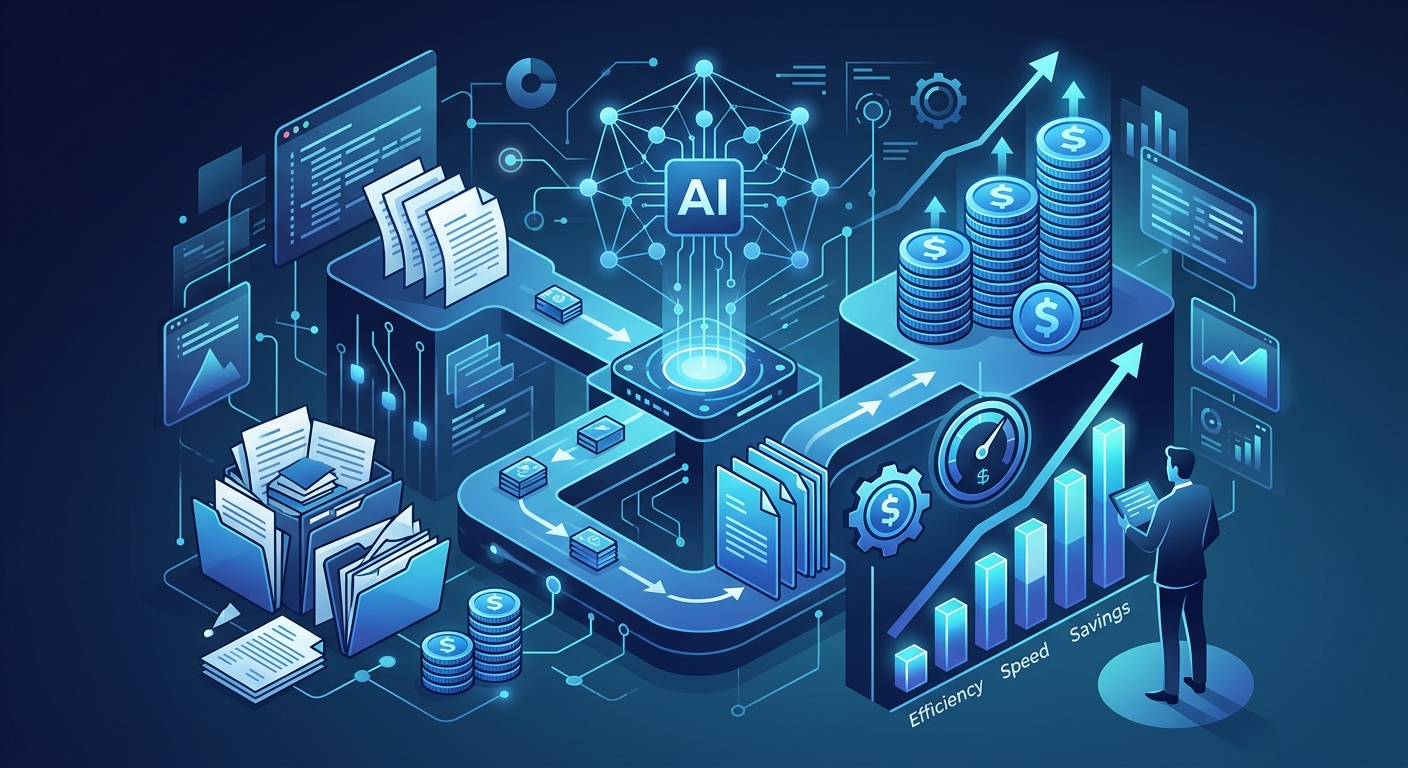
Insurance carriers face a structural margin squeeze. Rising claim volumes, complex regulatory requirements, and legacy labor models have inflated operational costs while eroding policyholder experience. The industry’s traditional remedies—incremental hiring and fragmented software patches—no longer scale. At meo, we drive a fundamental shift by deploying autonomous AI agents as a scalable, accountable workforce. This guide details how carriers can accurately quantify AI automation savings, transition from speculative efficiency projects to outcome-driven systems, and secure executive approval through a pay-for-performance model that eliminates upfront financial risk.
The Hidden Overhead of Traditional Claims Processing
Manual First Notice of Loss (FNOL) intake, triage, and rework cycles drain carrier margins in ways that rarely appear on standard P&L reports. Adjusters and operations staff routinely spend up to 40% of their capacity navigating disconnected legacy systems, transcribing unstructured documents, and correcting routing errors. This friction compounds as claim complexity increases and catastrophe events drive volume spikes. Legacy Robotic Process Automation (RPA) and rule-based engines initially promised relief but consistently fail against real-world, unstructured claims data. They lack cognitive reasoning, break when workflows deviate from rigid scripts, and demand expensive, ongoing maintenance to manage edge cases. Industry research confirms that carriers must replace fragmented, manual workflows with structured, traceable systems that accelerate processing and drastically reduce human intervention Nurix AI. When overhead scales linearly with claim volume, traditional labor models become financially unsustainable and directly compress combined ratios.
Redefining AI Automation Cost Savings: From Task Efficiency to Outcome Delivery
Historically, carriers justified technology investments through speculative headcount reductions—a flawed metric that ignores training lag, knowledge transfer, operational disruption, and the reality that automation rarely eliminates entire roles. True AI cost savings are measured by verified outcomes: compressed cycle times, sub-1% error rates, audit-ready documentation, and strict regulatory compliance. Autonomous AI agents replace fragmented point-solution stacks with a unified, accountable workforce capable of real-time reasoning, adaptation, and self-correction. Unlike static software, these agents execute claims tasks end-to-end, from FNOL intake and document validation to routing, coverage analysis, and settlement support. Market data validates this trajectory: the global insurtech sector is projected to reach $23.5 billion by 2026, with AI-driven claims automation delivering 75% faster resolution and 30–40% operational cost reductions VantagePoint. At meo, we anchor AI ROI directly to these metrics, ensuring technology investments yield verifiable bottom-line impact rather than theoretical efficiency gains.
The Executive Formula for AI Agent ROI
Accurate AI ROI calculation requires abandoning vanity metrics and anchoring valuation to hard operational financials. The executive formula centers on three core levers: processing cost per claim, error remediation reduction, and strategic FTE reallocation. For example, deploying an AI agent to autonomously handle 80% of routine claims generates approximately $36,000 in annualized labor savings per 1,600-claim cohort Darwin AI. This capital is either preserved in avoided hiring or strategically reinvested into complex litigation management, fraud detection, and policyholder retention. This financial clarity makes pay-for-performance pricing a strategic differentiator. Traditional SaaS models demand steep upfront licensing, implementation fees, and multi-year contracts, regardless of output or accuracy. meo inverts that risk: carriers pay only when agents deliver verified results against predefined SLAs. By tying vendor compensation to successfully processed claims, accuracy thresholds, and compliance adherence, AI transforms from a speculative capital expenditure into a predictable, variable operating cost that scales precisely with demand.
AI Agent Total Cost of Ownership vs. Legacy Labor Models
Evaluating AI agent Total Cost of Ownership (TCO) demonstrates why autonomous workforces outperform traditional staffing models across a three- to five-year horizon. Legacy labor carries substantial hidden costs: recruitment expenses averaging 15–20% of annual salary, ongoing benefits administration, compliance training overhead, and productivity dips during turnover. AI agents eliminate these fixed liabilities through transparent TCO structures that cover deployment, continuous compliance auditing, model optimization, and elastic scaling during catastrophe spikes—eliminating the friction of overtime and temporary staffing. Leading carriers now prioritize predictable, performance-linked economics over rigid, capacity-constrained software licensing Layerup. Additionally, AI agents neutralize legacy integration debt by connecting natively to existing policy administration systems, customer portals, and third-party data ecosystems without costly middleware SCNsoft. The result is an agile cost structure that absorbs market volatility while maintaining service quality and regulatory compliance.
Structuring an AI Workforce Business Case That Secures Approval
Securing board and C-suite approval requires replacing speculative efficiency narratives with quantifiable, risk-managed deployment frameworks. Successful carriers execute phased rollouts aligned with established claims KPIs, regulatory guardrails, and corporate risk thresholds. Phase one targets high-volume, low-complexity claims to establish baselines for straight-through processing, accuracy, and cycle-time reduction. Subsequent phases scale into complex triage, subrogation analysis, and multi-channel communications, with each stage gated by strict performance audits and compliance reviews. The business case must emphasize measurable outcomes: reduced Loss Adjustment Expenses (LAE), improved combined ratios, and higher policyholder Net Promoter Scores (NPS). By framing AI agents as an accountable, pay-for-performance workforce rather than an experimental IT initiative, carriers de-risk adoption, directly align technology spend with margin protection, and secure long-term operational profitability.
Conclusion
The era of speculative AI investments and unquantified labor overhead is over. Insurers that deploy autonomous, outcome-driven AI agents through a pay-for-performance model will systematically eliminate operational drag and secure predictable returns. Partner with meo to transform your claims operations from a reactive cost center into a scalable, margin-positive engine. Schedule an executive briefing to model your AI ROI and deploy an accountable, production-ready workforce.