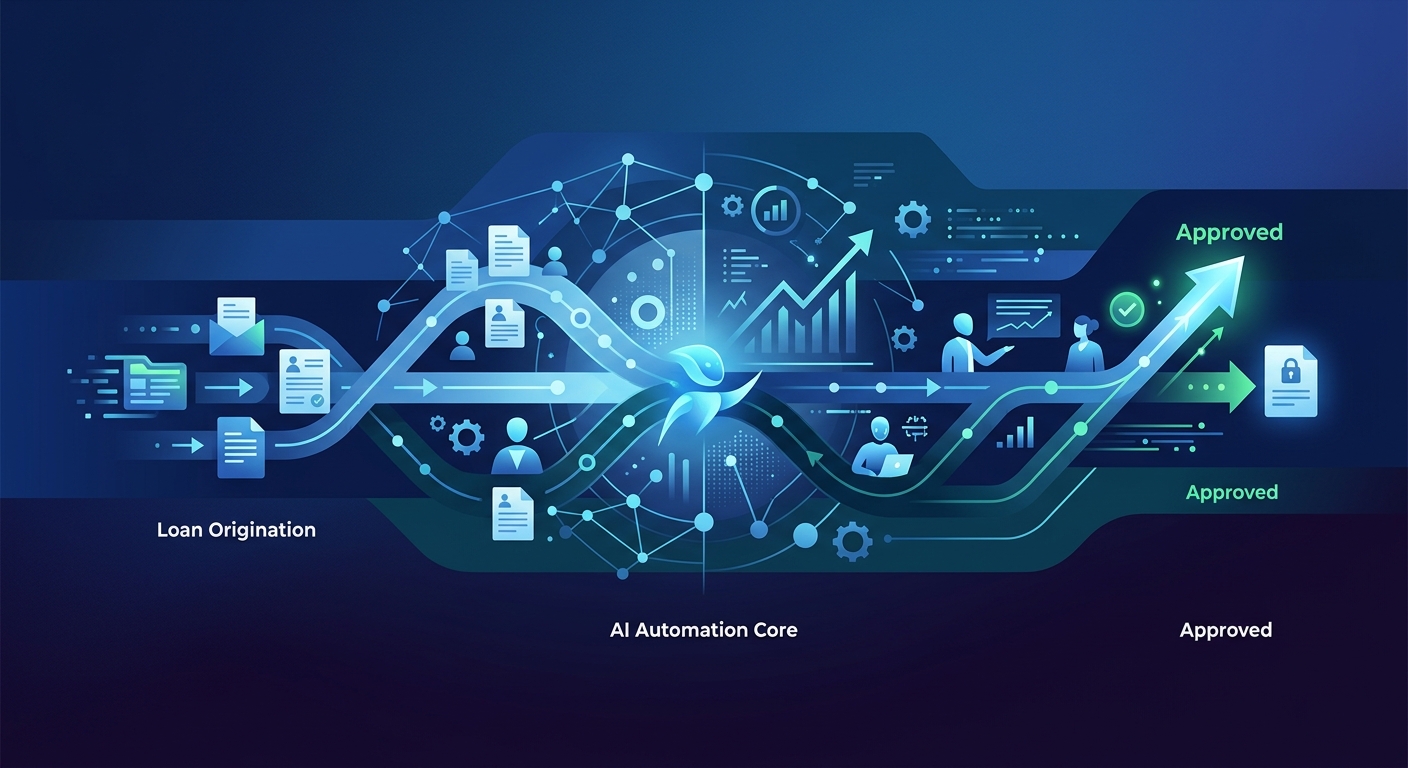
The modern enterprise cannot tolerate the latency and opacity of manual underwriting. As regulatory scrutiny tightens and borrower expectations accelerate, financial institutions must transition from fragmented, labor-intensive pipelines to autonomous, outcome-driven operations. meo deploys an accountable AI workforce that replaces speculative technology investments with measurable business results.
The Hidden Cost of Manual Origination and Legacy Automation
Traditional loan origination pipelines are structurally bottlenecked by manual data extraction, disjointed approval workflows, and heavy reliance on outsourced processing teams. These inefficiencies inflate operational overhead and extend decision cycles by days or weeks, directly eroding revenue velocity and borrower retention Intellectyx. Legacy Robotic Process Automation (RPA) and rule-based systems compound these challenges by failing to interpret complex, unstructured financial documents. When confronted with non-standard tax returns, handwritten addendums, or multi-format bank statements, rigid automation fails, triggering high exception rates and costly manual interventions aimonk.com.
Incremental software patches cannot resolve systemic latency. Financial leaders are shifting from experimental AI pilots to deterministic, outcome-driven agents that deliver production-grade accuracy and full auditability. Recent banking automation benchmarks show that autonomous agentic systems achieve 99.9% processing accuracy while reducing operational costs by up to 25% in high-volume environments Phacet. The strategic imperative is clear: institutions must eliminate speculative technology spend and replace rigid legacy workflows with an outcome-priced workforce that scales alongside portfolio growth.
How Enterprise AI Agents Redefine Loan Origination & Underwriting
Enterprise-grade AI agents function as an integrated orchestration layer, not isolated point solutions. From initial application intake and dynamic KYC verification to real-time credit risk modeling and final decision routing, these agents autonomously manage multi-step financial workflows with precision Intellectyx. Unlike legacy systems that halt for manual compliance reviews, AI-native underwriting platforms continuously validate regulatory requirements against live policy updates. They automatically generate immutable, regulator-ready audit trails without bottlenecking throughput.
This architecture is engineered for seamless, API-native integration with existing loan origination systems (LOS), core banking platforms, and third-party data vendors. Deployment requires minimal infrastructure changes, ensuring rapid time-to-value while preserving institutional data sovereignty. By deploying specialized Compliance & Risk Agents, institutions enforce real-time policy checks, dynamically adjust risk thresholds based on macroeconomic signals, and maintain strict adherence to evolving regulatory frameworks. The result is a frictionless underwriting pipeline where processing speed, analytical rigor, and compliance operate in continuous alignment.
Scaling Across the Portfolio: Insurance Automation and Claims Processing
The deterministic architecture transforming lending delivers identical value across the broader financial services ecosystem. Institutions are deploying the same foundational models to streamline policy issuance, automate adjudication, and accelerate claims processing. Insurance automation agents standardize complex, high-volume workflows by autonomously extracting policy terms, cross-referencing coverage limits, and executing subrogation logic without manual oversight. These systems resolve the inconsistent adjudication standards, documentation gaps, and delayed payout cycles that historically plague traditional claims handling.
Unifying lending and insurance operations under a single, scalable AI workforce strategy eliminates redundant vendor contracts and consolidates operational oversight. This cross-functional model enables institutions to leverage shared risk models, standardized compliance frameworks, and centralized performance tracking across all product lines. As enterprises adopt integrated Financial Services & Insurance automation strategies, they achieve substantial overhead reductions while improving customer satisfaction through faster, transparent resolutions. The architecture natively supports fraud detection, policy anomaly flagging, and automated reinsurer reporting, establishing a unified operational backbone that scales enterprise-wide.
The meo Advantage: Accountable AI on a Pay-for-Performance Model
Traditional enterprise software procurement is fundamentally misaligned with operational outcomes. Institutions routinely commit millions to upfront licensing, implementation fees, and annual maintenance contracts before verifying tangible ROI. meo eliminates this capital inefficiency with a strict pay-for-results pricing structure. Clients only pay when agents successfully process files, reduce cycle times, and maintain predefined compliance thresholds. This model is anchored to auditable, executive-grade KPIs, including cycle time reduction, regulatory accuracy, and verified cost-per-file processed.
Every deployment is monitored through centralized executive dashboards, providing full operational transparency. Leadership tracks agent performance, exception rates, and financial impact in real time. Through continuous optimization and rigorous Agent Monitoring & Quality Assurance, we keep performance aligned with evolving business objectives. Furthermore, the architecture is explicitly designed to prevent vendor lock-in, granting institutions full data ownership, modular configuration control, and the agility to scale or pivot as market conditions shift. By directly tying technology costs to delivered outcomes, meo transforms AI from a speculative capital expenditure into a predictable, profit-driving operational asset.
Strategic Implementation Roadmap for Regulated Institutions
Deploying autonomous agents in highly regulated financial environments demands a disciplined, phased methodology that prioritizes data sovereignty, model governance, and regulatory alignment. meo’s implementation framework begins with a secure, sandboxed integration that maps existing workflows, validates data pipelines, and establishes compliance guardrails before live deployment. This structured approach ensures that Data Integration & Setup aligns seamlessly with institutional risk tolerances, internal audit protocols, and external mandates.
Concurrent with technical deployment, we execute comprehensive workforce transition planning. Rather than displacing institutional knowledge, we systematically redeploy experienced underwriters, claims adjusters, and compliance analysts into high-value advisory roles, complex exception handling, and strategic relationship management. This human-in-the-loop optimization preserves critical expertise while eliminating repetitive, low-margin tasks.
ROI is measured from day one through rigorous stress-testing of agent decisions against historical underwriting and claims datasets, ensuring deterministic accuracy before enterprise-wide scaling. Once baseline performance meets contracted KPIs, proven configurations deploy systematically across regional branches and product verticals. The architecture leverages a unified control plane for centralized governance, continuous model refinement, and real-time policy updates aimonk.com. By adhering to this compliance-first roadmap, regulated institutions achieve rapid, auditable automation while maintaining full operational control, strategic agility, and measurable financial performance.
The era of speculative AI pilots and labor-intensive underwriting is over. meo delivers an accountable, pay-for-performance AI workforce that replaces manual overhead with verified, measurable outcomes across loan origination and insurance operations. Explore our pay-for-performance model to deploy your first outcome-priced agent and transform your financial operations.