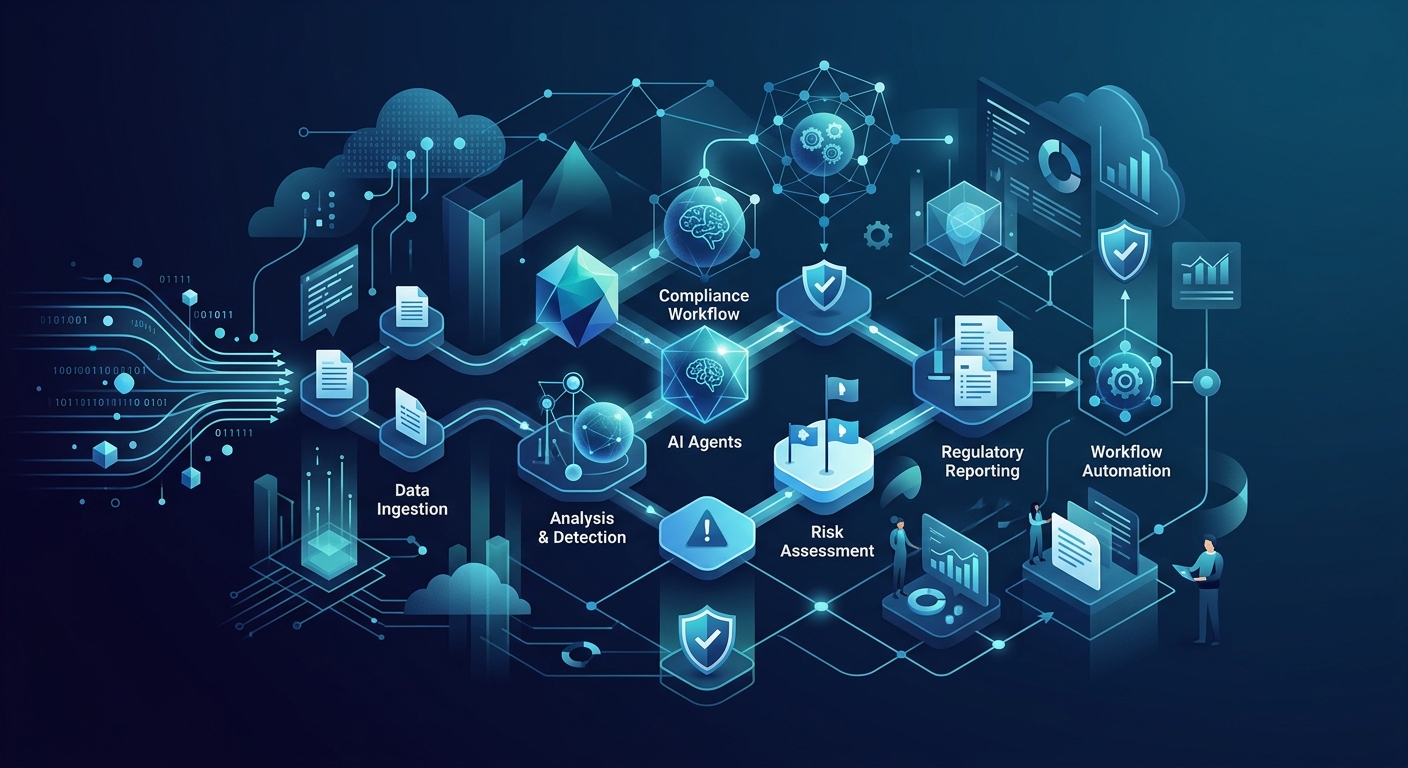
TL;DR Summary: Traditional financial compliance relies on expensive manual processes and rigid legacy systems that cannot scale with modern regulatory demands. Autonomous AI agents transform compliance into an outcome-driven workforce that operates 24/7, integrates natively with existing platforms, and delivers auditable decision logs. Through a pay-for-performance deployment model, financial institutions replace fixed overhead with measurable, SLA-backed compliance throughput.
Key Points:
- Manual compliance and legacy systems create unsustainable overhead, regulatory exposure, and operational bottlenecks.
- Autonomous AI agents execute continuous AML/KYC monitoring, claims adjudication, and audit logging 24/7 without human fatigue.
- meo’s pay-for-performance model ensures organizations only invest when predefined compliance KPIs and accuracy thresholds are consistently met.
Manual compliance can no longer sustain modern financial operations. Accelerating regulatory mandates and compounding transactional complexity have pushed legacy compliance models past their breaking point. The traditional approach—scaling headcount to match compliance volume—has reached its structural limit. The solution is an autonomous, outcome-driven AI workforce engineered specifically for financial and insurance regulatory workflows. At meo, these are not experimental software deployments. They are performance-driven operational units that convert fixed labor overhead into measurable, auditable outcomes.
How do AI agents transform financial compliance workflows?
AI agents replace manual, error-prone compliance processes with autonomous, 24/7 operational units that continuously monitor transactions, verify documentation, and maintain immutable audit trails. By shifting from fixed labor overhead to a pay-for-performance model, organizations gain scalable, auditable compliance that ties fees to measurable regulatory outcomes.
The Compliance Bottleneck in Financial Services
Manual compliance workflows generate unsustainable overhead and exponentially increase regulatory exposure across banking, wealth management, and insurance. Analysts spend 60–80% of their working hours on repetitive data reconciliation, document validation, and exception triage. These tasks offer zero strategic value while consuming substantial operational budgets. When reviewers fatigue under volume pressure, error rates climb and regulatory exposure compounds Digiqt.
Legacy rule-based systems compound this friction. Built for static environments, they cannot interpret evolving mandates, cross-border data rules, or dynamic AML thresholds without costly, months-long reconfigurations. These delays create temporary compliance gaps and operational bottlenecks Azilen. Institutions relying on manual processes and rigid architectures inevitably face slower time-to-market, inflated cost-to-serve metrics, and heightened audit scrutiny Beam Data. The constraint is no longer technological; it is operational. Financial leaders require an adaptive, autonomous layer that integrates with existing infrastructure without disruptive rip-and-replace initiatives.
How Autonomous Agents Redefine Compliance Operations
Autonomous AI agents operate as continuous, goal-driven units that execute monitoring, verification, and exception handling 24/7. Unlike traditional automation bound by static if-then logic, agentic systems dynamically parse regulatory updates, contextualize transaction patterns, and route exceptions only when human judgment is strictly necessary. This architecture ensures compliance throughput scales linearly with business volume, eliminating the need for proportional headcount expansion Smallest.ai.
Crucially, these agents integrate natively with core banking systems, legacy insurance platforms, and distributed data lakes. Secure APIs, webhooks, and zero-trust pipelines eliminate the data silos that force compliance teams to toggle across a dozen disconnected platforms. Manual handoffs between front-office intake, middle-office risk assessment, and back-office reporting are replaced by deterministic, traceable workflows. The result is a unified compliance fabric where onboarding data, trade surveillance logs, and claims documentation flow seamlessly through a single audit-ready pipeline Virtual Workforce.
Deployments yield immediate reductions in reconciliation lag and false-positive fatigue. Continuous state awareness enables agents to cross-reference historical customer behavior, regulatory updates, and real-time market signals simultaneously. This eliminates the latency that allows violations to slip through review gaps, shifting compliance from reactive reporting to proactive risk control Beam Data.
Core Applications: AML, KYC & Insurance Claims Automation
AI agents deliver immediate operational impact in high-volume, high-stakes domains. In AML and KYC workflows, agents continuously screen transactions against dynamic sanctions lists, politically exposed person (PEP) databases, and adverse media feeds. They autonomously verify corporate registries, beneficial ownership structures, and source-of-wealth documentation, generating structured compliance dossiers ready for regulatory submission. Continuous monitoring improves detection accuracy while eliminating the false negatives that trigger costly regulatory penalties Virtual Workforce.
In insurance, AI agents transform claims adjudication by embedding real-time fraud detection, policy validation, and coverage analysis directly into intake. Upon submission, agents instantly cross-reference policy terms, historical loss data, supporting documentation, and jurisdictional coverage limits. Suspicious patterns trigger automated escalation, while routine claims proceed through accelerated settlement pathways. Every decision is logged in an immutable, cryptographically verifiable audit trail, enabling regulators to reconstruct the exact compliance rationale behind any payout Digiqt.
Agents also standardize underwriting documentation and continuously track regulatory changes across state and federal jurisdictions. When new directives are issued, agents parse the text, map it to existing underwriting rules, and automatically generate impact assessments. This ensures continuous alignment without manual policy rewrites or delayed product launches. By automating document-heavy, rule-intensive processes, organizations accelerate cycle times while maintaining strict adherence to NAIC, SEC, and FinCEN standards Azilen.
The Accountability Shift: From Fixed Overhead to Measurable Outcomes
Traditional compliance outsourcing shifts payroll; it does not transfer liability. When institutions outsource AML monitoring or claims review to third-party providers, they retain ultimate regulatory accountability while losing direct visibility into execution. Human-driven teams remain vulnerable to training variance, turnover, and fatigue. This structural misalignment forces leaders to pay fixed overhead for unpredictable throughput.
Autonomous agents resolve this accountability gap by delivering auditable decision logs, quantifiable error-rate metrics, and strict SLA-backed performance guarantees. Every action an agent takes—whether approving a low-risk KYC submission or flagging complex structuring—is timestamped, version-controlled, and mapped to the exact regulatory citation that triggered the decision. This deterministic transparency enables internal audit teams to conduct real-time compliance reviews instead of retrospective sample testing.
Institutions replace fixed headcount expenses with variable, outcome-tied OpEx. Rather than funding FTEs for quarterly volume spikes, enterprises deploy an AI compliance workforce that scales elastically and bills only against verified throughput. If an agent fails to meet predefined accuracy thresholds, processing speeds, or regulatory alignment metrics, the organization does not pay. This performance-driven economic model aligns vendor incentives directly with enterprise risk management, transforming compliance from a cost center into a predictable operational asset Virtual Workforce.
Deploying a Pay-for-Performance AI Workforce
meo’s deployment model ties capital allocation directly to verified compliance KPIs and accuracy thresholds. We do not sell software licenses; we deliver operational outcomes. Before deployment, compliance leaders map target workflows to concrete metrics: adjudication cycle time, false-positive reduction, audit trail completeness, and regulatory alignment scores. These benchmarks form the foundation of our pay-for-performance contract structure.
Implementation follows a phased methodology designed to minimize disruption while establishing baseline performance. Phase one runs in calibration mode, processing live data alongside human teams to validate accuracy against historical benchmarks. Phase two introduces supervised autonomy, where agents handle routine tasks while routing complex exceptions to human reviewers. Phase three scales to fully autonomous operation, supported by continuous monitoring, automated regulatory updates, and real-time performance dashboards.
This structured rollout ensures the AI workforce scales in direct alignment with enterprise risk tolerance and growth targets. Compliance officers retain full governance through immutable audit logs, configurable rule parameters, and immediate override protocols. Tying investment to verified outcomes eliminates speculative technology spend and guarantees capital deployment only where measurable results are delivered Smallest.ai. The result is a resilient, scalable, and fully accountable compliance operation engineered for tomorrow’s regulatory landscape.
Conclusion
The era of scaling compliance through headcount expansion and legacy system patches is over. AI compliance agents represent a fundamental restructuring of operational economics, replacing fixed overhead with auditable, outcome-driven performance. By deploying through a pay-for-performance model, financial and insurance institutions accelerate processing times, eliminate manual bottlenecks, and guarantee regulatory alignment without speculative capital expenditure. At meo, we engineer systems to deliver measurable compliance throughput, not software promises. If your organization is ready to replace unpredictable labor costs with accountable, performance-backed automation, schedule a compliance architecture assessment with our deployment team today.