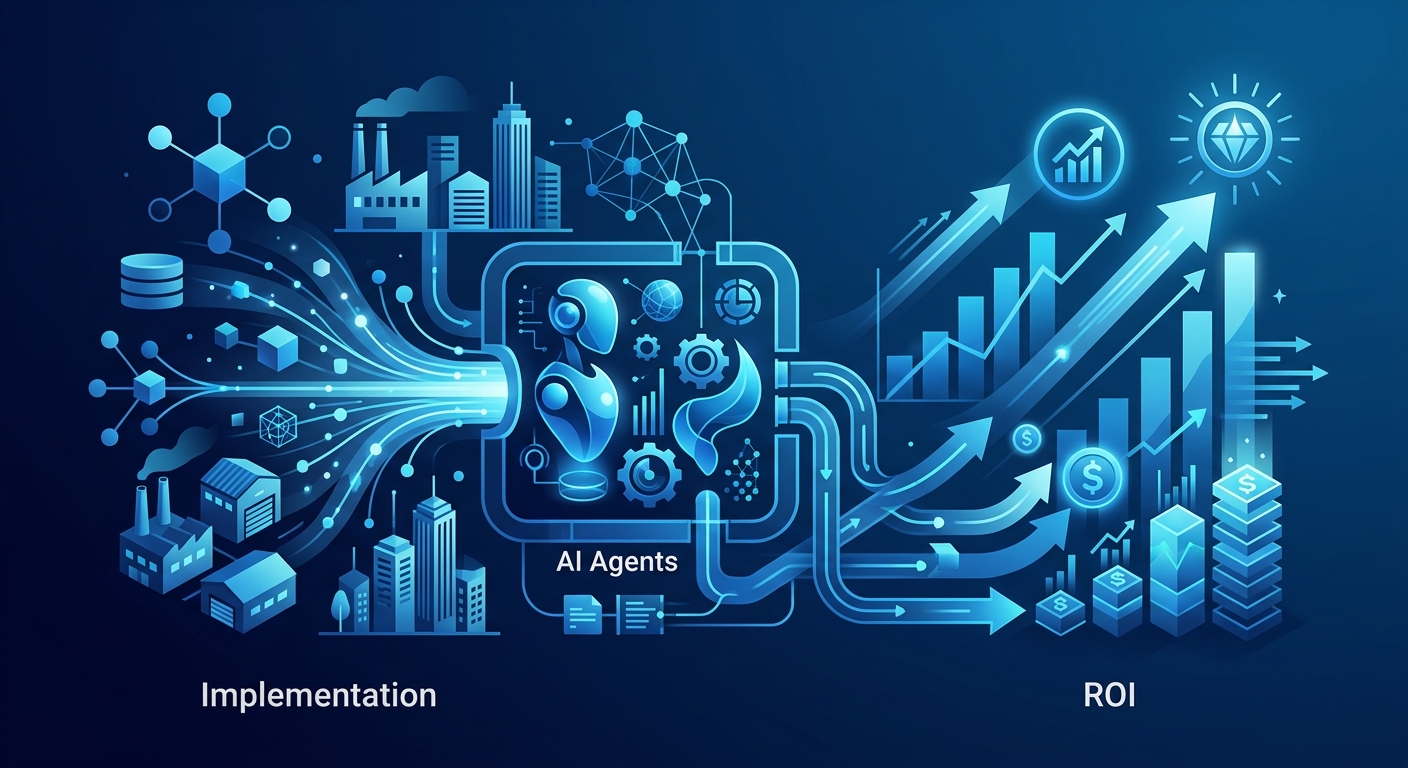
Commercial claims operations are constrained by fragmented workflows, manual data entry, and reactive staffing models. As loss ratios tighten and policyholder expectations accelerate, carriers and third-party administrators (TPAs) can no longer tolerate legacy bottlenecks. Deploying an accountable AI workforce transforms claims from a cost center into a precision-driven, outcome-priced function. Our pay-for-performance framework ensures these agents operate as production-grade resources—scaling only when verified business results are achieved, rather than serving as experimental IT pilots.
The Commercial Claims Imperative: Moving Beyond Legacy Workflows
Manual First Notice of Loss (FNOL) intake, document triage, and claims documentation create severe operational drag. Adjusters routinely spend 40–60% of their capacity on administrative overhead instead of complex loss evaluation, inflating cycle times and leakage risk. Industry analysis confirms that AI agents are restructuring insurance operations by automating high-volume, rule-bound tasks while elevating human expertise to exception handling and strategic decision-making AI Insurance Automation: Claims, Underwriting Agents 2026.
AI claims processing agents compress FNOL-to-triage cycles from days to near-real-time routing. By extracting structured data from unstructured loss reports, photographs, police narratives, and vendor invoices, these systems eliminate transcription errors and standardize initial reserving logic. The executive mandate is clear: transition from reactive headcount scaling during catastrophe events to an outcome-driven workforce architecture. Organizations that embed AI claims processing as a permanent operational layer achieve consistent throughput regardless of volume volatility Reimagining the Claims Processing Function with AI Agents.
Architecting an Accountable AI Workforce
Deploying financial services AI agents requires mapping commercial claims workflows to specialized, role-specific digital workers. A production-grade architecture deploys distinct agents for intake routing, policy coverage validation, multi-modal document extraction, and predictive loss reserving. Each agent operates within a strictly defined scope, executing deterministic logic while adapting to semi-structured commercial policy language.
Accountability is engineered into the architecture from day one. Deterministic guardrails prevent model hallucinations by restricting outputs to pre-validated coverage matrices and approved adjuster playbooks. Every action, data extraction, and routing decision generates an immutable audit trail, ensuring full reconstructability for internal quality assurance or external regulatory review. Crucially, human-in-the-loop escalation protocols are embedded at predefined confidence thresholds. High-severity losses, coverage disputes, and complex subrogation cases automatically route to senior adjusters, preserving expert judgment where it delivers the highest return.
Technical prerequisites center on secure API orchestration, legacy core connectivity, and enterprise-grade document parsing. Agents integrate seamlessly with existing claims management ecosystems, eliminating disruptive rip-and-replace projects. By establishing robust data integration and secure setup protocols, organizations maintain uninterrupted operations while onboarding automated workflows that sync with historical claim databases and real-time vendor portals.
Regulatory Compliance & Enterprise Integration
Commercial insurance operates within a stringent regulatory environment. State Department of Insurance (DOI) mandates, NAIC model regulations, and data sovereignty requirements demand transparent AI processing, explicit data lineage, and fully auditable decision-making. Security, compliance, and governance are foundational constraints, not deployment afterthoughts. Every automated pipeline maintains SOC 2 Type II and ISO 27001 certifications, operating within a zero-trust framework that enforces strict role-based access control and end-to-end encryption for sensitive policyholder data.
Enterprise integration prioritizes interoperability with dominant policy administration and claims platforms. Agents communicate natively with Guidewire ClaimCenter, Duck Creek, and legacy systems via standardized REST APIs and secure webhooks. Compliant AI orchestration ensures automated workflows adhere to jurisdictional data residency rules, automatically redacting PII where required and maintaining strict chain-of-custody logs for digital evidence. This architecture neutralizes the compliance friction that typically stalls AI initiatives, enabling carriers to deploy at scale without regulatory risk.
Structuring ROI & The Pay-For-Performance Model
Traditional AI procurement relies on speculative software licensing, shifting implementation risk entirely to the enterprise. We invert this paradigm by aligning investment directly to verified P&L impact. Before deployment, baseline KPIs are established: claims leakage reduction, adjuster hours reallocated to complex files, FNOL-to-settlement velocity, and fully loaded cost-per-claim. These metrics form the contractual foundation of the engagement.
Under the pay-for-performance framework, organizations only invest when agents deliver auditable business results. Insurance carriers deploying specialized claims agents have achieved $4.4 million in annual operational savings, 2.3-month payback periods, and autonomous resolution of 89% of routine inquiries AI Agents in Insurance: Automating Claims Processing at Scale | Insights - Ajentik - AI Healthcare Automation | Ajentik - AI Healthcare Automation. This model eliminates speculative technology spend and guarantees that every dollar deployed translates directly to measurable efficiency gains or loss mitigation.
By tying the AI workforce directly to commercial claims outcomes, finance and operations leadership gain complete budget predictability. Capacity scales dynamically with claim volume, while costs remain strictly bound to performance thresholds. Claims automation shifts from a capital expenditure gamble to a variable, outcome-verified operational asset.
Phased Deployment Roadmap & Change Management
Successful AI workforce integration follows a disciplined, risk-managed methodology. Phase one initiates shadow-mode validation, where agents process live claims in parallel with human adjusters to establish baseline accuracy and calibrate decision boundaries. Phase two transitions to supervised execution, with agents handling routine commercial lines autonomously while routing exceptions through predefined agent monitoring and quality assurance checkpoints. Final deployment enables autonomous routing with executive oversight, maintaining real-time visibility into throughput, leakage metrics, and compliance adherence.
Change management aligns claims leadership and adjuster teams to an augmented operating model. Rather than displacing expertise, agents absorb administrative friction, freeing senior adjusters to focus on complex loss engineering, coverage disputes, and retention strategies. Continuous optimization loops integrate adjuster feedback, recalibrate extraction models quarterly, and enforce strict performance auditing to ensure the workforce compounds in value over time.
Next Steps: Transitioning From Overhead to Outcomes
Transitioning commercial claims from labor-heavy overhead to a guaranteed-outcome model requires a structured starting point. Begin with a comprehensive claims maturity assessment to identify high-ROI automation candidates, prioritizing workflows with high volume, repetitive documentation, and measurable leakage exposure. Establish clear success thresholds tied directly to the pay-for-performance framework, ensuring strategic alignment across IT, claims operations, and finance.
Launch a capped-risk pilot with agreed outcome metrics and transparent reporting dashboards. By defining success upfront and removing speculative technology spend, carriers and TPAs can deploy a production-ready, scalable AI workforce without operational disruption. Contact our team to initiate your claims maturity assessment and establish a performance-verified deployment roadmap.