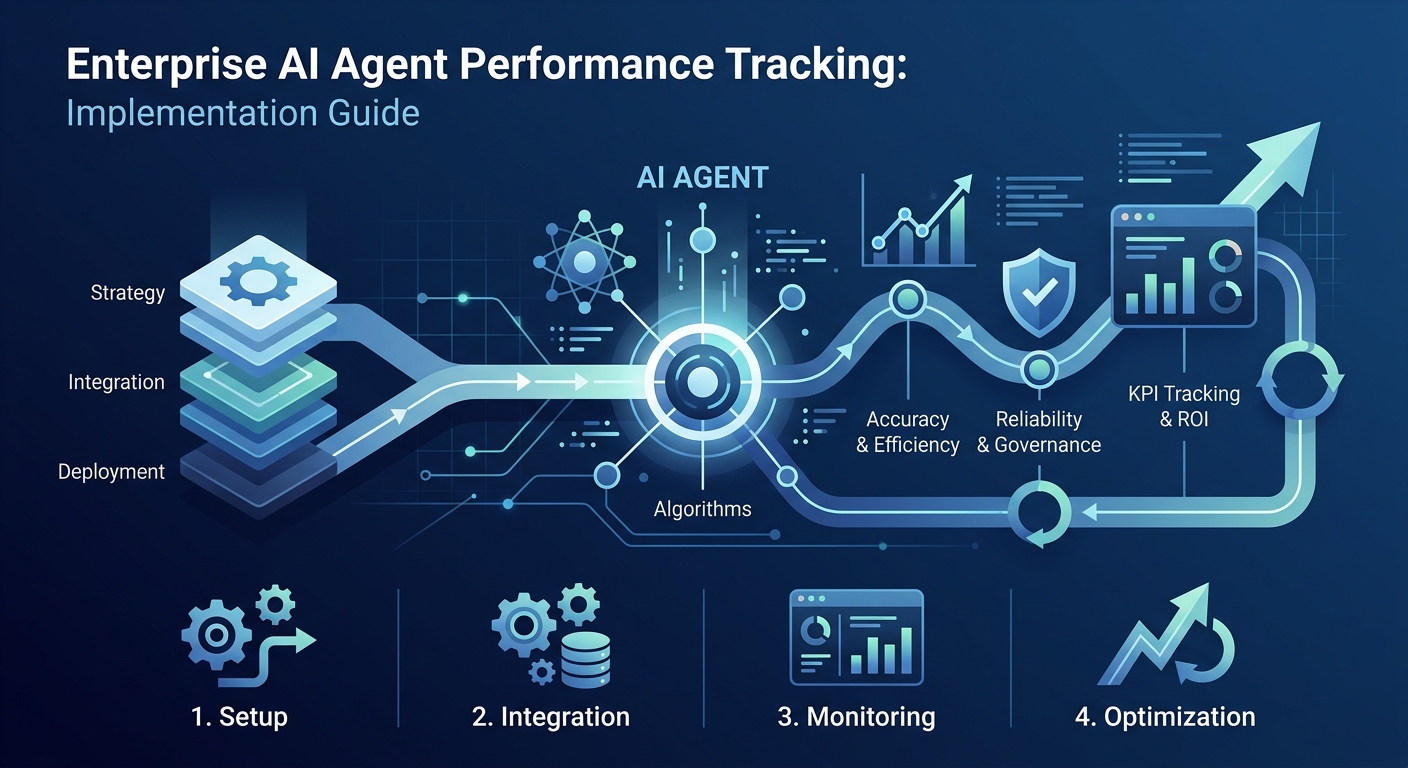
AI has transitioned from experimental technology to core operational infrastructure. Executive leaders now face a single mandate: replace unpredictable labor costs with an accountable, measurable digital workforce. This guide provides a structured implementation framework to transition AI agents from isolated pilots to production-grade performance engines. Treating agent tracking as a financial discipline establishes the transparent, auditable foundation required for outcome-based procurement and scalable ROI.
The Executive Case for AI Agent Performance Tracking
Exploratory AI pilots are obsolete. Enterprises that successfully scale automation evolve experimental deployments into accountable workforce units governed by strict financial boundaries. Legacy IT oversight models, which rely on manual audits and reactive troubleshooting, cannot support autonomous, high-throughput operations. These methods lack the continuous visibility required to manage operational risk or justify capital allocation.
Transparent performance tracking is a prerequisite for enterprise adoption, regulatory compliance, and financial accountability. Without rigorous, real-time observation, organizations cannot verify whether an agent delivers measurable business value or generates technical overhead. Establishing auditable tracking frameworks mitigates operational risk, aligns AI initiatives with corporate strategy, and creates the baseline required to transition from fixed software licensing to outcome-driven procurement. Organizations lacking structured oversight face deployment risks that proven tracking methodologies can reduce by up to 60% [1].
Defining Measurable KPIs for AI Agent Monitoring
Effective agent performance tracking requires abandoning vanity metrics like raw token counts or vague accuracy scores. Anchor evaluation frameworks directly to P&L-impacting business outcomes. Critical KPIs must include first-contact resolution rate, cost-per-task, compliance adherence percentage, and throughput velocity. These indicators determine whether an AI workforce reduces labor overhead or merely digitizes it.
Validate ROI by establishing baseline benchmarks against legacy human workflows. Quantifying the exact cost, cycle time, and error rates of manual processes reveals the precise efficiency delta generated by deployed agents. This comparative analysis converts abstract AI capabilities into tangible financial leverage.
Map technical telemetry directly to executive dashboards across four interconnected dimensions: technical execution, business impact, compliance and safety, and user experience [2]. Synthesizing these dimensions into unified reporting provides finance and operations teams with a single source of truth to dictate whether agent deployments scale, pause, or reconfigure.
Building Real-Time AI Agent Monitoring Infrastructure
Production-grade monitoring requires lightweight, continuous telemetry pipelines that observe operations without introducing latency. Synchronous logging frameworks degrade execution speed and inflate cloud infrastructure costs. Deploy asynchronous event-streaming architectures instead to capture decision paths, tool invocations, and output timestamps in real time.
Within this pipeline, deterministic guardrails and automated alert thresholds enforce governance. When an agent deviates from approved parameters, triggers a compliance flag, or exceeds error tolerances, the system must instantly route alerts to human operators or activate fallback protocols. Modern observability platforms now provide native visibility into decision chains and performance bottlenecks, enabling teams to isolate failures before they cascade [3].
Optimize telemetry sampling to balance granularity with system performance. High-throughput environments require dynamic sampling rates that adapt to workflow complexity. Prioritize high-signal events—such as policy violations, tool failures, or SLA breaches—while compressing routine execution logs. This architecture ensures monitoring scales linearly with agent volume without triggering proportional infrastructure overhead.
AI Workforce Quality Assurance & Continuous Feedback Loops
Scale AI workforces by redesigning quality assurance for autonomous operations. Deploy continuous automated audits for high-volume, rule-based workflows to eliminate manual review bottlenecks. Reserve human-in-the-loop validation exclusively for complex edge cases or scenarios where automated confidence scores fall below predefined thresholds.
Implement self-correcting prompt refinement cycles. When an agent fails or receives a low-confidence rating, the system should automatically log the failure context, generate optimized prompt variations, and test them in evaluation sandboxes prior to redeployment. Leading evaluation frameworks now support automatic issue clustering and generative performance assessments, drastically reducing the manual QA overhead traditionally required to maintain model accuracy [4]. These closed-loop systems generate compounding efficiency gains, transforming quality control from a cost center into a continuous performance accelerator.
Guaranteeing AI Output Reliability Across Enterprise Workflows
Reliability is engineered through strict governance and continuous validation, not assumed. The primary threats to consistency are model drift, contextual hallucination, and workflow fragmentation. Mitigate these risks through version-controlled prompt libraries and immutable workflow definitions. Track every prompt iteration, tool configuration, and decision tree as production code to enable instant rollback to validated states when performance degrades.
Multi-step processes require mandatory cross-agent consistency checks. Validate intermediate outputs for logical coherence and data integrity before passing them downstream. This chain-of-trust architecture prevents localized failures from corrupting broader business processes.
Reliability protocols must scale without triggering linear increases in QA staffing or infrastructure spend. Leverage automated evaluation suites and deterministic routing rules to maintain enterprise-grade reliability with flat marginal costs. The industry is rapidly shifting from isolated task automation to coordinated, outcome-driven systems where workflows operate as unified digital teams [5]. Baking reliability directly into the architecture eliminates post-deployment bottlenecks and ensures consistent execution at scale.
Aligning Agent Metrics with Pay-for-Performance Outcomes
Transparent, auditable tracking serves as the operational backbone of the pay-for-performance model. When performance data is immutable and directly tied to business KPIs, deployment risk transfers from the enterprise to the provider. Compensation shifts from speculative licensing fees and seat-based pricing to verified, measurable outcomes.
Structure enterprise SLAs around this framework through precise contractual alignment. Trigger compensation tiers based on verified metrics such as successful case resolutions, compliance adherence rates, and documented cost savings per workflow cycle. Enforce these SLAs through independent audit logs and shared real-time performance dashboards. This structure eliminates disputes over value delivery and aligns incentives around continuous optimization.
Transitioning from fixed licensing to results-driven procurement unlocks measurable capital efficiency. AI agent monitoring ceases to function as an IT compliance exercise and operates as a direct financial instrument. When tracking frameworks are mature, transparent, and rigorously enforced, AI agents transition from experimental overhead to accountable workforce partners. This model delivers predictable, auditable ROI that scales alongside business demand.
Ready to replace unpredictable labor costs with a measurable, accountable AI workforce? Contact MEO to deploy our performance-tracking framework and transition to an outcome-based pricing model.