Introduction
The enterprise AI landscape has shifted decisively from experimental pilots to mission-critical automation. Yet, organizations that deploy AI agents as unauditable black boxes risk operational fragility, compliance exposure, and unpredictable cost structures. Continuous AI agent monitoring is no longer a technical afterthought; it is the financial and operational backbone of scalable automation. At meo, we engineer monitoring architectures that convert probabilistic language models into deterministic, accountable workforce assets. By aligning real-time telemetry with strict pay-for-performance pricing, enterprises can systematically replace legacy labor overhead with measurable, auditable business outcomes.
The Executive Imperative for Continuous AI Agent Monitoring
Transitioning from experimental AI to a reliable, scalable workforce demands oversight that operates at machine speed and enterprise scale. Traditional human supervision models are fundamentally unscalable. Manual review introduces context-switching fatigue, inconsistent judgment, and severe bottlenecks that negate the efficiency gains of automation. When organizations rely on post-deployment audits or periodic sampling, they expose themselves to silent failures, compliance drift, and unquantified operational risk.
Automated telemetry replaces these fragile, human-dependent loops by enforcing deterministic guardrails and measurable accountability at every execution node. Embedding continuous observation directly into the operational layer grants enterprises immediate visibility into agent behavior, resource allocation, and decision accuracy. This architectural shift transforms monitoring from a reactive technical safeguard into a proactive financial control mechanism. When AI agents are governed as a formal workforce rather than experimental software, organizations can systematically mitigate operational risk, enforce regulatory compliance, and guarantee that every automated action directly advances bottom-line efficiency. Continuous oversight ensures predictable scaling without compromising enterprise standards or financial discipline.
Core Protocols for Real-Time Agent Observation & Intervention
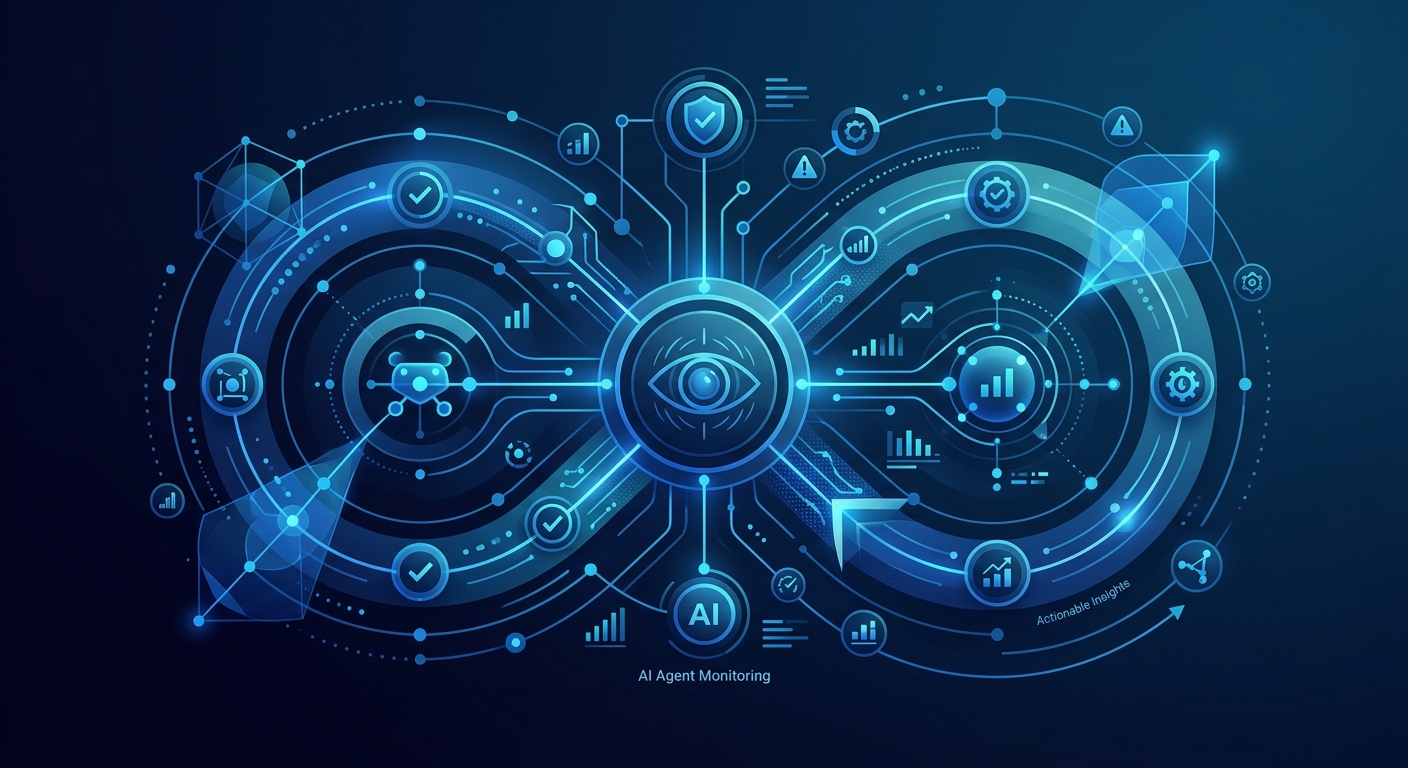
Effective monitoring requires a multi-layered telemetry architecture that captures the complete execution lifecycle. Robust observability begins with rigorous input validation to filter malformed requests and enforce strict data governance. It then advances to reasoning path analysis, where decision trees are traced step-by-step to verify logical consistency against enterprise rules. Finally, precise output execution tracking validates that generated actions align with intended operational parameters before reaching downstream systems.
To maintain stability at scale, automated anomaly detection continuously evaluates transaction patterns against established performance baselines. When deviations exceed configurable escalation thresholds, the system triggers immediate protocol adjustments—such as rate limiting, workflow rerouting, or parameter rollback—without disrupting broader operations. For complex, high-stakes scenarios, seamless human-in-the-loop handoffs are engineered directly into the orchestration layer. This hybrid intervention model guarantees that edge cases, novel compliance requirements, and mission-critical decisions receive executive-level validation. Routine operations proceed autonomously to preserve speed and throughput, while critical decision points maintain strict oversight. The protocol ensures uninterrupted continuity without sacrificing accountability or precision.
AI Workforce Quality Assurance & Output Reliability Frameworks
Quality assurance is the structural foundation of predictable enterprise automation. Deterministic validation pipelines must align explicitly with existing standard operating procedures (SOPs) and regulatory compliance frameworks to guarantee output reliability across high-volume, complex workflows. Static evaluation metrics fail in dynamic environments; therefore, continuous model drift detection and automated benchmark recalibration are mandatory. These systems monitor shifts in input distributions, output variance, and reasoning degradation, triggering dynamic prompt optimization loops before performance drops below acceptable thresholds.
meo’s QA frameworks embed evaluation metrics directly into production pipelines, eliminating latency between performance degradation and corrective action. By running parallel validation streams alongside live execution, organizations can instantly compare agent outputs against gold-standard reference datasets. This rigorous architecture ensures that AI agents consistently deliver enterprise-grade precision, converting probabilistic models into reliable, audit-ready operational assets. Whether processing thousands of customer interactions or executing complex supply chain optimizations, deterministic validation guarantees consistent reliability, strict compliance adherence, and zero tolerance for operational drift.
Agent Performance Tracking Tied to Measurable ROI
The financial viability of automated operations hinges on rigorous performance tracking. Granular execution metrics—including task completion velocity, first-touch resolution rates, resource consumption, and error frequency—must map explicitly to executive-level KPIs and direct revenue impact. Transparent, fully auditable dashboards provide leadership with real-time visibility into efficiency gains, labor cost displacement, and operational throughput. This precise value quantification is what enables meo’s strict pay-for-performance pricing model.
Enterprise leaders do not fund infrastructure speculation; they invest exclusively in verified business outcomes. When monitoring infrastructure directly correlates agent execution to measurable ROI, traditional capital expenditure models give way to transparent, results-driven partnerships. Every automated action is accounted for, every efficiency gain is quantified, and every investment is justified by auditable performance data. If an agent fails to meet predefined success thresholds, financial responsibility remains with the provider, not the client. This incentive alignment ensures continuous optimization, eliminates wasted automation spend, and transforms AI deployment from a cost center into a predictable profit multiplier.
Best Practices for Scaling a Governed AI Workforce
Scaling a governed AI workforce requires disciplined architecture from day one. Establishing executive oversight councils and defining clear, measurable Service Level Agreements (SLAs) upfront ensures that automation initiatives remain tightly coupled with strategic business objectives. Successful deployments follow phased implementation strategies, progressively expanding monitoring guardrails as agents demonstrate reliability across controlled environments. This iterative rollout minimizes operational disruption while generating the performance data required to refine protocols and recalibrate thresholds.
Integrating continuous observation directly into MLOps and CI/CD pipelines transforms monitoring from a post-deployment audit into a continuous improvement engine. As organizations mature their automation capabilities, forward-looking architectures enable fully autonomous operations that self-optimize, adapt to market shifts, and deliver compounding efficiency without proportional increases in human oversight. By institutionalizing iterative protocol refinement, enterprises future-proof their AI workforce against regulatory changes, data evolution, and emerging operational complexities. The result is a resilient, self-correcting automation ecosystem that scales predictably, delivers consistent ROI, and operates with uncompromising accountability.
Conclusion
Continuous AI agent monitoring is the operational and financial linchpin of enterprise automation. Without rigorous telemetry, deterministic validation, and outcome-aligned tracking, AI deployments remain experimental, costly, and unpredictable. meo’s monitoring architecture transforms AI agents into a scalable, accountable workforce where oversight directly correlates to measurable business results. By tying performance tracking to strict pay-for-performance pricing, we eliminate speculative investment and tie fees to the verifiable ROI of automated actions.
Ready to replace legacy labor overhead with measurable, auditable outcomes? Partner with meo to deploy a governed AI workforce backed by continuous monitoring, strict quality assurance, and a pricing model that pays only for proven results.