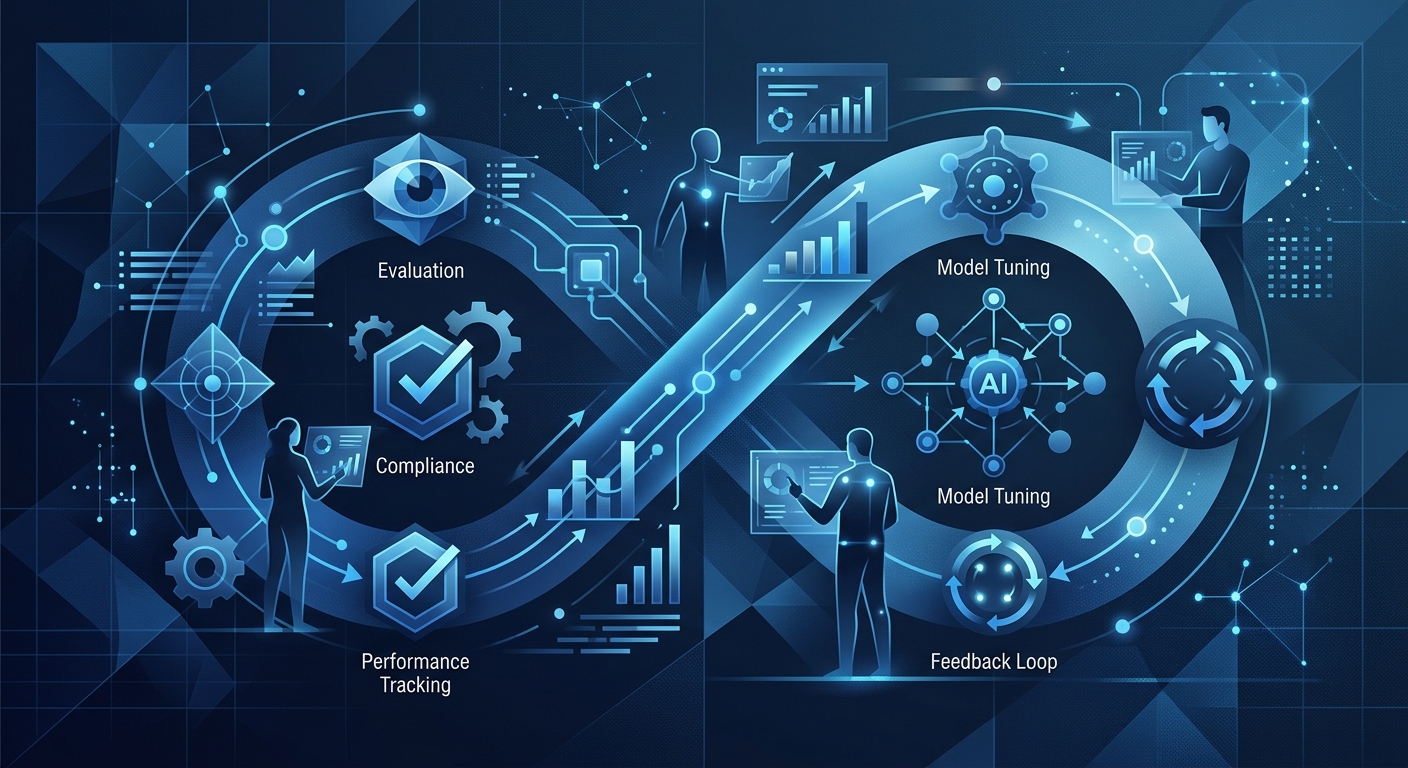
Deploying AI agents is no longer experimental—it is a strategic workforce transformation. Traditional quality assurance, built for deterministic software, fails against the probabilistic nature of generative AI. To replace legacy labor overhead with autonomous, outcome-driven operations, organizations require a continuous QA architecture that operates at business speed. This is not about safeguarding code; it is about commercial results.
At meo, we treat AI output reliability as a contractual obligation. Our continuous QA protocols convert autonomous agents into accountable, billable workforce assets. By embedding real-time validation, transparent oversight, and performance-aligned billing, we aim for every deployed agent to deliver measurable business value from day one.
The Executive Imperative for Continuous QA
Static testing cannot survive in dynamic, production-grade AI environments. Pre-deployment checklists ignore contextual drift, evolving data inputs, and complex reasoning chains. As organizations scale from pilot programs to enterprise deployments, the tolerance for error disappears. Autonomous agents managing customer escalations, financial reconciliations, or compliance audits cannot degrade silently. Governance must evolve from one-time approvals to continuous, lifecycle-spanning evaluation (State of AI Agents 2026).
Executives must shift from managing technology to managing outcomes. Continuous QA bridges experimental AI and scalable automation by enforcing strict operational thresholds. Quality becomes a live, measurable input tied directly to revenue, compliance, and risk. Without this foundation, scaling autonomous operations introduces unacceptable volatility. With it, organizations achieve the reliability required to retire costly legacy labor and scale predictably.
Real-Time Agent Monitoring & Observability
Operational control demands end-to-end workflow visibility. Modern AI agent monitoring tracks more than uptime or API latency; it requires granular insight into decision pathways, tool usage, and final outputs. Contemporary frameworks capture not just system metrics, but actual agent decisions, actions, and business outcomes in real time (AI Agents Monitoring Framework, 2026).
Our architecture enforces automated anomaly detection with instant escalation. If an agent encounters an edge case, breaches decision boundaries, or drops below confidence thresholds, the system triggers immediate fallback routines or human intervention. This prevents compounding errors before they impact revenue or compliance. Every interaction is cryptographically timestamped, creating an immutable audit trail for regulatory review and executive transparency. This oversight aligns directly with our Security, Compliance & Governance standards, eliminating operational black boxes. Real-time visibility converts uncertainty into scalable accountability.
Multi-Layer Quality Assurance Frameworks
Enterprise-grade AI reliability requires a dual-validation architecture. We deploy a hybrid QA framework that pairs deterministic rule engines with advanced LLM evaluators. Deterministic checks enforce hard boundaries—formatting, data integrity, and regulatory redlines. LLM evaluators assess semantic accuracy, contextual appropriateness, and reasoning coherence across complex workflows. This approach eliminates single points of failure and drastically reduces production hallucinations.
Strategic human oversight remains essential for high-impact scenarios. Rather than creating bottlenecks, our framework routes only low-confidence or high-stakes outputs to domain experts. This targeted intervention preserves human capital while maintaining rigorous standards. Critically, the system integrates continuous drift correction. AI performance degrades as business rules, market conditions, or data distributions shift. Our QA protocols automatically detect drift, triggering prompt optimization, retrieval-augmented generation (RAG) updates, and workflow recalibration. Agents adapt in real time, eliminating costly manual retraining cycles and ensuring consistent compliance across scaling deployments.
Performance Tracking & KPI Alignment
Technical metrics lack commercial context without financial alignment. Effective agent performance tracking maps execution data—task completion time, error frequency, and resolution accuracy—directly to operational and revenue targets. We configure executive dashboards that translate complex AI telemetry into clear business intelligence: accuracy rates, throughput volumes, and cost-avoidance trajectories.
Crucially, AI output should be benchmarked against legacy baselines and established SLAs. If a manual claims process historically required four hours and 92% accuracy, the AI agent is measured against—and expected to exceed—both metrics. Leadership can instantly quantify time savings, quality improvements, and ROI. This granular tracking validates investment while identifying optimization opportunities across the AI agent ROI and business case spectrum. By tying execution to financial outcomes, performance tracking shifts from retrospective reporting to predictive resource allocation, making it possible to test how autonomous operations compare with traditional staffing models.
QA as the Commercial Engine for Pay-for-Performance
At meo, continuous QA is the commercial foundation of our Pay-for-Performance Model. Verified quality data does not sit in dashboards; it triggers billing. When an agent executes a workflow within predefined accuracy and compliance thresholds, the system automatically validates and invoices the outcome. This creates absolute incentive alignment: clients pay only for verified business results, shifting costs from fixed labor overhead to verified operational outcomes.
Traditional staffing charges for hours, regardless of output quality. Our QA-driven billing charges exclusively for successful, auditable results. As organizations scale, they bypass recruitment, training, attrition, and management expenses. The QA protocol acts as a commercial gatekeeper, ensuring every billed unit represents verified value creation. By decoupling cost from headcount and linking it to performance, enterprises gain unprecedented financial agility. This architecture proves AI agents are not cost centers—they are revenue-generating, outcome-delivering workforce assets.
Conclusion
Continuous quality assurance bridges the gap between AI experimentation and enterprise-grade workforce transformation. By embedding real-time monitoring, multi-layered validation, and performance-aligned tracking into every deployment, organizations can confidently replace legacy labor costs with autonomous, outcome-driven operations. At meo, our protocols are designed to keep AI output reliable, transparent, and directly tied to your bottom line.
Ready to deploy an autonomous workforce that funds itself through verified results? Schedule a strategic Agentic Readiness Assessment to transform your operational economics.