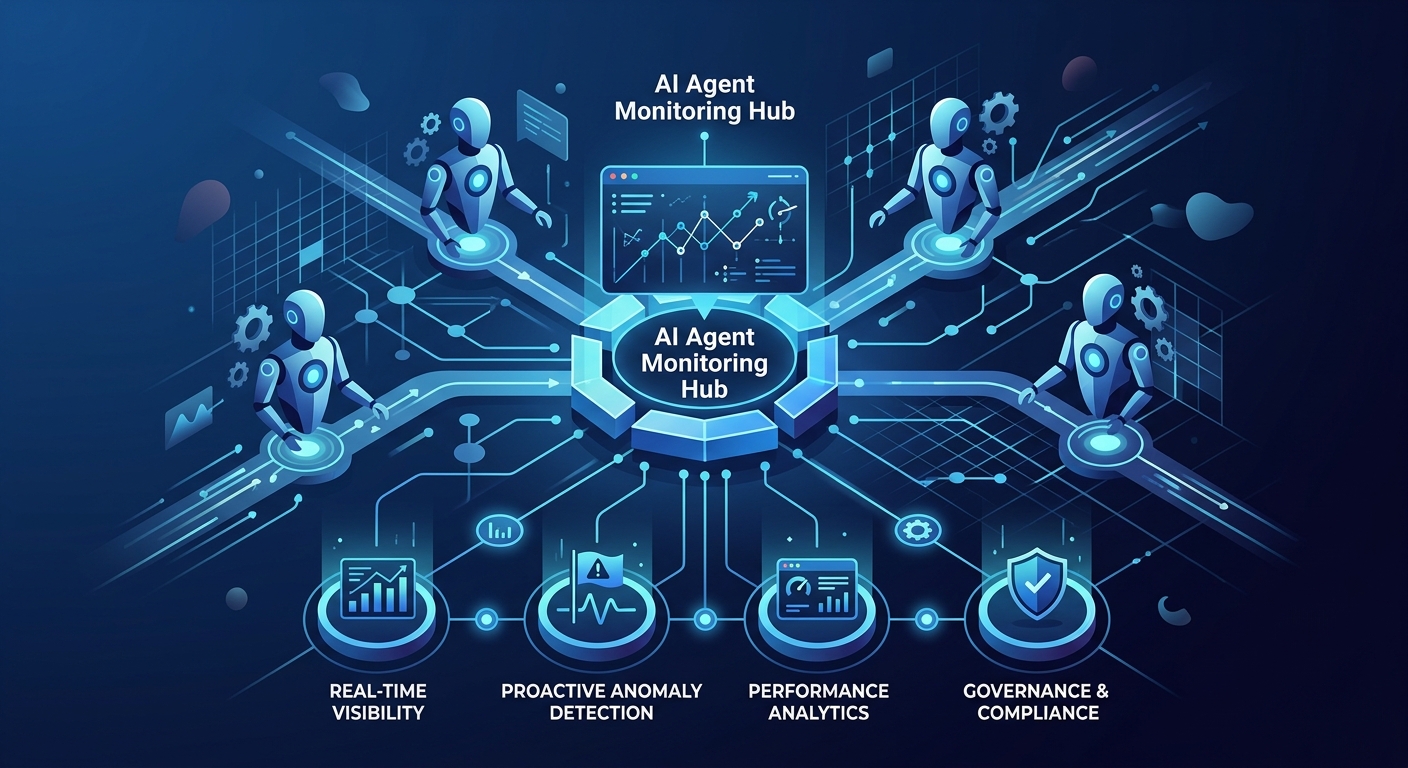
Autonomous AI workforces have transitioned from experimental pilots to core operational infrastructure. However, many enterprises still evaluate these systems using legacy IT metrics—uptime, server load, and request latency—which fail to capture operational reality. AI agents do not merely execute code; they reason, make decisions, and drive business processes. Treating them as static software obscures semantic drift, compliance vulnerabilities, and revenue leakage. At meo, we operate on a foundational principle: AI agents constitute an accountable workforce, and their monitoring must directly reflect business outcomes. This evolution is not optional. It is the prerequisite for scalable, pay-for-performance AI deployment.
The Executive Imperative: Shifting from Uptime to Outcome Tracking
Traditional IT monitoring fails autonomous AI workforces because it prioritizes infrastructure health over decision quality. A system can maintain 99.9% uptime while consistently producing inaccurate, non-compliant, or financially detrimental outputs. Executive leadership must redefine success by anchoring metrics to tangible business outcomes: first-contact resolution rates, cost-per-task, and regulatory compliance. Engineering accountability directly into the monitoring architecture transforms scaling from a liability into a predictable operation. Organizations that pivot from reactive debugging to outcome-based tracking can deploy agent fleets with precision, converting probabilistic models into deterministic business value.
Architecting an Enterprise-Grade AI Agent Monitoring Framework
Enterprise-grade monitoring requires multi-layered telemetry that spans the agent’s cognitive and operational lifecycle. Teams must establish comprehensive visibility across reasoning pathways, tool-execution logs, and final output generation to capture complete workflow context Uptime Robot. These technical signals must map directly to operational KPIs and compliance mandates, converting raw metrics into SLA adherence scores and audit-ready compliance markers. Automated escalation protocols are equally critical. When agents exceed error thresholds, process ambiguous inputs, or trigger policy violations, the system must immediately route tasks to human supervisors or predefined fallback workflows. This architectural rigor ensures monitoring functions as an active control layer, not a retrospective reporting tool.
Operationalizing AI Workforce Quality Assurance
Effective AI quality assurance requires continuous evaluation loops that assess semantic accuracy and contextual alignment in real time. Replacing sporadic manual audits with automated scoring engines ensures every output aligns with brand standards, data privacy requirements, and procedural guidelines. Advanced observability platforms facilitate causal tracing and automated issue clustering, enabling teams to isolate performance degradation at the prompt, tool, or reasoning layer before it reaches end users Braintrust. Autonomous validation must integrate with strategic human-in-the-loop oversight for complex scenarios and high-stakes decisions. Concurrently, every interaction must generate immutable, timestamped audit trails. This documentation framework satisfies regulatory mandates and internal governance, converting opaque AI processes into transparent, auditable operations.
Tracking Agent Performance for Measurable ROI
Tracking agent performance for measurable ROI requires aligning technical dashboards with departmental objectives and enterprise financial targets. Executives should prioritize metrics such as revenue captured, permanently resolved support cases, and administrative hours reclaimed over generic accuracy scores. At meo, we enforce this through pay-for-performance triggers: investment occurs only when agents deliver verified, contractually bound outcomes. This model requires rigorous attribution modeling to isolate AI-driven results from baseline human activity. By benchmarking efficiency gains against legacy labor costs—recruitment, training, benefits, and management—organizations can quantify the precise cost differential of an AI workforce. Enterprises adopting outcome-aligned tracking consistently achieve 30–40% reductions in operational overhead while accelerating time-to-value Cloud AI Trends. The result is a self-funding, scalable workforce where every completed task compounds ROI.
Guaranteeing AI Output Reliability in Mission-Critical Workflows
Ensuring AI output reliability in mission-critical workflows requires dynamic guardrails and real-time constraint enforcement. Static rule sets cannot adapt to evolving operational environments; enterprises must deploy validation engines that continuously cross-reference outputs against live compliance thresholds, data classification protocols, and core business logic. When confidence scores dip below established baselines, automated fallback mechanisms and redundancy protocols activate immediately, preserving continuity and preventing costly errors from reaching production. Historical telemetry further functions as a predictive asset. By monitoring degradation patterns—such as context limit saturation, API latency fluctuations, or seasonal volume shifts—engineering teams can preemptively recalibrate parameters or initiate targeted retraining ZBrain. This proactive methodology transforms reliability from reactive troubleshooting into engineered certainty.
Implementation Roadmap: From Baseline Deployment to Continuous Optimization
Successful implementation follows a phased, risk-managed roadmap designed for seamless integration within existing enterprise architectures. Initial deployments should target high-volume, low-risk workflows to establish baseline telemetry and validate interoperability with legacy ERP, CRM, and data systems Latitude. Organizations must then benchmark these results against industry standards and internal historical data to accurately calibrate performance expectations. Subsequent refinement cycles drive continuous optimization: expanding agent scope, tightening operational guardrails, and integrating edge-case learnings. Each iteration compounds model accuracy while systematically reducing marginal costs. Over time, this disciplined methodology transitions AI monitoring from a maintenance function into a sustained competitive advantage.
Conclusion
AI workforce quality assurance has evolved from a technical prerequisite into the operational foundation of enterprise scalability. Transitioning from legacy uptime metrics to outcome-driven accountability enables organizations to deploy autonomous agents with precision, transparency, and measurable ROI. At meo, we do not license software; we deliver verified business outcomes through a strict pay-for-performance framework. To replace legacy labor overhead with an accountable, self-optimizing AI workforce, contact our enterprise solutions team. Let us architect your monitoring infrastructure and deploy your first outcome-priced agent fleet.