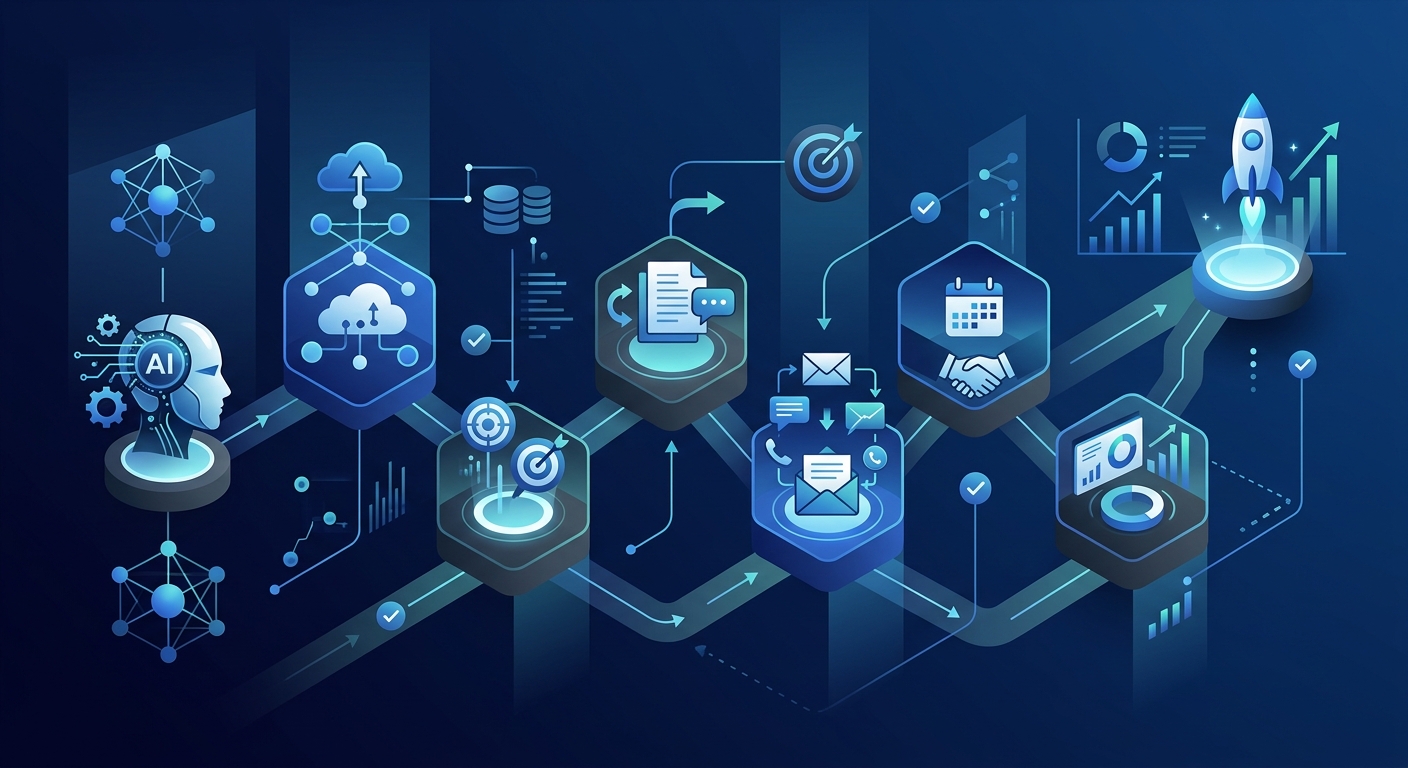
Deploying an autonomous sales development function is no longer an IT experiment; it is a strategic capital allocation decision. Leading revenue organizations are rapidly shifting from rigid, fixed-cost headcount models to agile, outcome-driven AI workforces. By replacing labor overhead with measurable pipeline generation, executives can scale outreach capacity without linearly scaling payroll. This checklist provides a disciplined, step-by-step framework for deploying AI sales agents that operate as an accountable, pay-for-performance extension of your revenue engine.
1. Pre-Deployment Infrastructure & Data Readiness
AI agents perform only at the level of the data they consume and the systems they inhabit. Before activating autonomous workflows, revenue leaders must enforce strict data hygiene and architectural readiness. Audit your CRM to eliminate duplicate records, standardize field taxonomy, and establish deterministic lead routing rules. Poor data routed through an AI pipeline accelerates forecast inaccuracy and wastes compute cycles; clean data ensures precise attribution and reliable forecasting.
Next, map comprehensive API integrations across your existing tech stack. Modern AI lead qualification agents require bi-directional, real-time synchronization with your CRM, email platform, calendaring system, and cloud dialer. Native integrations prevent data silos and ensure every prospect interaction is instantly logged, enriched, and actioned (Leading Native AI SDR Agents for 2026). Verify webhook stability, implement automated retry logic, and enforce data governance protocols to maintain compliance during automated enrichment.
Finally, establish baseline conversion metrics before authorizing AI activity. Document current human SDR benchmarks: email open rates, reply rates, meeting show rates, and SQL-to-opportunity conversion velocity. These baselines serve as control variables for validating ROI. Without historical benchmarks, you cannot justify the transition from fixed labor to variable, outcome-based spend. Treat this phase as the foundational audit that determines whether your AI workforce will scale profitably or stall operationally.
2. Defining Operating Parameters & Success Metrics
Autonomous deployment requires strict operational guardrails, not open-ended experimentation. Configure precise Ideal Customer Profile (ICP) boundaries, firmographic filters, and buyer persona triggers that dictate exactly who qualifies for outreach. Equally critical are automated disqualification rules. AI agents must be programmed to recognize negative intent signals, budget mismatches, and non-ICP attributes early in the sequence, preventing wasted resources on low-probability prospects (Top 5 Autonomous SDR Agents of 2026).
Engineer compliance and risk mitigation directly into the outreach cadence. Implement automated frequency caps, timezone-aware sending windows, and dynamic opt-out management aligned with TCPA, CAN-SPAM, and GDPR regulations. Messaging frameworks should enforce brand consistency while enabling real-time personalization based on prospect intent data. Establish strict data privacy protocols to ensure all prospect information is encrypted, access-controlled, and retained according to enterprise security standards.
Most critically, tie deployment milestones to pay-for-performance KPIs. Shift evaluation from activity volume to revenue-impacting metrics: cost-per-qualified-meeting, pipeline velocity, and meeting-to-opportunity conversion rate. When AI agents are measured against the same economic outcomes as human representatives, the transition from overhead to strategic investment becomes mathematically transparent. This alignment transforms AI sales agents into a true revenue-generation workforce that scales only when it delivers measurable business value.
3. Training, Simulation & Human-in-the-Loop Calibration
An AI agent’s contextual intelligence is built through deliberate data ingestion and iterative refinement. Seed the model with historical win/loss transcripts, email archives, and objection-handling playbooks from your top-performing representatives. This training corpus enables the AI to recognize nuanced buying signals, industry-specific terminology, and stakeholder dynamics that foundational models miss. Properly calibrated AI agents can automate 80–90% of traditional SDR tasks, operating continuously without degradation in output (AI Agents for Sales: Automate Your Pipeline in 2026).
Despite high automation rates, a human-in-the-loop architecture remains non-negotiable for complex enterprise deals. Establish clear escalation protocols where the AI seamlessly delegates multi-threaded negotiations, compliance inquiries, or customized pricing discussions to human account executives. Handoffs must be frictionless: the agent should summarize historical context, surface key objections, and schedule the transition directly within the CRM. This hybrid model preserves deal velocity while ensuring high-stakes conversations receive expert oversight.
Before authorizing full-scale autonomous deployment, execute controlled A/B tests across segmented prospect cohorts. Compare AI-generated sequences against human benchmarks on reply quality, meeting acceptance rates, and sentiment scoring. Use these trials to calibrate tone, optimize send timing, and refine disqualification logic. Transition to unsupervised operation only when the AI consistently meets or exceeds human performance thresholds across statistically significant sample sizes. This disciplined calibration phase eliminates guesswork and guarantees predictable revenue impact.
4. Go-Live Execution & Real-Time Pipeline Orchestration
Autonomous sales development must never be deployed as a single, enterprise-wide toggle. Execute a phased cohort rollout, beginning with low-risk, high-volume segments to isolate performance variables and maintain operational continuity. Activate the AI against a single geographic region or product line first, allowing your team to monitor system behavior, validate routing logic, and resolve edge cases before expanding to broader markets.
Once the initial cohort stabilizes, automate end-to-end pipeline orchestration. The AI should manage prospect identification, multi-channel outreach, meeting scheduling, and CRM enrichment without manual intervention. When a prospect accepts an invitation, the agent must instantly sync calendar details, assign the correct account owner, and trigger pre-meeting intelligence briefs. This zero-touch workflow eliminates administrative friction, accelerates response times, and ensures every qualified lead enters the pipeline within minutes of intent capture.
Real-time visibility is mandatory for executive accountability. Deploy live operational dashboards tracking qualification accuracy, response latency, bounce rates, and meeting show rates. Correlate these metrics with pipeline contribution and cost-per-meeting to validate economic efficiency. When dashboards demonstrate consistent alignment between AI activity and revenue outcomes, scale the autonomous function across adjacent territories and product lines with predictable, compounding returns.
5. Optimization, Accountability & Scaling the AI Workforce
Deployment is not a finish line; it is the baseline for continuous revenue optimization. Implement closed-loop feedback mechanisms that route closed-won revenue data back into the AI’s training architecture and prompt libraries. When deals close, analyze which messaging frameworks, outreach channels, and qualification thresholds drove success. Iterate prompts weekly, refine ICP triggers, and retire underperforming sequences. This continuous feedback loop ensures your AI agents systematically improve predictive accuracy and revenue contribution.
Financial accountability requires rigorous unit economics analysis. Compare the fully loaded cost of human SDRs—salary, benefits, management overhead, attrition, and ramp time—against the variable, outcome-based cost of your AI agents. When AI delivers equivalent or superior qualified meetings at a fraction of the fixed cost, the strategic advantage is definitive. This pay-for-performance model converts sales capacity from a rigid expense into a flexible, scalable investment.
Finally, replicate proven deployment frameworks across adjacent revenue functions. Once autonomous SDRs consistently hit cost-per-qualified-meeting targets and accelerate pipeline velocity, apply the same architecture to customer onboarding, account expansion, and churn prevention. By standardizing your AI deployment playbook, you build a compounding revenue engine that scales horizontally without incremental operational risk. Organizations that master this systematic approach will permanently outpace competitors reliant on linear, headcount-driven growth.
Conclusion
The transition from traditional sales development to autonomous, AI-driven revenue operations is a structural shift, not a tactical upgrade. By treating AI agents as a performance-accountable workforce rather than a software experiment, revenue leaders eliminate fixed overhead, accelerate pipeline velocity, and tie every dollar spent directly to measurable outcomes. Follow this checklist to deploy with precision, maintain strict operational guardrails, and scale only when results justify the investment. Partner with Meo to architect your autonomous revenue workforce and transition to a true pay-for-performance sales model today.