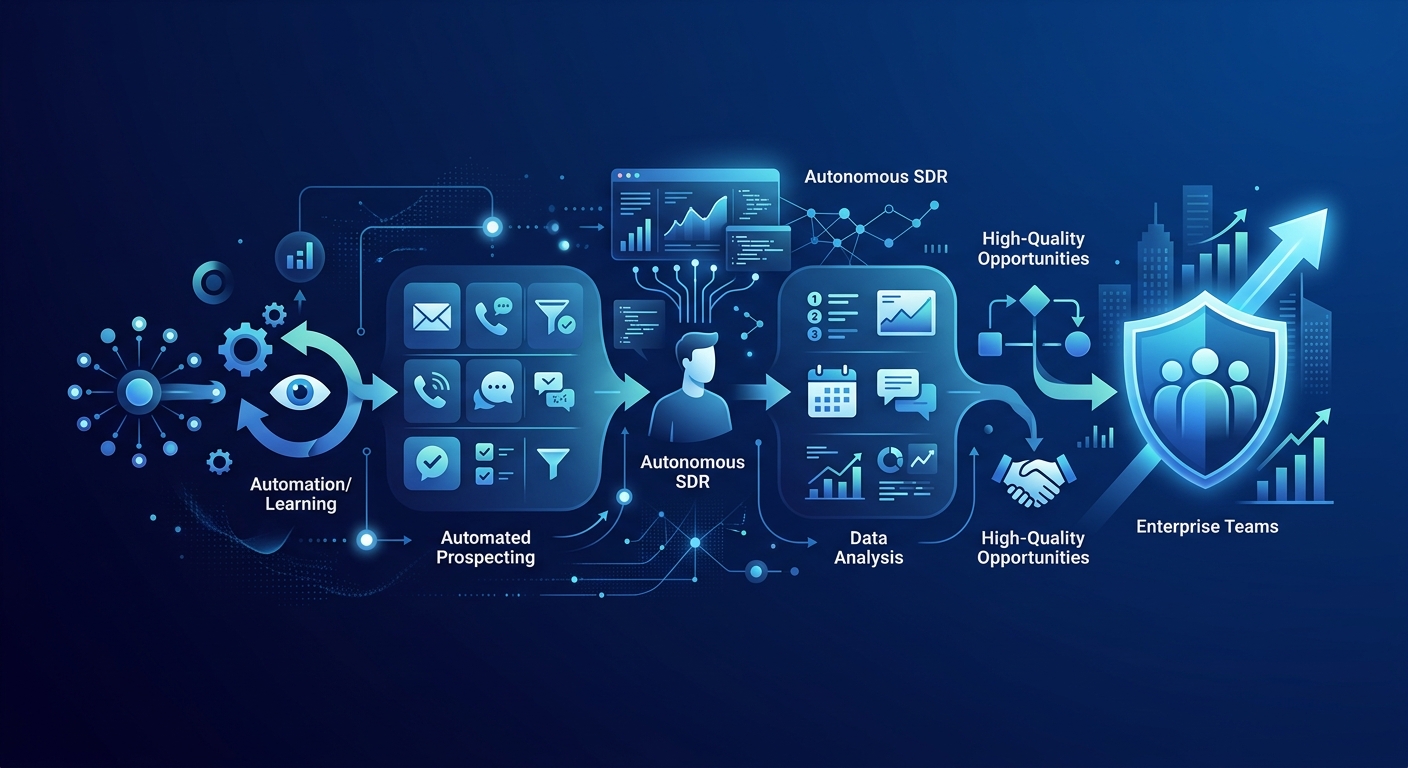
Traditional sales development is structurally inefficient. Linear headcount expansion compounds overhead, extends ramp cycles, and fragments qualification standards. Forward-looking revenue organizations no longer debate whether to deploy AI—they determine how to operationalize it as a governed, accountable workforce. This guide outlines the enterprise best practices required to transition from experimental AI adoption to outcome-driven autonomous sales development. By implementing structured workflows, rigorous governance, and performance-aligned commercial models, executives can replace fixed labor costs with predictable, measurable pipeline contribution.
The Strategic Shift to Autonomous Sales Development
Replacing linear headcount scaling with outcome-driven capacity requires a fundamental shift in workforce planning. Traditional SDR teams scale proportionally to budget, creating rigid cost structures that cannot flex with market demand. Autonomous workflows deliver elastic capacity that aligns directly with pipeline targets. Rather than functioning as simple automation tools, AI agents operate as 24/7 digital workers that execute research, outreach, and qualification with minimal human intervention Top 5 Best AI Sales Agents in 2026 | 11x Blog.
Pre-deployment readiness is non-negotiable. Enterprises must establish strict benchmarks for CRM data hygiene, define precise Ideal Customer Profile (ICP) parameters, and standardize marketing-to-sales handoff protocols. Without this foundation, AI amplifies operational noise instead of revenue clarity. Autonomous workflows must align directly with RevOps KPIs and top-line targets. Success metrics should shift from activity-based vanity metrics (emails sent, dials made) to outcome-based indicators (verified SQLs, meeting show rates, pipeline velocity). This alignment positions autonomous development as a strategic growth lever, not a tactical efficiency tool.
Architecture of a Scalable AI Sales Workforce
A scalable AI sales workforce requires an architecture built on interoperability, contextual awareness, and adaptive execution. The foundation demands seamless integration across CRM ecosystems, marketing automation platforms (MAP), and third-party data enrichment layers. Siloed data creates operational blind spots; unified data pipelines enable agents to act with precision and maintain context throughout the buyer journey Top 5 Autonomous SDR Agents of 2026: The Complete Buyer's Guide. Unlike legacy automation that executes rigid, pre-programmed sequences, autonomous agents interpret real-time signals and dynamically adjust outreach based on prospect behavior and historical conversion patterns.
Multi-channel sequencing must be triggered by verified buyer intent, not arbitrary schedules. High-performing systems deploy orchestration engines that monitor engagement latency, content consumption, and firmographic triggers to determine optimal outreach timing and channel. This ensures messaging reaches prospects during active evaluation windows, significantly increasing reply and conversion rates.
Equally critical is the implementation of closed-loop feedback for continuous optimization. Every interaction, objection, drop-off, and positive response must feed into a centralized learning repository. This data continuously refines prompt engineering, routing logic, and predictive scoring algorithms. Properly implemented, these architectural principles eliminate the manual research and administrative tasks that consume over 80% of traditional SDR capacity AI SDR for Sales Teams: How to Choose, Implement & Scale in 2026. For technical deployment standards, review our Data Integration & Setup framework.
Optimizing AI Lead Qualification for Pipeline Velocity
Static qualification frameworks bottleneck pipeline velocity. Enterprise teams must deploy AI lead qualification agents that execute dynamic, criteria-based scoring updated in real time. Unlike legacy models that assign fixed points to demographic data, agentic systems evaluate conversational context, stated pain points, budget authority, and implementation timelines to calculate live readiness scores.
Modern platforms enable autonomous conversational qualification and objection handling. Through advanced natural language processing, agents simulate human-like dialogue, systematically extracting critical buying committee intelligence while addressing friction points in real time 10 Best AI SDR Tools Actually Tested by Sales Teams (2026). This ensures only genuinely interested, budget-verified prospects advance to account executives, eliminating meeting dilution and improving AE close rates.
To maintain pipeline integrity, enforce automated routing, strict disqualification protocols, and unbreakable SLAs. Prospects failing to meet predefined thresholds are automatically routed to long-term nurture sequences or disqualified with clear CRM documentation. Strict service-level agreements govern response windows, follow-up cadences, and booking accuracy, ensuring every qualified lead transitions to sales-ready status within defined parameters. This disciplined approach transforms qualification from a bottleneck into a predictable, high-velocity growth engine Top 13 AI SDR Tools in 2026 | Best Tools to Drive Sales | Docket. Learn how to configure these protocols in our dedicated guide to AI Lead Qualification Agents.
Enterprise Governance, Compliance & Human Oversight
Enterprise-scale deployment demands uncompromising governance. Outbound touchpoints must operate within strict regulatory boundaries, requiring embedded compliance guardrails across all agent decision trees. Every communication requires automated validation against GDPR, TCPA, and CAN-SPAM mandates, including consent verification, opt-out enforcement, domain warming protocols, and jurisdictional restrictions. Automating these controls is essential to mitigating financial and reputational risk.
Accountability requires immutable audit trails. Enterprises must maintain comprehensive logs detailing outreach sequences, decision rationale, agent-to-prospect interactions, and routing justifications. These records ensure transparency for internal compliance reviews, external audits, and executive oversight. Human oversight remains critical for preserving brand integrity and managing edge cases. Organizations must define precise intervention thresholds—such as high-value enterprise flags, sensitive compliance inquiries, negative sentiment spikes, or contract negotiations—that trigger seamless escalation to human representatives. This hybrid governance model ensures autonomous operation at scale while retaining executive control over risk, messaging tone, and strategic account management. For detailed compliance frameworks, explore our Security, Compliance & Governance standards.
Transitioning to Pay-for-Performance AI Deployment
Legacy SaaS licensing forces organizations to absorb fixed software costs regardless of pipeline output, shifting deployment risk entirely to the buyer. Forward-looking enterprises are transitioning to accountable, outcome-based pricing models that eliminate overhead risk. In this paradigm, investment ties directly to verified SQLs, booked executive meetings, and downstream revenue impact. By structuring vendor SLAs around measurable pipeline contribution, companies invert the traditional procurement equation: costs scale only with verified commercial results.
This alignment forces vendors to optimize for conversion efficiency, not just feature delivery. It also provides finance and RevOps leaders with predictable customer acquisition cost (CAC) models, clear ROI attribution, and scalable budgeting frameworks. When structured correctly, AI transitions from an experimental cost center to a self-funding growth asset. Organizations anchoring procurement to verified outcomes consistently outperform those locked into per-seat licensing, achieving higher pipeline yield with lower financial risk. Understand how we align commercial incentives with verified outcomes through our Pay-for-Performance Model.
Execution Roadmap: From Pilot to Scaled Operations
Scaling autonomous workflows requires disciplined execution, not aggressive rollouts. Successful enterprises orchestrate phased deployments anchored in cross-functional alignment across RevOps, sales leadership, and IT. Initial pilots should operate in isolated territories or specific ICP segments, enabling teams to validate data routing, message resonance, and system stability before broader expansion. Controlled A/B testing on messaging frameworks, routing logic, and cadence frequency identifies high-conversion patterns and eliminates underperforming sequences prior to enterprise-wide scaling.
Once baseline metrics are established, capacity scaling triggers—such as lead volume thresholds, seasonal demand shifts, or new product launches—automatically adjust agent deployment levels. This iterative methodology ensures continuous optimization, minimizes operational disruption, and guarantees predictable pipeline expansion. A structured rollout framework is critical for long-term resilience and cultural adoption across traditional sales teams. For strategic deployment guidance, reference our framework for Building an Agentic Operating Model.
Conclusion
Autonomous SDR workflows have evolved from experimental technology to a strategic imperative for organizations seeking to decouple revenue growth from headcount constraints. By architecting governed, outcome-driven AI systems, enterprises eliminate fixed overhead while guaranteeing measurable pipeline contribution. At meo, we operationalize this shift through a strict pay-for-performance framework, ensuring your investment scales only alongside verified commercial results. Ready to deploy a scalable, accountable AI sales workforce? Contact our team to design your agentic deployment strategy.