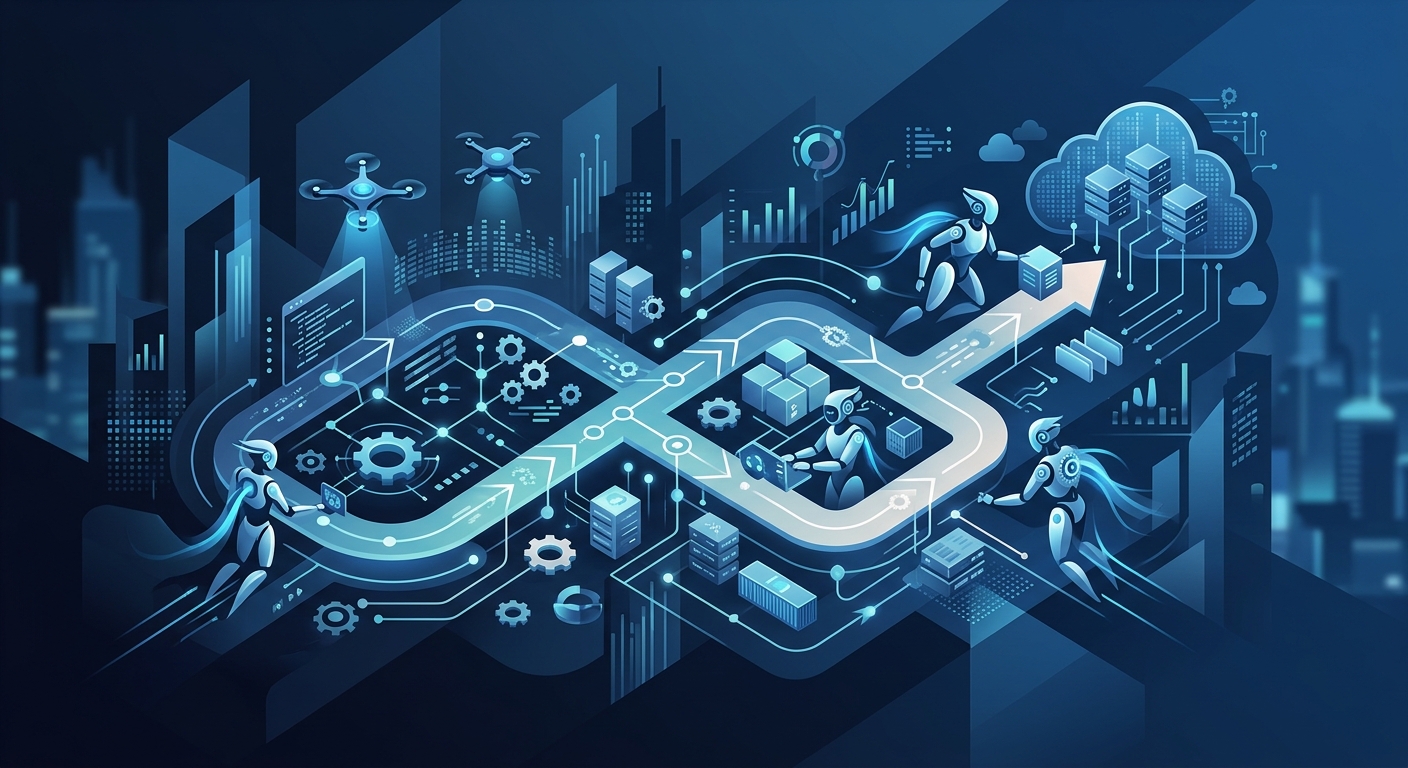
Traditional CI/CD pipelines were engineered for predictable, linear software releases. Modern enterprise environments demand dynamic, self-correcting delivery systems. At meo, we approach pipeline optimization not as a software procurement exercise, but as a strategic workforce transformation. By deploying autonomous DevOps agents, engineering leaders replace reactive operational overhead with a scalable, accountable AI workforce. Operating under a strict pay-for-performance model, organizations only incur costs when pipeline reliability, MTTR reduction, and cloud spend optimization are contractually verified. Manual pipeline oversight is obsolete.
The CI/CD Bottleneck: Why Traditional IT Ops Cannot Scale
Manual pipeline maintenance and persistent alert fatigue drain engineering velocity. Senior talent, essential for architectural innovation, remains trapped in repetitive triage cycles. Traditional IT operations rely on reactive incident handling, which extends mean time to resolution (MTTR) and amplifies downstream deployment risk. Legacy monitoring tools compound the issue: they are inherently retrospective and lack predictive scaling or automated remediation capabilities. Industry analysis confirms that AI and machine learning are now critical for forecasting system behavior, automating repetitive tasks, and maintaining operational stability across cloud-native environments [1]. Without intelligent intervention, scaling CI/CD velocity becomes unattainable. The constraint is no longer infrastructure capacity; it is human bandwidth. Organizations attempting to staff their way out of pipeline instability confront unsustainable labor costs, unpredictable release cycles, and compounding technical debt. The strategic imperative is clear: shift from manual oversight to automated, outcome-driven execution.
How Autonomous DevOps Agents Transform Pipeline Execution
Autonomous DevOps agents fundamentally transform pipeline execution, maintenance, and recovery. Unlike brittle, static scripts, these AI-driven IT operations agents function as self-healing workflows. They autonomously execute rollbacks, patch vulnerable dependencies, and dynamically optimize build times using historical performance telemetry. Context-aware diagnostics form the operational core: agents continuously correlate logs, infrastructure metrics, and distributed traces in real time, converting fragmented data into actionable intelligence. We have moved past rigid scripting into an era where AI agents comprehend system dependencies and execute corrective actions without manual intervention [2]. Upon build failure, a Pipeline Health Monitor Agent immediately isolates the root cause, eliminating delays associated with manual stack-trace analysis [3]. This shifts the operational paradigm from passive detection to autonomous resolution. Security and compliance enforcement are embedded directly into the execution layer. Policy checks run parallel to deployment stages, intercepting non-compliant artifacts before staging. This architecture removes manual approval bottlenecks while preserving rigorous audit trails. By deploying agentic AI as first-class responders, organizations detect failures earlier and diagnose issues with the precision traditionally reserved for senior architects [4]. The outcome is CI/CD automation that operates intelligently, resiliently, and continuously—without requiring constant human supervision.
Architecting AI Infrastructure Management for Enterprise Environments
Enterprise-scale AI deployment demands architectural rigor, not experimental playbooks. Effective AI infrastructure management requires secure, role-bound agent deployment that integrates natively with existing GitOps workflows and Infrastructure as Code (IaC) repositories. Agents operate under the principle of least privilege, strictly scoped to designated namespaces, environments, and deployment stages to prevent unauthorized state mutations. Native compatibility with cloud orchestration platforms—Kubernetes, Terraform, and ArgoCD—ensures AI agents extend existing delivery frameworks rather than disrupting them. Unconstrained autonomy, however, introduces unacceptable operational risk. Forward-thinking architectures enforce governed autonomy through configurable human-in-the-loop thresholds. Critical production deployments, financial ledger updates, and infrastructure security patches trigger mandatory engineering sign-offs prior to execution. Research in cognitive DevOps confirms that enterprise adoption hinges on model explainability, drift mitigation, and structured oversight to maintain engineering trust [5]. By architecting AI agents as bounded, auditable extensions of the engineering team, organizations achieve scalable automation without compromising compliance or operational control.
Pay-for-Performance: Accountability in AI Incident Response
Traditional SaaS models charge for access, not outcomes. At meo, we invert this dynamic. Our pay-for-performance AI DevOps model aligns investment directly with pipeline health, deployment success rates, and incident resolution metrics. Organizations pay for verified results, not seat licenses or idle platform subscriptions. Engineered to reduce MTTR by 60–80%, these agents execute parallel diagnostic workflows, apply remediation playbooks automatically, and escalate complex anomalies only when necessary. Executive dashboards deliver real-time visibility into deployment success, cloud cost optimization, and system uptime. Every optimized build minute, prevented outage, and resolved vulnerability is tracked and validated against predefined SLAs. This accountability framework eliminates speculative labor costs while ensuring AI investments translate into measurable business impact. Engineering leaders secure predictable OPEX, fully auditable performance metrics, and an AI workforce that scales elastically alongside deployment volume.
The Executive Roadmap to an Agent-Driven DevOps Workforce
Transitioning to an agent-driven DevOps workforce requires a disciplined, phased implementation.
Phase 1: Baseline Establishment. Quantify current MTTR, pipeline failure rates, and cloud resource waste. Phase 2: Controlled Pilot. Deploy agents in non-production environments or against low-risk microservices. Engineers validate agent behavior, calibrate escalation thresholds, and establish operational trust. Phase 3: Production Integration. Scale deployment across core production workloads, embedding AI IT operations agents directly into the delivery pipeline.
Success requires equal investment in technology and change management. Organizations must establish clear collaboration protocols that reposition engineers from tactical executors to strategic overseers of autonomous workflows. Forward-thinking CTOs deploy these agents not as experimental utilities, but as accountable, measurable extensions of engineering capacity. Enterprises that institutionalize this architecture today will define the velocity, reliability, and cost structure of tomorrow’s software delivery landscape.
Conclusion
CI/CD pipelines are no longer mere engineering workflows; they are strategic assets requiring intelligent, outcome-driven management. Autonomous DevOps agents deliver precisely this: predictable reliability, continuous optimization, and strict executive accountability. At meo, we stand behind our architecture with a pay-for-performance guarantee. If our agents do not demonstrably reduce MTTR, optimize pipeline throughput, or scale operations, you incur no cost. Schedule a strategic assessment to deploy an AI workforce engineered for verifiable business impact.