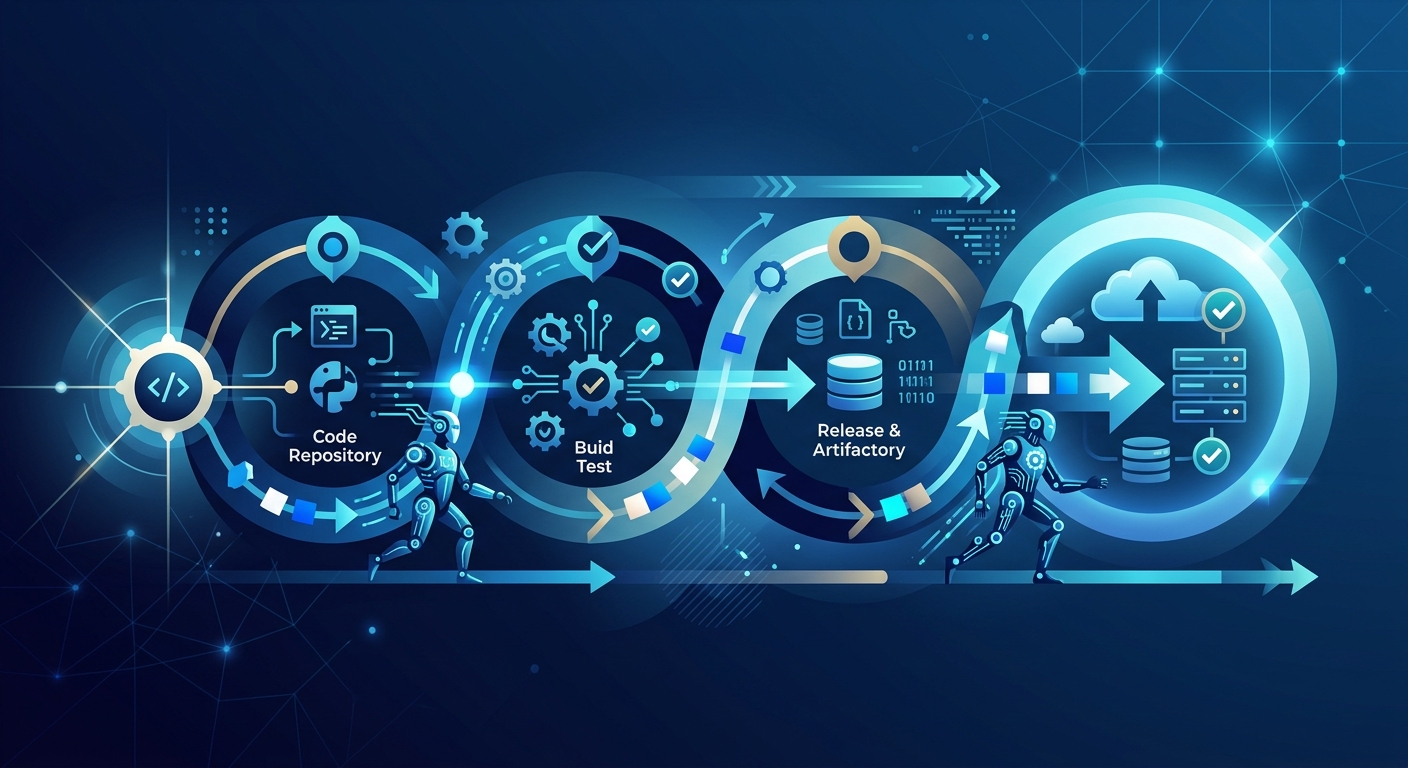
Enterprise deployment pipelines are no longer just technical workflows; they are critical business operations. Yet traditional DevOps models remain tethered to manual oversight, rigid scripts, and reactive incident management. As cloud-native architectures scale, headcount-dependent pipeline management generates hidden friction, unpredictable downtime, and escalating operational costs. The industry is now shifting toward autonomous DevOps agents: self-orchestrating systems that function as accountable extensions of your engineering workforce. At meo, AI is not a feature add-on. It is a measurable, outcome-driven workforce that eliminates overhead in exchange for verified performance.
The Hidden Overhead in Traditional Deployment Pipelines
Manual deployment cycles drain engineering capacity by fragmenting focus and introducing systemic latency. Context switching between ticket triage, infrastructure validation, and release coordination consumes up to 30% of senior engineering bandwidth. Rollback delays compound this inefficiency, often triggering cross-functional escalation that stalls product velocity. Legacy CI/CD automation exacerbates scaling bottlenecks. Static, linear execution paths fracture under microservice complexity and stringent compliance demands.
Traditional pipelines were engineered for monolithic architectures and predictable release windows. Modern enterprise environments require continuous delivery across hybrid clouds, regulated data boundaries, and dynamic feature flags. Rule-based systems fail to interpret contextual drift or adapt to shifting compliance requirements, forcing costly human intervention. Leaders must redirect engineering resources from maintenance to strategic innovation by deploying intelligent systems that absorb routine execution with precision and accountability.
Autonomous DevOps Agents vs. Scripted Automation
Autonomous DevOps agents represent a fundamental architectural leap beyond static infrastructure-as-code (IaC) frameworks and scripted CI/CD runners. Unlike traditional pipelines that execute predefined commands regardless of environmental state, these agents apply contextual reasoning, dynamic path resolution, and continuous self-optimization. They evaluate deployment health, interpret dependency graphs, and adjust execution strategies in real time using live telemetry and compliance constraints.
Rule-based scripts rely on rigid logic, making them brittle when facing novel failure modes or configuration drift. In contrast, AI-native DevOps systems leverage foundation models to reason through complex cloud states, provision multi-cloud resources, and execute multi-step remediation autonomously. Crucially, these agents maintain pipeline velocity without compromising governance. By embedding policy-aware execution layers directly into their reasoning loops, they validate security baselines, enforce least-privilege access, and generate auditable decision trails prior to commit. This transforms compliance from an afterthought into a foundational design principle.
Architecting AI Infrastructure Management for Zero-Disruption Integration
Deploying AI-driven infrastructure management does not require dismantling existing toolchains. Successful integration follows a phased, non-invasive architecture that integrates seamlessly with your current stack. The process begins by connecting agents to version control systems, artifact registries, and cloud provider APIs via secure, token-scoped credentials. Agents ingest historical deployment logs, architecture diagrams, and compliance playbooks to establish a validated operational baseline before assuming execution authority.
Guardrails are non-negotiable at enterprise scale. Strict permission scoping confines agent operations to predefined cloud boundaries and service meshes. Comprehensive audit trails capture every decision, command execution, and environmental state change, creating immutable records for internal review and external compliance audits. Human-in-the-loop approval gates remain active for high-impact changes, such as database schema migrations or production environment reconfigurations, ensuring strategic oversight without operational bottlenecks.
Compliance alignment is engineered into the architecture from day one. Systems map directly to SOC 2 Type II, ISO 27001, and industry-specific regulatory frameworks. Continuous automated policy checks intercept non-compliant resource allocations before they reach execution queues. This proactive posture transforms compliance from a quarterly audit burden into a continuous, automated verification layer.
Deploying AI Incident Response Agents for Real-Time Pipeline Resolution
When deployments fail, traditional incident response relies on manual log parsing, cross-team escalation, and delayed mitigation. AI incident response agents invert this reactive model. By continuously monitoring telemetry and predicting failure thresholds, they initiate remediation before SLAs are breached. These agents correlate build logs, network latency spikes, and dependency health scores to isolate root causes within seconds rather than hours.
Predictive bottleneck identification enables agents to reroute traffic, scale ephemeral environments, or trigger automated rollback sequences when anomaly scores exceed predefined risk tolerances. This preserves system integrity and prevents cascading failures across distributed architectures. By correlating historical incident patterns with real-time metrics, agents execute targeted rollbacks that restore stability without disrupting successful downstream components.
Continuous learning loops ensure these systems compound value over time. Every resolved incident, successful deployment, and near-miss feeds back into the agent’s decision models, systematically reducing Mean Time to Resolution (MTTR) and eliminating recurring friction. As agents self-heal increasingly complex pipeline states, engineering teams experience fewer production disruptions and higher release confidence. This transforms incident management from a cost center into a performance multiplier.
The Accountability Imperative: Measuring Outcomes, Not Activity
Enterprise leaders must abandon activity-based DevOps metrics, such as ticket volume or maintenance hours, in favor of outcome-based indicators. Operational maturity is measured by hard business indicators: pipeline success rate, deployment frequency, change failure rate, and lead time. These DORA-aligned metrics directly correlate with revenue velocity, customer retention, and market responsiveness.
At meo, we reject opaque, seat-based licensing that charges for potential rather than performance. Our pay-for-performance model ties capital deployment directly to verified pipeline outcomes. Organizations pay only when autonomous DevOps agents demonstrably increase deployment frequency, reduce failure rates, and maintain strict SLA compliance. This aligns vendor incentives with enterprise objectives, positioning AI infrastructure management as an accountable workforce extension rather than experimental overhead.
Executive Blueprint for Phased AI DevOps Adoption
Enterprise adoption requires disciplined execution, not technological leaps.
Phase 1 (Sandbox Validation): Deploy agents in isolated environments, establish baseline metrics, and implement strict risk containment protocols to validate decision accuracy.
Phase 2 (Parallel Operation): Run agents alongside traditional workflows. Agents progressively assume execution as confidence thresholds and governance checks are met.
Phase 3 (Full Production Scale): Execute enterprise-wide deployment, activate continuous optimization loops, and reallocate engineering resources from pipeline maintenance to strategic product development.
This disciplined approach guarantees zero-disruption migration, measurable ROI, and sustainable operational scale.
Conclusion: Deploy Intelligence, Not Overhead
The future of enterprise deployment pipelines belongs to organizations that treat AI as an accountable workforce, not a tactical tool. Autonomous DevOps agents eliminate hidden overhead, enforce continuous compliance, and transform incident response from reactive firefighting to proactive resolution. At meo, we deliver this transformation through a performance-linked model that ties fees to measurable pipeline efficiency without upfront labor risk. Schedule an architectural assessment to baseline your current deployment metrics and design a risk-contained, outcome-driven adoption roadmap.