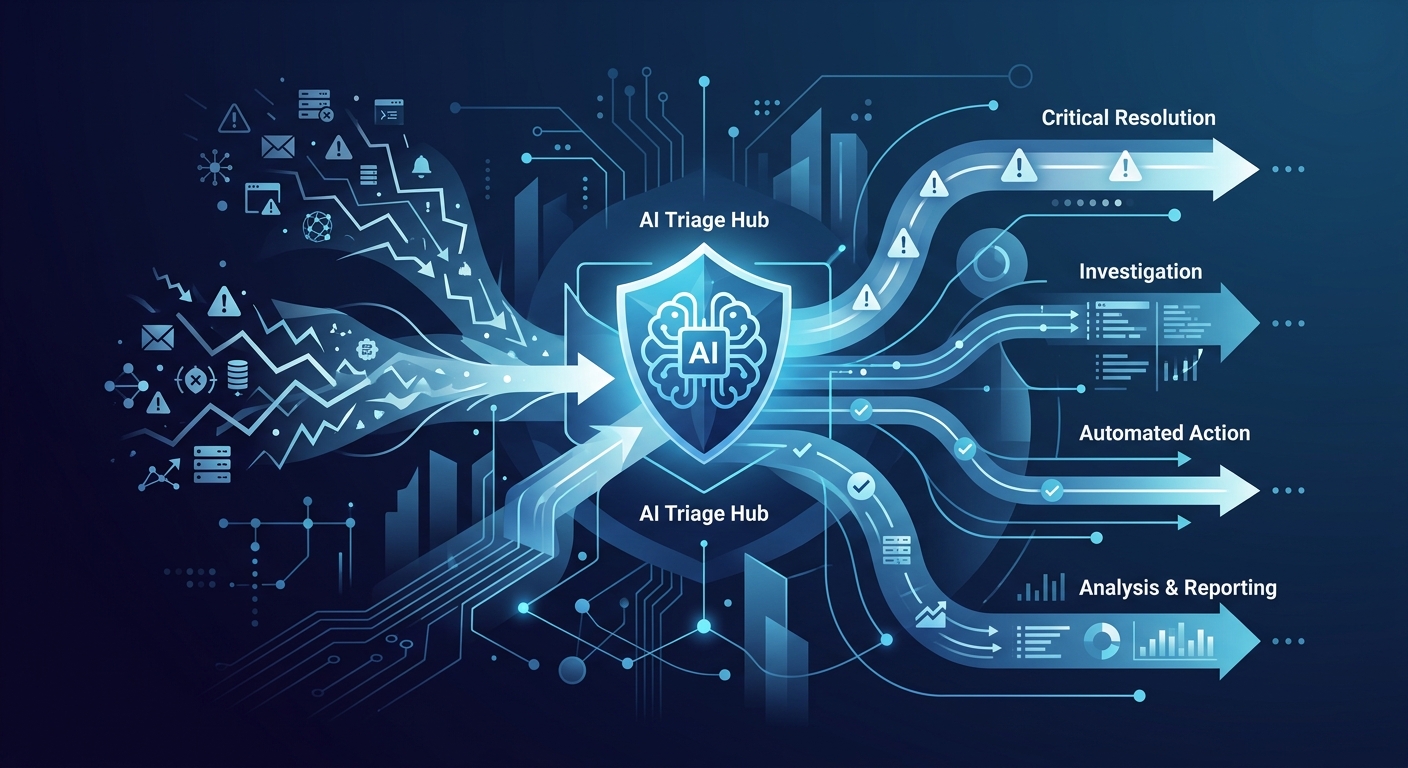
Traditional IT operations have reached a critical inflection point. As infrastructure complexity outpaces engineering headcount, manual incident triage has become a primary bottleneck, draining technical capacity and inflating operational overhead. meo redefines this landscape by deploying AI agents not as experimental tools, but as an accountable, outcome-driven workforce. By aligning AI infrastructure management with a strict pay-for-performance model, we ensure your organization invests only when agents deliver verified business results. This guide outlines the transition from manual triage to measurable, production-grade automation.
The High Cost of Manual Incident Triage in Enterprise IT
Legacy NOC and SOC models depend heavily on human analysts to manually filter thousands of daily alerts, a process that inherently breeds alert fatigue and operational inefficiency. Research indicates IT teams waste up to 30% of their time simply filtering false positives and correlating fragmented event streams [Cyfuture]. This hidden labor overhead directly delays mean time to resolution (MTTR) and allows incidents to escalate before meaningful intervention occurs. During periods of infrastructure volatility or rapid scaling, human-dependent triage cannot keep pace with exponential telemetry growth. To quantify this displacement, enterprises must first establish baseline KPIs: current MTTR, false-positive rates, analyst hours per incident, and ticket backlog velocity. Only by measuring the true cost of inaction can organizations accurately evaluate the ROI of transitioning to an autonomous operational model.
How AI IT Operations Agents Automate Detection, Analysis & Routing
Modern AI IT operations agents operate as autonomous diagnostic engines, continuously ingesting real-time telemetry, distributed application logs, and CMDB topology data to correlate multi-source events into a unified operational narrative. Unlike traditional threshold-based monitoring tools that generate alert fatigue, autonomous agents detect anomalies, trace them to root causes, execute remediation runbooks, and resolve incidents before engineers are paged [Cyfuture]. By leveraging advanced pattern recognition and root-cause analysis, these systems auto-enrich incidents with historical context, dependency mapping, and dynamic severity scoring. For example, when a database latency spike triggers cascading application timeouts, the agent automatically correlates the events, identifies the blocking process, and executes a targeted query termination runbook. This eliminates diagnostic guesswork and drastically reduces cognitive load. When incidents exceed automated resolution boundaries—such as novel security anomalies or complex architectural failures—the agent seamlessly escalates them to human engineers. The handoff delivers a fully contextualized ticket with diagnostic logs and recommended next steps, ensuring senior talent focuses exclusively on high-impact engineering rather than repetitive triage.
Engineering Autonomous DevOps Agents for Production-Grade Reliability
Deploying AI in production requires deterministic guardrails, not probabilistic experimentation. Enterprise-grade autonomous DevOps agents operate within strict operational boundaries, utilizing multi-layered approval workflows, automated rollback protocols, and sandboxed execution environments to guarantee safe remediation [JetRuby Agency]. These agents integrate natively with existing ITSM platforms, observability stacks, and CI/CD pipelines, eliminating disruptive rip-and-replace migration cycles. Every configuration change, script execution, or service restart is governed by policy-as-code frameworks that prevent unauthorized privilege escalation or out-of-scope modifications. Furthermore, every agent action is recorded in immutable, cryptographically verifiable audit trails, delivering complete transparency and automated compliance reporting for highly regulated environments. By treating AI agents as governed infrastructure components rather than standalone automation scripts, organizations achieve production-grade reliability. This architectural rigor ensures AI infrastructure scales safely across distributed, multi-cloud environments while maintaining strict adherence to ITIL change management policies and enterprise security postures.
Measuring Impact: From Incident Response Agents to Workforce Accountability
The transition to AI-driven operations must be anchored in verifiable business metrics, not theoretical efficiency gains. Primary success indicators include sustained MTTR reduction, measurable mean time between failures (MTBF) improvement, and automated ticket deflection across tier-one support queues. As AI incident response agents absorb routine triage and remediation workloads, organizations can directly calculate labor cost displacement and strategically reallocate senior engineering resources toward product development, platform modernization, and architectural innovation [Wizr.ai]. This paradigm shift moves IT operations from activity-based reporting—such as tracking ticket volume or analyst utilization—toward outcome-based accountability measured via transparent, real-time performance dashboards. Leadership gains immediate visibility into agent productivity, resolution accuracy, and SLA adherence. By tying AI agent deployment directly to operational KPIs, enterprises transform IT from a cost center into a predictable, high-velocity capability. These autonomous systems become accountable digital workers, delivering continuous, quantifiable improvements in system stability, engineering throughput, and overall operational resilience.
Deploying AI Infrastructure Management with a Pay-for-Performance Model
Traditional AI software procurement forces enterprises to absorb significant upfront licensing costs with no guarantee of operational adoption or ROI. At meo, we structure deployments around verified business outcomes rather than speculative software fees. Our pay-for-performance framework aligns agent scaling with milestone-based billing, directly tied to documented SLA improvements and validated MTTR reductions. This model eliminates shelfware risk by ensuring capital is deployed exclusively toward measurable operational wins. As agents autonomously resolve incidents and stabilize infrastructure, your investment scales proportionally to the value delivered. By shifting from CapEx-heavy software licensing to OpEx-aligned outcome purchasing, traditional organizations can modernize IT infrastructure management with zero financial risk and guaranteed accountability [PeerSoftware].
Executive Implementation Roadmap for Traditional Organizations
Successful AI agent deployment follows a disciplined, phased execution strategy. Phase 1 establishes baseline triage workflows, integrates core data sources, and defines strict success thresholds aligned with existing SLAs. Phase 2 launches a controlled pilot on non-critical services, validating agent accuracy, remediation speed, and compliance guardrails under real-world operational conditions. Phase 3 scales the AI agent workforce across mission-critical infrastructure, implementing continuous optimization loops and executive governance frameworks. This structured approach ensures seamless integration while maintaining operational continuity throughout the transition.
The era of reactive, labor-intensive IT operations is over. AI agents are no longer experimental—they are the foundation of a scalable, accountable operational workforce [Gartner via PagerDuty]. With meo’s pay-for-performance model, you can eliminate manual triage overhead, tie fees to measurable MTTR reductions, and reinvest engineering capital into strategic innovation. Partner with meo to deploy autonomous DevOps agents that deliver verified results. Schedule your operational baseline assessment today and start paying only for outcomes, not overhead.