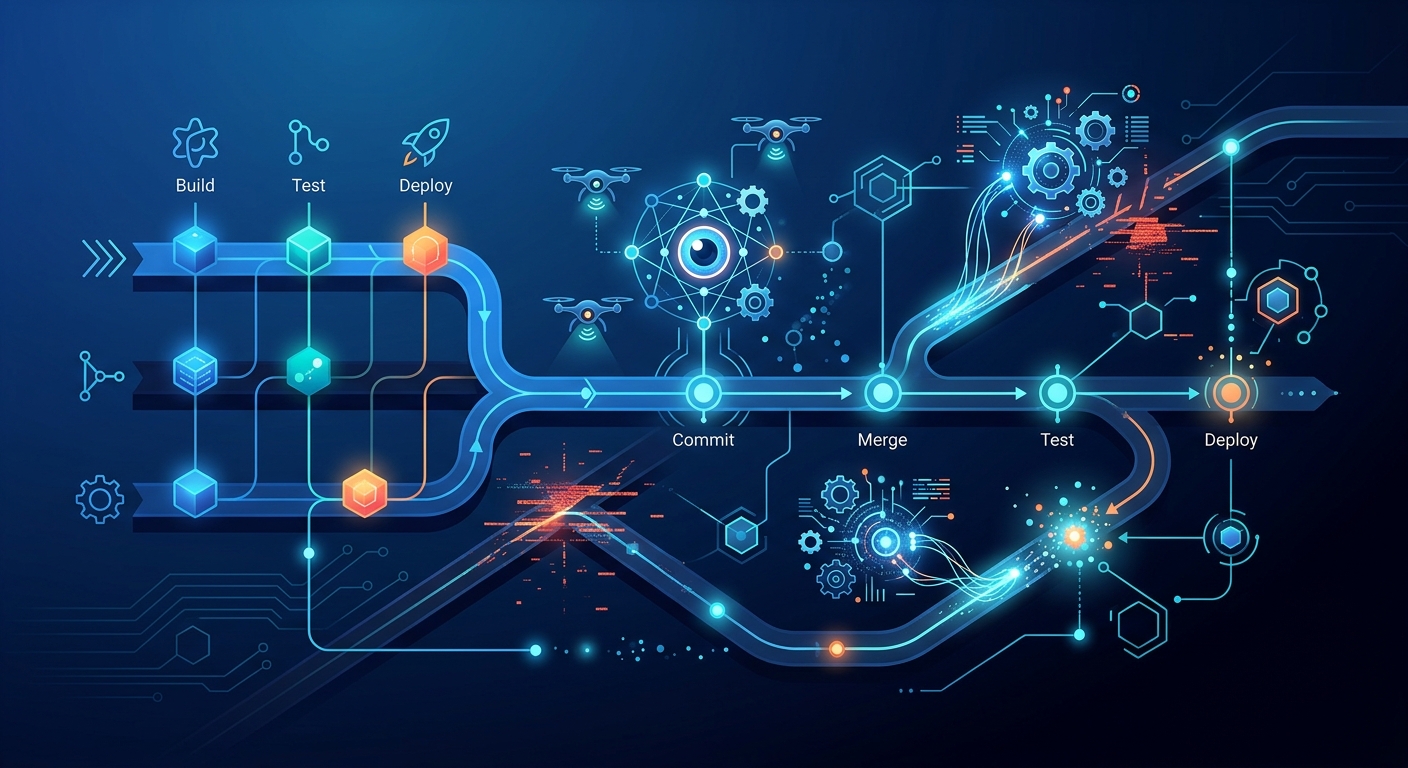
Traditional CI/CD was engineered to accelerate software delivery, yet it has evolved into a maintenance-heavy liability. Enterprises expend thousands of engineering hours annually patching brittle pipelines, investigating intermittent failures, and manually rolling back deployments. At MEO, we treat reactive pipeline management as a financial constraint, not merely a technical hurdle. The next evolution does not require additional monitoring dashboards or complex orchestration scripts. It requires autonomous DevOps agents that function as an accountable, outcome-driven extension of your engineering team. By shifting from manual oversight to self-healing infrastructure, organizations eliminate hidden labor overhead, ensure consistent release stability, and direct capital exclusively toward measurable operational results.
The Hidden Overhead of Manual CI/CD Management
Reactive pipeline maintenance drains engineering bandwidth that should be allocated to product innovation. Industry benchmarks indicate that high-performing teams lose up to 30% of their capacity managing infrastructure friction rather than developing revenue-generating features. When engineers manually troubleshoot broken builds or validate environment states, deployment bottlenecks multiply and Mean Time to Recovery (MTTR) escalates rapidly.
Traditional monitoring tools operate on fixed thresholds, generating alerts only after failures disrupt the delivery lifecycle. They cannot anticipate infrastructure drift, silent dependency conflicts, or configuration degradation before code reaches production. This lag forces teams into a reactive troubleshooting cycle where every release accumulates technical debt. The true cost extends beyond delayed rollouts; it directly impacts roadmap velocity and time-to-market. ResearchGate demonstrates that self-managing systems are essential to breaking this cycle, while DevOps.com emphasizes that legacy alerting models lack the contextual awareness required to prevent cascading pipeline failures.
How Autonomous DevOps Agents Enable Self-Healing Pipelines
Autonomous DevOps agents transform CI/CD from a fragile assembly line into a resilient, self-correcting ecosystem. Through continuous analysis of pipeline telemetry, resource utilization, and application dependencies, AI-driven infrastructure management detects anomalies before they trigger deployment blocks. Unlike legacy systems that rely on rigid, threshold-based rules, AI agents employ predictive modeling to identify subtle compute drift, network latency spikes, and version mismatches across distributed environments.
Upon detecting deviations, agents initiate closed-loop automation: isolating affected components, applying targeted remediations, executing safe rollbacks, and reprovisioning environments without human intervention. This real-time correction eliminates manual triage queues and ensures deterministic delivery outcomes. By embedding intelligence directly into the pipeline, organizations achieve consistent release stability while drastically reducing operational friction. As XenonStack outlines, agentic AI now operates independently across the software lifecycle, provisioning infrastructure, validating code integrity, and executing remediation workflows autonomously.
Direct Comparison: Legacy Toolchains vs. AI-Driven Release Automation
The operational divide between traditional workflows and AI-driven automation is quantifiable across three executive metrics: deployment success rate, rollback latency, and labor allocation. Legacy toolchains typically achieve 60–75% deployment success, with rollback processes averaging 20–45 minutes due to manual verification, approval chains, and environment reconciliation. In contrast, AI-managed pipelines consistently deliver 90%+ success rates, with automated rollbacks executing in under three minutes.
This acceleration directly reshapes labor economics. Senior engineers previously consumed by log parsing, repetitive debugging, and manual provisioning are reallocated to strategic architecture and high-value development. Financially, this shift yields a documented 40–60% reduction in pipeline-related labor overhead. Furthermore, accountability differs fundamentally. Script-heavy pipelines operate on implicit trust; failures require hours of cross-tool log tracing, creating opaque ownership and delayed resolution. AI IT operations agents operate on verified, outcome-tracked frameworks. Every remediation, configuration change, and deployment decision is logged, validated against business KPIs, and continuously audited. Modern enterprise evaluations now prioritize agent architectures capable of adapting to dynamic operational environments rather than executing static scripts (FitGap). This paradigm shifts DevOps from a reactive cost center to a predictable, auditable delivery engine.
AI Incident Response Agents in Production Environments
When failures bypass CI/CD gates and impact live systems, AI incident response agents serve as the primary operational defense. These agents execute automated triage, correlating logs, distributed traces, and infrastructure metrics across microservice architectures to pinpoint root causes instantly. Traditional monitoring floods on-call teams with redundant alerts, increasing cognitive load and delaying critical interventions. AI correlation engines filter signal from noise, suppress duplicates, and surface actionable diagnostics tailored to the specific failure context.
Crucially, these agents maintain strict compliance and immutable audit trails. Every remediation step, configuration adjustment, and access request is documented to satisfy SOC 2, ISO 27001, and industry-specific mandates. By automating the diagnostic loop, enterprises reduce MTTR by up to 50% while ensuring engineering teams focus on architectural resilience rather than incident coordination. Proactive, cross-system incident resolution is no longer optional; it is a baseline requirement for scaling modern production environments (DevOps.com).
The Pay-for-Performance Model: Funding Outcomes, Not Overhead
Traditional DevOps infrastructure relies on fixed licensing fees and expanded headcount, forcing organizations to pay for theoretical capacity rather than actual delivery. MEO’s pay-for-performance model inverts this paradigm. Clients invest exclusively when AI agents deliver verified outcomes: stabilized pipelines, reduced MTTR, accelerated deployment velocity, and quantifiable labor savings.
This risk-mitigated approach aligns technology expenditure directly with business performance. If agents fail to stabilize workflows or reduce operational overhead, financial exposure remains zero. Executive leadership gains transparent ROI tracking tied directly to uptime, deployment success rates, and reductions in manual maintenance hours. By treating AI infrastructure management as a performance-based workforce, enterprises eliminate sunk costs in underutilized licenses and redundant engineering cycles. Every dollar deployed toward automation translates into predictable, auditable operational value.
Strategic Deployment for Traditional Enterprises
Enterprise adoption of autonomous systems requires disciplined integration, not disruptive replacement. MEO implements phased deployment frameworks that align with existing ITIL governance, change management protocols, and DevSecOps controls. Initial deployments operate within strictly scoped permission boundaries, executing low-risk tasks such as log correlation, environment validation, and non-critical configuration patching.
Human-in-the-loop approval gates remain active during transition phases, ensuring compliance while agents establish organizational baselines and learn failure patterns. As accuracy metrics and trust thresholds improve, autonomy scales progressively across hybrid and on-premise environments. This structured methodology mitigates operational risk, satisfies audit requirements, and accelerates time-to-value without compromising established security postures. Industry deployments confirm that custom-configured agents integrate seamlessly into legacy enterprise stacks (YouTube - Top 10 DevOps & AI Tools 2026), enabling traditional IT environments to adopt AI-driven operations without architectural overhaul.
Conclusion
The era of manually sustaining fragile CI/CD pipelines has ended. AI IT operations agents and autonomous workflows deliver deterministic release outcomes, eliminate reactive overhead, and operate within strict accountability frameworks. Through a pay-for-performance model, enterprises deploy self-healing infrastructure with zero financial risk, funding only verified operational improvements. Partner with MEO to transform your release pipeline into an accountable, outcome-driven engine. Request a pipeline performance audit to quantify your recoverable labor overhead and deployment velocity gains this quarter.