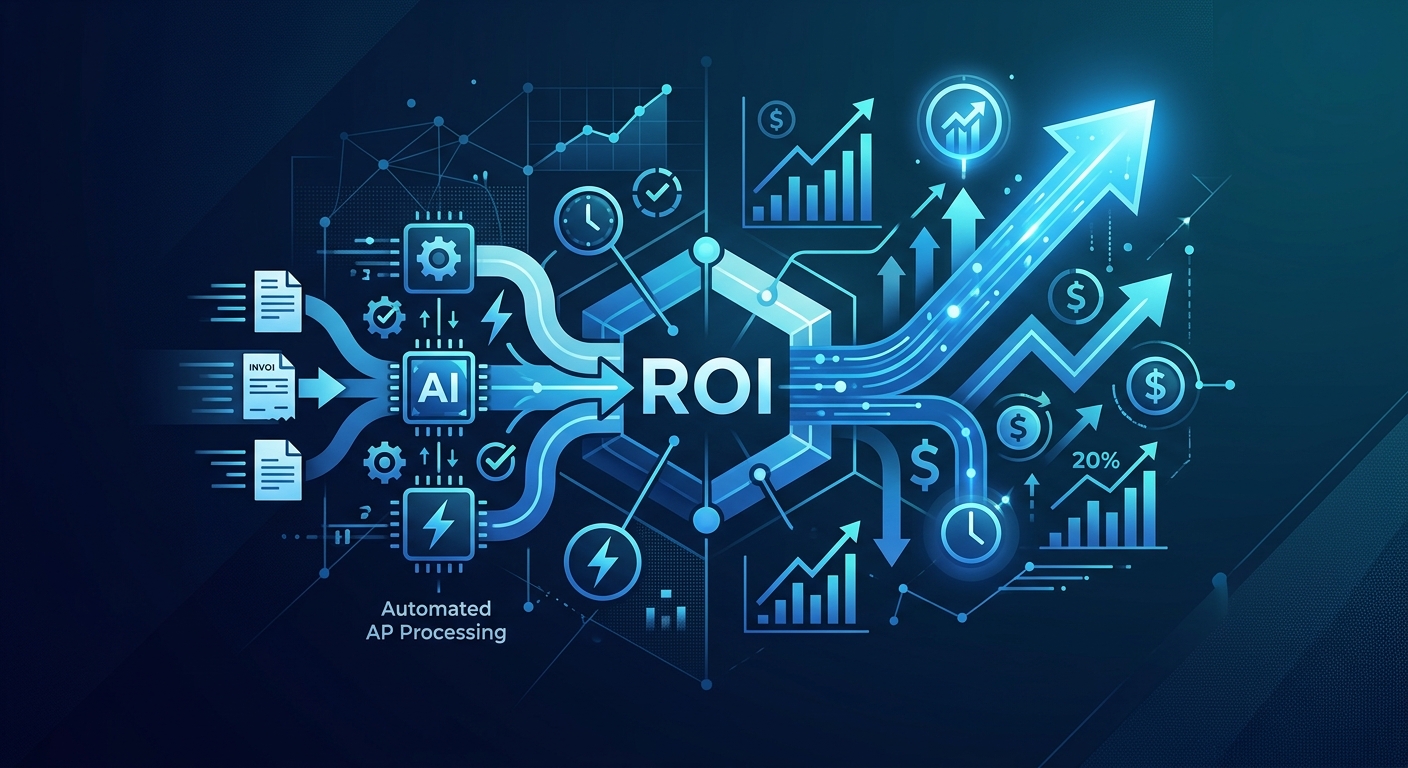
Accounts payable is no longer a back-office cost center; it is a strategic financial lever directly impacting working capital, vendor relationships, and operational resilience. Yet, most organizations still measure AP efficiency using legacy SaaS metrics that ignore the true economics of intelligent automation. As enterprises transition from static software tools to autonomous AI agents, ROI calculations must evolve from seat-based licensing to accountable workforce modeling. Meo deploys AI invoice processing agents on a pay-for-performance framework, ensuring capital is deployed only when agents deliver verified, measurable outcomes. This guide outlines how finance leaders can accurately quantify automated AP value, moving beyond superficial cost-cutting to capture labor displacement, risk mitigation, and cash flow optimization.
Why Traditional AP Metrics Fail the AI Agent Era
Legacy AP automation was sold as software, measured by subscriptions, licenses, and implementation fees. AI agents operate fundamentally differently: they function as a scalable, outcome-driven workforce. Measuring them with traditional software ROI models obscures their true impact and underestimates their capacity for labor displacement. Before deploying an AI solution, finance leaders must establish precise operational baselines. Understanding current invoice and payment processing costs is a prerequisite to calculating meaningful returns Ascend Software.
These baselines must include fully loaded cost-per-invoice, current touchless processing rates, exception queue volumes, and total manual labor hours. The strategic flaw in legacy ROI calculations lies in their narrow focus on direct FTE savings. Organizations routinely overlook the compounding costs of compliance risk, audit exposure, and scalability bottlenecks. When transaction volumes spike during seasonal peaks or M&A integrations, traditional systems fracture under manual routing and error-prone data entry. AI workforce economics shifts the paradigm: enterprises track verified outcomes—matched invoices, resolved exceptions, and completed workflows—rather than software utilization. This outcome-based measurement aligns financial investment directly with operational throughput.
Direct Cost Reductions: Labor, Processing & Exception Management
The most immediate and quantifiable impact of AI invoice processing is the dramatic reduction in manual touchpoints and the acceleration of straight-through processing (STP) rates. AI agents autonomously extract, validate, and reconcile invoice data, eliminating repetitive data entry and routing only true exceptions for human review Stripe. To calculate direct ROI, apply the standard cost-per-invoice formula: Total AP Processing Costs ÷ Total Invoices Processed Matil. This denominator must extend beyond clerk salaries to include software overhead, exception handling labor, and the hidden costs of delayed approvals.
When evaluating labor impact, differentiate between headcount attrition and strategic talent redeployment. While some organizations realize direct FTE reductions through natural turnover, high-performing enterprises redeploy AP specialists into value-generating functions like vendor negotiation, working capital strategy, and FP&A analysis. Automated agents seamlessly execute complex workflows at scale: three-way matching against POs and delivery receipts, dynamic approval routing, automated vendor onboarding, and intelligent exception resolution. By offloading repetitive, rule-bound tasks to AI, enterprises eliminate operational variability. The result is a predictable, linear cost structure where processing expenses scale downward per unit, regardless of volume complexity.
Indirect Value: Cash Flow Optimization, Compliance & Audit Readiness
Direct cost reductions represent only one dimension of AP automation ROI. The indirect financial impact—frequently overlooked in traditional evaluations—often delivers the highest enterprise value. Accelerated invoice cycle times unlock tangible cash flow advantages, including early payment discounts and optimized working capital deployment. Automation compresses cycle timelines, unlocking liquidity and strengthening strategic vendor partnerships NetSuite. Predictable payment execution and eliminated errors empower procurement teams to negotiate favorable terms with confidence.
Equally critical is quantifiable risk mitigation. Duplicate payments, fraudulent submissions, and late-fee penalties represent massive, preventable revenue drains. AI agents continuously audit transaction streams, cross-referencing vendor master data, banking details, and historical payment patterns to intercept anomalies before disbursement. Automated systems also generate standardized, real-time audit trails that drastically reduce compliance overhead. In highly regulated environments, maintaining granular, timestamped records for every transaction is non-negotiable. Digitizing AP processes delivers enhanced control, rigorous compliance, and measurable bottom-line impact Corpay. These indirect benefits compound over time, transforming AP from a reactive cost center into a proactive financial control layer.
The Pay-for-Performance Advantage: De-Risking Your AI Investment
Traditional enterprise software deployments demand heavy upfront CapEx, extended implementation timelines, and multi-year licensing commitments—all before processing a single invoice. This legacy procurement model transfers deployment risk entirely to the buyer, frequently resulting in shelfware, underutilized features, and vendor management overhead. Meo’s pay-for-performance AI framework reverses this dynamic. We structure engagements around accountable workforce economics: clients incur costs only when AI agents successfully process, match, route, and clear invoices. There are no speculative software fees. Investment is strictly tied to verified operational output.
This model eliminates shelfware risk and aligns vendor incentives with enterprise outcomes. If an agent fails to meet accuracy thresholds or processing SLAs, the provider absorbs the financial impact. Furthermore, outcome-based pricing removes capacity planning friction. Enterprises scale agent deployment dynamically alongside transaction volume, seasonal demand, or geographic expansion without renegotiating licenses or provisioning infrastructure. By treating AI as a measurable workforce rather than a static tool, organizations strip away the financial uncertainty of traditional automation. The AI Agent ROI & Business Case becomes transparent from day one: every dollar correlates directly to an invoice processed, an exception resolved, or a compliance checkpoint cleared. This accountability transforms AI procurement from a speculative expense into a predictable, performance-driven operational strategy.
A Practical ROI Calculation Framework for Finance Leaders
To translate AI AP capabilities into boardroom-ready projections, finance leaders should adopt a structured, multi-variable ROI model. The foundational formula is straightforward but requires precise data inputs: (Direct Labor Savings + Process Efficiency Gains + Risk Avoidance) – Implementation Overhead. Begin by calculating baseline labor costs per invoice, then apply the projected STP uplift to determine monthly hour reductions. Factor in captured early-payment discounts, eliminated late fees, and reduced duplicate payments as risk-avoidance multipliers. Subtract implementation, integration, and training overhead to derive net annual savings. Finally, calculate percentage return using the standard metric: ROI = ((Annual Savings – Annual Cost) ÷ Annual Cost) × 100.
Beyond the final percentage, track leading indicators that predict long-term ROI trajectory: cycle time reduction, exception queue shrinkage, and vendor dispute resolution rates. These metrics serve as early warning systems for process bottlenecks and agent optimization needs. For sustained financial impact, build a 12-month projection model that scales agent deployment alongside enterprise transaction growth and seasonal demand. Organizations that align AI capacity planning with invoice volume trends achieve compounding efficiency gains within two quarters. By treating AI agents as a dynamic, accountable workforce and measuring outcomes rather than utilization, enterprises unlock a new standard of operational and financial performance.
Conclusion
Calculating ROI for AI AP processing agents requires a fundamental shift from legacy software metrics to accountable workforce economics. When enterprises measure outcomes—straight-through processing rates, cash flow acceleration, and risk elimination—rather than license fees, the true value of automation becomes unmistakable. Meo’s pay-for-performance model ensures your AI investment remains directly tied to verified business results, eliminating deployment risk and scaling seamlessly with operational demand. Replace overhead with measured performance. Request a customized ROI projection and deploy an AI agent workforce engineered for measurable financial impact.