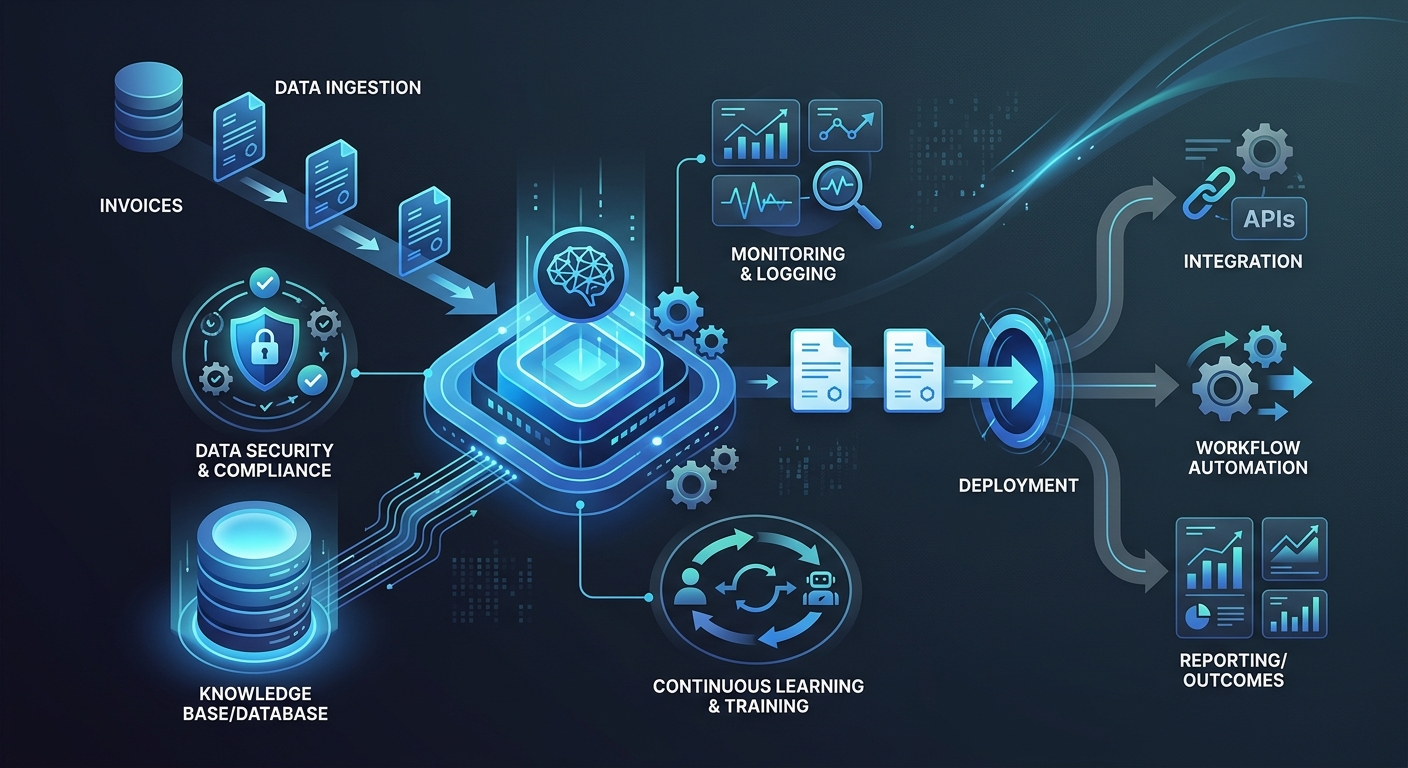
Treat AI invoice processing as a strategic workforce deployment, not an IT implementation checklist. When executed with operational discipline, automated AP evolves from a manual, error-prone back-office function into a tightly governed, intelligence-driven financial control point Scry AI. High-performing organizations realize transformative ROI by reframing invoice processing agents as an accountable, scalable workforce rather than passive software. By anchoring deployment to financial KPIs, enforcing rigorous data governance, and adopting outcome-based contracting, finance leaders permanently replace traditional labor overhead with predictable, measurable results.
The following practices detail how to deploy an AI AP workforce that delivers immediate operational leverage and scales across enterprise complexity.
1. Anchor Deployment to Measurable Business Outcomes
Successful agent deployment begins with financial alignment, not technical integration. Finance executives must replace vanity metrics like documents scanned per hour with balance-sheet KPIs: cost per invoice processed, Days Payable Outstanding (DPO), and exception-handling cycle time. These metrics provide direct visibility into operational efficiency and working capital impact. As the market matures, automation has shifted from a competitive differentiator to a baseline requirement for financial agility Vic.ai.
Establish baseline performance thresholds before onboarding agents. These thresholds dictate when the system scales autonomously or triggers human oversight. If invoice processing time or error rates exceed predefined limits, deployment protocols should automatically adjust capacity or escalate exceptions. This guarantees every deployed agent actively reduces labor overhead rather than compounding it. Cross-functional alignment is mandatory: CFOs, controllers, procurement leads, and IT must agree on ROI targets, approval boundaries, and success criteria prior to launch. Measurable alignment prevents scope creep and ensures the AI AP workforce operates as a profit-center function. For teams tracking deployment economics, reviewing established ROI & Performance Metrics provides a proven framework for baseline calibration and continuous value tracking.
2. Standardize Data Pipelines and Exception Routing
Agent performance depends entirely on the underlying data architecture. Before deployment, audit vendor master data, legacy invoice formats, and ERP field structures. Inconsistent naming conventions, unstructured PDFs, and non-standard line-item layouts create immediate parsing bottlenecks. Standardizing master data upfront eliminates downstream reconciliation failures and reduces the computational overhead required for field mapping Precoro.
Equally critical is designing deterministic escalation paths. Not every invoice warrants full automation. Configure routing logic so high-confidence matches flow directly into payment pipelines, while low-confidence or anomalous invoices trigger structured handoffs to specialized AP staff. This preserves human capacity for strategic dispute resolution, vendor negotiations, and complex three-way matching instead of manual data correction. Implement structured validation rules—mandatory PO cross-referencing, tax code verification, and duplicate detection—to maintain 99%+ field accuracy across non-standard formats. When data pipelines are engineered for resilience, extraction errors drop significantly, and exception-handling transforms from a reactive bottleneck into a proactive control mechanism. Organizations that standardize early avoid costly rework and accelerate integration through proven Data Integration & Setup protocols.
3. Execute Phased Rollouts With Parallel Validation
Enterprise-scale automation fails when deployed as a monolithic rollout. Instead, restrict agents to a controlled vendor subset first, running parallel processing against historical and live AP workloads. This dual-track approach allows the system to learn your organization’s unique invoice taxonomy, approval hierarchies, and edge-case scenarios without disrupting cash flow or supplier relationships. By managing high-volume, multi-format invoices with minimal manual input, agents drastically reduce processing time while finance teams validate outcomes against live production data Domo.
During parallel validation, rigorously test extraction accuracy, approval routing logic, and ERP sync reliability. Monitor field confidence scores, false-positive rates, and payment posting latency. Expand scope to additional vendor tiers or regional business units only after the system consistently exceeds predefined accuracy benchmarks. Crucially, base scale-up decisions on real-time performance telemetry, not vendor projections. Continuous monitoring dashboards that track agent decision paths, error rates, and throughput velocity provide the empirical evidence required to authorize broader deployment. For teams managing multi-phase rollouts, implementing robust Agent Monitoring & Quality Assurance ensures every expansion is data-driven and risk-controlled.
4. Enforce Enterprise-Grade Governance and Audit Readiness
Automation without governance is a compliance liability. Every action, decision, and data transformation executed by invoice processing agents must be captured in immutable, timestamped logs. This audit trail is mandatory for SOX compliance, external financial audits, and internal forensic reviews. When auditors request transaction histories, your system must produce a fully reconstructed ledger of agent reasoning, confidence thresholds, and approval routing without manual intervention.
Deploy role-based access controls (RBAC) and automated threshold approvals to mitigate financial exposure. High-value invoices, vendor changes, or non-standard payment terms should automatically route to designated approvers based on predefined risk matrices. This prevents unauthorized disbursements while preserving processing velocity for routine transactions. Furthermore, embed continuous compliance monitoring directly into the agent workflow. Regulatory requirements, tax codes, and internal control policies evolve constantly; agents must adapt to new compliance parameters automatically, without requiring full system retraining. Governance is not an add-on—it is the foundation that separates tactical efficiency tools from enterprise-grade financial infrastructure. For organizations prioritizing control frameworks, reviewing comprehensive Security, Compliance & Governance standards ensures agents operate within strict regulatory boundaries while maintaining full audit transparency.
5. Structure Operations Around a Pay-for-Performance Model
Traditional SaaS licensing misaligns incentives by charging for seats or features regardless of operational impact. Maximize ROI by shifting to outcome-based contracting where investment scales exclusively with verified AP results. A pay-for-performance automation model guarantees you only pay when agents successfully process invoices, reduce exception rates, or accelerate payment cycles. This directly aligns vendor accountability with your financial objectives.
Tie deployment milestones to realized cost savings, processing velocity, and measurable error reduction. Structure payment tiers around validated invoices processed, manual FTE hours eliminated, or DPO improvements. This transforms deployment from a fixed IT expense into a variable, performance-linked operational investment. Continuous optimization is maintained through closed feedback loops: every exception, approval override, and audit flag becomes training data that refines agent decision-making over time. By coupling financial incentives with operational outcomes, organizations ensure long-term workforce efficiency and sustained cost reduction. To understand how performance-linked pricing eliminates deployment risk, review the Pay-for-Performance Model and see how accountable automation replaces traditional overhead with predictable, results-driven operations.
Conclusion
Deploying invoice processing agents requires more than extraction algorithms. It demands executive discipline, rigorous data governance, and an uncompromising focus on financial outcomes. Treat your automated AP environment as a managed workforce, not a software project. This approach eliminates labor overhead, enforces audit readiness, and optimizes working capital at scale. At meo, fees are tied to verified outcomes. Explore our methodology and transition your AP function into an accountable, high-performance operation.