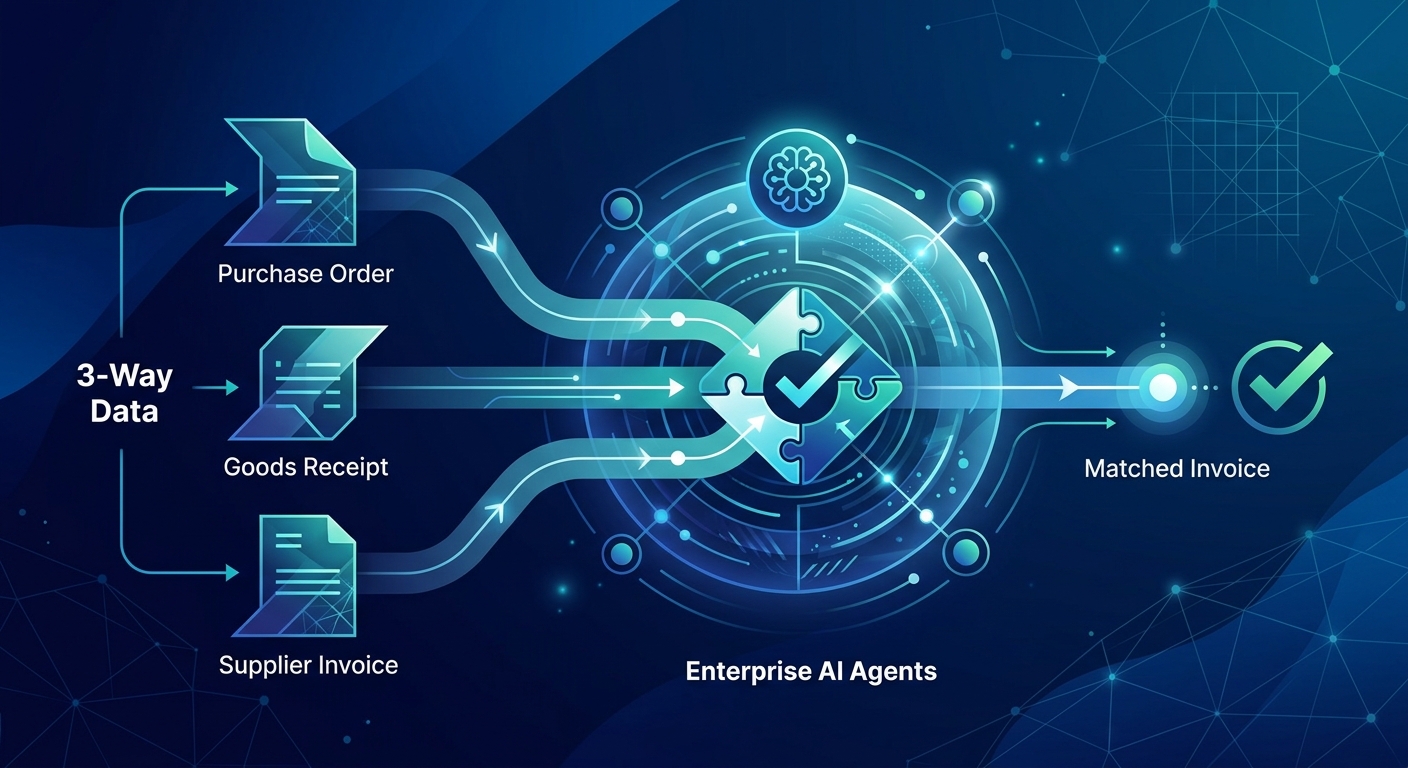
Manual accounts payable workflows cannot scale with modern enterprise procurement volumes. As organizations face mounting pressure to optimize working capital and eliminate back-office friction, traditional invoice processing has become a strategic liability. This guide outlines how autonomous AI agents deliver zero-touch 3-way invoice matching, replacing unpredictable labor costs with measurable financial outcomes.
The Hidden Cost of Traditional 3-Way Matching
Traditional 3-way matching remains a systemic bottleneck for enterprise finance operations. Requiring manual cross-referencing of purchase orders, goods receipts, and supplier invoices, the process consumes 15–30 minutes of skilled labor per transaction (source). At scale, this overhead rapidly eclipses the strategic capacity of the AP function. Beyond direct payroll costs, manual reconciliation introduces severe compliance vulnerabilities. Human error drives duplicate payments, missed early-payment discounts, and exposure to sophisticated invoice fraud (source). When procurement, receiving, and billing data remain siloed across disconnected ERPs or email inboxes, AP professionals are reduced to administrative data handlers rather than financial controllers. This operational friction delays cash flow visibility, strains vendor relationships, and forces linear headcount scaling instead of working capital optimization.
Why Enterprise AI Agents Outperform Legacy AP Software
Legacy optical character recognition (OCR) and robotic process automation (RPA) platforms operate on rigid, rule-based triggers. They perform adequately on standardized documents but fracture when confronted with non-standard invoice formats, missing line items, or partial shipments. Enterprise AI agents deploy contextual reasoning and autonomous decision-making to interpret unstructured documents, reconcile discrepancies, and navigate complex approval hierarchies without manual intervention. Unlike static software requiring constant template maintenance, autonomous AP agents learn from historical resolutions and dynamically adapt to evolving vendor behaviors (source).
Critically, these agents integrate bi-directionally with core ERP ecosystems (SAP, Oracle, NetSuite, Dynamics 365). Rather than simply pushing matched invoices downstream, they natively pull vendor master data, validate tax codes, verify budget availability, and post general ledger entries directly within the financial system (source). This architectural shift eliminates middleware layers that traditionally cause data latency and reconciliation failures. For finance leaders evaluating modernization paths, understanding the fundamental differences between legacy tools and cognitive systems is essential: AI Agents vs. Traditional Automation.
The Autonomous 3-Way Matching Workflow
The autonomous 3-way matching workflow operates on a continuous, closed-loop architecture engineered for zero-touch execution. Secure, high-volume document ingestion allows AI agents to extract, classify, and normalize line-item data from PDFs, scanned images, EDI streams, and vendor portals. In real time, the agent queries the ERP to retrieve corresponding purchase orders and receiving logs, performing a granular comparison across quantities, unit prices, SKUs, freight charges, and payment terms.
When data aligns within pre-configured tolerance thresholds, the agent validates the match and routes the invoice directly to payment scheduling—delivering cycle times up to 2X faster than manual baselines (source). When discrepancies arise, the agent does not halt the pipeline. It triggers autonomous resolution protocols: cross-referencing partial delivery receipts, applying contractual volume discounts, or initiating secure vendor communications to clarify variances. Every validation step and communication thread is securely timestamped, generating an immutable audit trail that satisfies SOX compliance, ISO standards, and internal risk mandates. This transparent framework ensures that while manual touchpoints are eliminated, financial oversight is strengthened through real-time, exception-driven monitoring. By deploying AI Invoice Processing Agents, enterprises transition from reactive error-chasing to proactive cash optimization.
The meo Advantage: Pay-For-Performance AP Automation
Traditional AP automation vendors rely on fixed-licensing or per-seat subscriptions that penalize scale and decouple software costs from actual business outcomes. meo eliminates this structural misalignment through a strict pay-for-performance pricing architecture. Organizations invest only when autonomous AI agents successfully match, validate, and route invoices for payment. If the agent fails to deliver a verified, compliant match, the client incurs zero cost. This model transforms AP from a fixed cost center into a variable, performance-driven function. Success is rigorously measured against enterprise-grade KPIs: first-pass match rates, cycle-time reduction, and days payable outstanding (DPO) optimization.
Because agent capacity scales elastically with invoice volume, finance leaders avoid capital expenditures on additional headcount, server infrastructure, or software seats. During seasonal procurement spikes, M&A integrations, or supplier consolidation, meo’s Pay-for-Performance Model automatically provisions additional processing power while holding to the agreed performance targets. Every deployed dollar directly correlates to processed invoices, captured early-payment discounts, and eliminated exception queues.
Execution Roadmap: From Baseline to Enterprise Scale
Deploying autonomous AP agents requires precision configuration, not disruptive system overhauls. meo’s execution methodology begins with secure, encrypted data onboarding and historical workflow benchmarking, establishing a clear performance baseline before automation activates. We then execute a phased, parallel deployment where AI agents process live invoices alongside existing AP staff. This validation phase confirms match accuracy against human decisions without impacting live payment rails, allowing controllers to calibrate tolerance thresholds, approve exception-handling logic, and build operational confidence.
Once performance targets consistently exceed baselines, the system transitions to autonomous production, and legacy manual processes are systematically retired. Post-deployment, continuous Agent Monitoring & Quality Assurance ensures models adapt to new vendor formats, contract amendments, and regulatory shifts. Our dedicated engineering team provides iterative optimization, tracking performance metrics and refining resolution protocols to maximize first-touch accuracy. By adhering to this structured Implementation Methodology, organizations seamlessly transition from fragmented, labor-intensive workflows to a fully scalable, zero-touch AP function with zero operational disruption.
Conclusion
3-way invoice matching is no longer a back-office administrative task; it is a strategic lever for working capital optimization and financial resilience. Enterprise AI agents eliminate the manual friction, compliance exposure, and fixed licensing costs that have historically constrained AP scalability. With meo’s pay-for-performance model, your organization invests only when verified matches drive tangible business results. Shift your AP strategy from fixed licensing to measurable outcomes. Contact our automation specialists to benchmark your current workflow and deploy autonomous agents on a performance-backed contract.