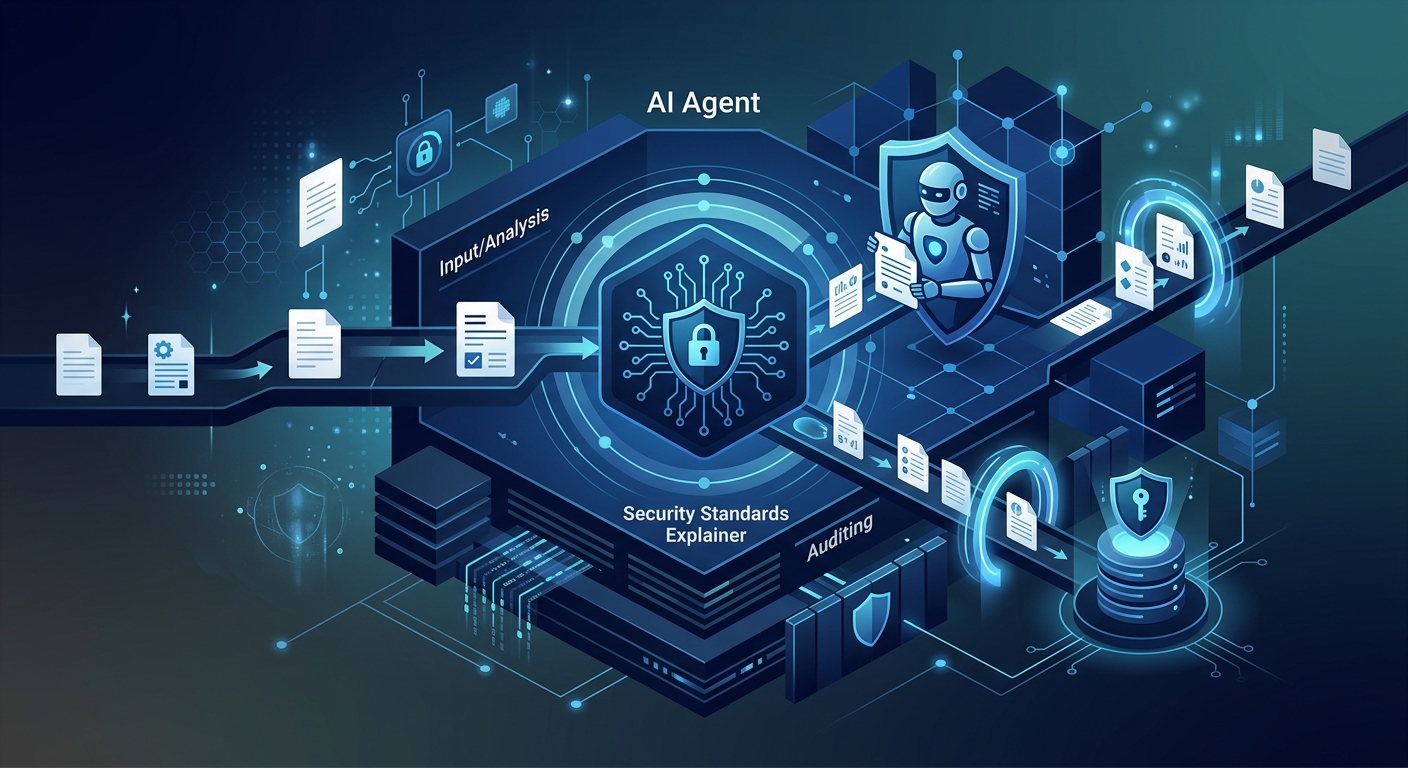
As traditional organizations scale AI back-office automation, the conversation has decisively shifted from experimental throughput to enterprise-grade security. Autonomous systems no longer operate as isolated pilots; they are integrated into mission-critical financial workflows where data integrity, regulatory compliance, and operational velocity are non-negotiable. At meo, we treat security not as a compliance checkbox, but as a performance multiplier. Enterprise-grade controls eliminate deployment risk, accelerate processing cycles, and establish the foundation for measurable ROI. Deploying document processing agents on rigorous security architectures transforms speculative technology investments into predictable, accountable workforce capacity.
The Executive Imperative: Security as the Foundation of AI ROI
Transitioning from proof-of-concept to enterprise production requires a fundamental architectural shift. Legacy perimeter defenses and manual oversight cannot govern modern autonomous agents. Traditional risk frameworks assume predictable human intervention points, but agentic systems execute decisions at machine speed across distributed data environments. As industry analysis confirms, agentic document processing demands cleaner, more secure integration with downstream systems than most legacy infrastructures currently support [1]. Without zero-trust foundations, organizations face unquantifiable exposure to data leakage, model drift, and compliance violations that instantly erase projected labor savings.
Secure architectures directly drive higher extraction accuracy, faster cycle times, and verified financial outcomes. When data is isolated, validated, and processed within cryptographically secured environments, agents operate with reduced noise and higher confidence thresholds. This precision reduces manual exception reviews, accelerates approval routing, and eliminates operational friction. For executives, the imperative is clear: proactive security controls are not a cost center. They are the prerequisite for replacing unpredictable labor overhead with measurable, scalable outcomes. Security-first deployments consistently accelerate time-to-value while eliminating the hidden costs of remediation, reprocessing, and regulatory penalties.
Core Security Architecture: Zero-Trust by Design
Enterprise-grade document processing agents require a security architecture built on zero-trust principles, where every data interaction is verified, encrypted, and strictly scoped. At the core of meo’s deployment model are isolated execution environments that prevent cross-tenant data contamination. Sensitive financial documents are processed within containerized workloads secured by AES-256 encryption at rest and TLS 1.3 in transit. Ephemeral, just-in-time credential provisioning ensures authentication tokens expire immediately upon task completion, eliminating persistent access key vulnerabilities.
Role-based access control (RBAC) and least-privilege principles are rigorously enforced across financial workflows. Agents receive only the exact data fields and system permissions necessary to execute specific AI-driven data entry tasks. An agent processing vendor invoices, for example, is strictly blocked from accessing unrelated HR records or banking configurations. This granular scoping prevents lateral movement and enforces rigid data boundaries. Production-grade systems require continuous behavioral anomaly monitoring [2]. Real-time telemetry tracks extraction patterns, routing logic, and processing velocity. If an agent deviates from baseline parameters or exhibits signs of model drift, automated kill-switches instantly halt execution, quarantine the process, and alert human supervisors. This prevents unauthorized data exfiltration and ensures high-volume processing never compromises financial integrity.
Compliance & Auditability: Regulatory-Ready by Default
Deploying accounts payable AI agents requires seamless alignment with stringent regulatory frameworks without introducing custom engineering bottlenecks. meo works under your security and privacy requirements, such as SOC 2, ISO 27001, GDPR, SOX, and PCI-DSS control objectives, and can complete your vendor security review. This compliance-first approach gives organizations audit-ready controls from day one, eliminating the need to retrofit legacy systems to meet evolving standards. Transparent, standardized protocols guarantee that AI integration enhances both security and workflow collaboration [3].
The cornerstone of regulatory auditability is an immutable, cryptographically signed audit trail. Every document ingestion, field extraction, validation check, and approval routing decision is logged with timestamped, tamper-evident records. This satisfies internal audit committees and external regulators by providing complete data lineage transparency. Unlike legacy automation that buries logic in proprietary logs, our agents generate transparent decision records that clearly explain the rationale behind every data classification and routing action. This accountability enables organizations to demonstrate compliance in real-time without sacrificing operational velocity. Auditors can query specific invoice batches or payment cycles and receive instant, verifiable proof of automated compliance, which takes much of the manual work out of audit preparation.
The Pay-for-Performance Security Guarantee
meo fundamentally redefines how organizations finance AI automation by tying security SLAs directly to measurable business results. Our pay-for-performance model operates on a simple, executive-aligned principle: if secure, accurate processing is not delivered, no cost is incurred. This contractual risk-sharing structure eliminates speculative AI overhead and guarantees accountability for both data integrity and extraction accuracy. Organizations no longer pay for platform licenses, compute consumption, or engineering hours; they pay exclusively for verified, compliant business outcomes.
Under this framework, security is not a retroactive compliance exercise. It is a continuous, contractually enforced operational metric. Every deployment includes real-time compliance validation, performance benchmarking against baseline SLAs, and automated accuracy reconciliation. If an agent fails to meet predefined security thresholds—whether through data handling anomalies, audit trail gaps, or accuracy degradation—the performance guarantee triggers immediate remediation protocols and financial adjustments. This aligns vendor accountability with client ROI, directly tying security investments to labor cost reduction. Executives gain predictable financial forecasting, while operations teams receive an accountable, self-optimizing workforce that scales only when it delivers verified results.
Implementation Roadmap: Secure, Phased Deployment
Deploying AI-driven data entry safely requires a phased, sandbox-to-production methodology that isolates legacy vulnerabilities while progressively scaling agent capabilities. Initial deployments operate in isolated staging environments that mirror production ERP architectures without exposing live financial data. This sandbox validates extraction logic, compliance routing, and security controls under rigorous load testing prior to live integration.
Secure API gateways and middleware then integrate agents with existing financial systems. These integration layers maintain native ERP controls, enforce strict input/output validation, and ensure network perimeters remain uncompromised. Organizations can scale AI back-office automation incrementally, starting with high-volume, low-risk document streams before expanding to complex contract or cross-border payment workflows. Structured, secure integration pathways enable 24/7 autonomous processing with enterprise-grade precision [4].
Post-deployment, continuous security posture monitoring runs parallel to performance benchmarking. Telemetry tracks processing velocity, accuracy rates, compliance adherence, and anomaly frequency. This dual-metric tracking ensures workforce scaling remains both predictable and accountable. As agent fleets grow, security controls automatically adjust to maintain zero-trust integrity, enabling organizations to systematically replace manual overhead with a predictable, auditable, and financially optimized AI workforce.
Conclusion
Enterprise-grade security is no longer a barrier to AI back-office automation; it is the engine that drives predictable ROI, regulatory compliance, and operational scale. By transitioning from experimental pilots to auditable, outcome-driven deployments, organizations can eliminate deployment risk and replace unpredictable labor costs with a pay-for-performance workforce. meo delivers secure, compliant, and highly accountable document processing agents that integrate seamlessly into existing financial infrastructure. Schedule a strategic deployment assessment with our architecture team to discover how security-first automation transforms your back office into a measurable, high-performance advantage.