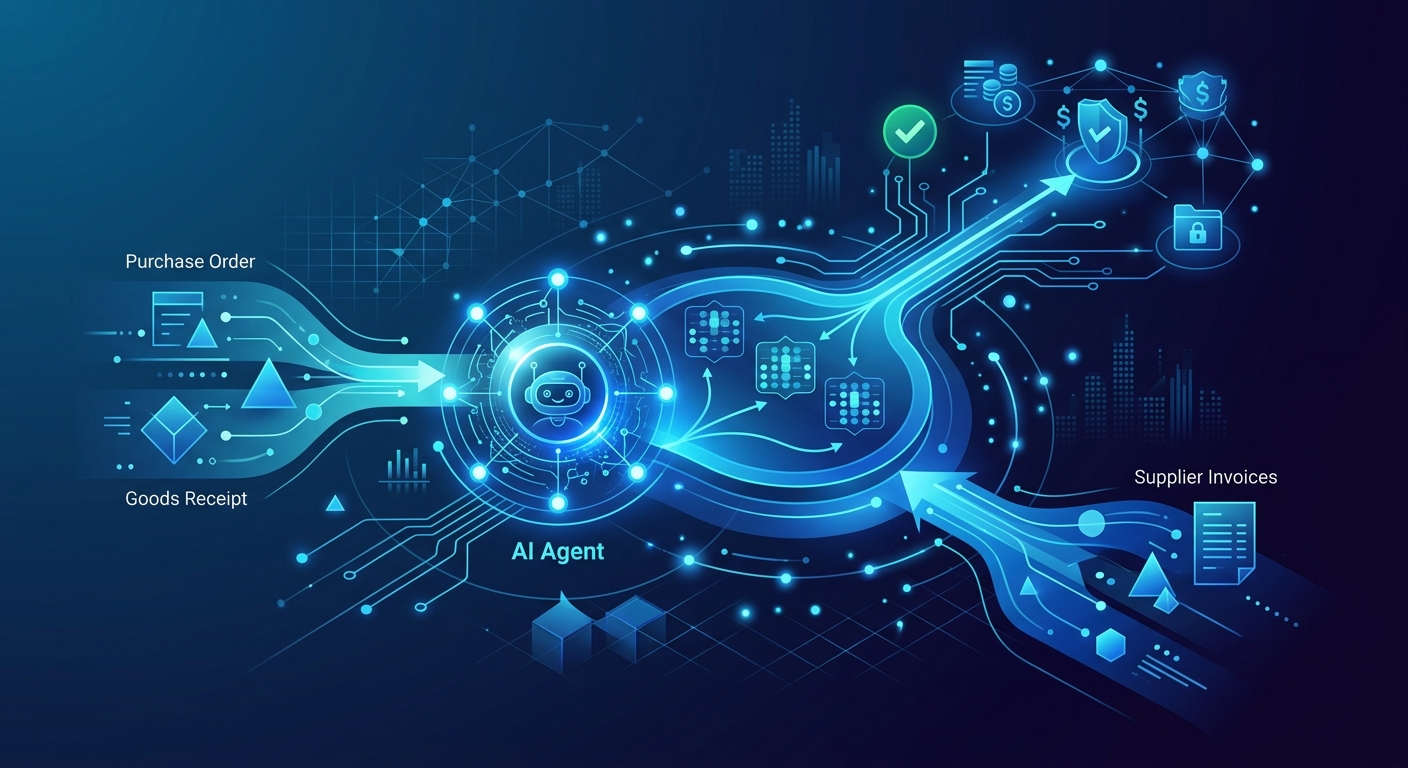
Accounts payable is no longer a back-office support function; it is a strategic control point for working capital, vendor relations, and financial integrity. Yet three-way invoice matching—the process cornerstone—remains persistently manual, error-prone, and resource-intensive. meo treats intelligent automation not as another software license, but as the deployment of an autonomous, outcome-driven workforce. By replacing administrative labor overhead with accountable AI agents, finance leaders improve match accuracy, eliminate reconciliation bottlenecks, and transform AP from a cost center into a measurable value driver.
The Operational and Financial Cost of Manual Matching
Traditional AP workflows drain working capital through operational friction. Manual three-way matching consumes 6 to 10 hours per hundred invoices, with baseline error rates consistently hovering between 2% and 4% across mid-market enterprises Rillion. Each discrepancy triggers late payment penalties, strained supplier relationships, and forfeited early-payment discounts. This reconciliation bottleneck forces finance teams into reactive firefighting instead of proactive cash flow management.
Legacy rule-based automation fails to scale. Static scripts and basic RPA bots rely on rigid logic that fractures under document variability. Altered PO formats, non-standard receipts, or scanned invoices with marginal artifacts immediately break workflows and force human intervention. When rules cannot adapt, organizations simply digitize manual inefficiency, retaining labor overhead while claiming automation maturity.
How Enterprise AI Agents Transform AP Operations
The operational paradigm has shifted from rigid automation to cognitive execution. Unlike RPA, which mimics keystrokes, enterprise AI agents reason, adapt, and self-correct in real time. They dynamically interpret context, validate cross-references, and adjust matching logic as vendor documentation evolves. This capability defines modern AI back office automation.
Agents integrate natively into existing ERP and procurement ecosystems via secure, bi-directional APIs. They pull live master data, post verified transactions, and operate continuously without middleware or architectural disruption. Organizations are no longer deploying isolated point solutions; they are scaling an accountable workforce governed by strict SLAs. Each agent owns the matching lifecycle, enforces financial controls, and increases throughput without incremental headcount or management overhead.
The Mechanics of Autonomous Three-Way Verification
Autonomous verification follows a precise, zero-touch workflow. The system simultaneously ingests, parses, and structures purchase orders, goods receipts, and supplier invoices. It cross-references line items, quantities, unit pricing, tax codes, and payment terms, ensuring alignment before routing approvals downstream. As industry analysis confirms, AI agents do not bypass accounting rules; they enforce them with unprecedented speed, contextual awareness, and mathematical precision Saxon.ai.
When discrepancies occur—quantity variances, pricing mismatches, or partial deliveries—agents autonomously investigate against pre-approved tolerance thresholds. They flag incomplete shipments and initiate vendor resolution workflows without human oversight. Edge cases trigger structured escalations to procurement or finance stakeholders, complete with compiled context, highlighted variances, and recommended resolution paths. This closed-loop architecture maintains processing velocity while guaranteeing audit readiness.
Scaling Document Intelligence and Data Extraction
Scaling invoice verification requires moving beyond basic OCR to contextual document intelligence. Advanced agents leverage vision-language models and semantic parsing to extract, validate, and normalize unstructured vendor data across highly diverse formats—including complex PDFs, low-quality scans, EDI streams, and email attachments Medium/UBIAI. This capability eliminates manual data entry overhead while sustaining enterprise-grade accuracy above 99.5%.
Enterprise deployment requires uncompromising security and seamless integration. Agents operate within sovereign cloud environments with strict data residency controls, AES-256 encryption at rest and in transit, and granular role-based access governance. Legacy ERP integration uses read-only API connectors that sync master data and post verified results without schema modifications or intrusive custom code. Decoupling data capture from human intervention transforms chaotic vendor submissions into structured, compliance-ready financial records.
Measuring Performance: KPIs, Audit Trails, and SOX Compliance
Every deployment is engineered for full accountability. Finance leaders track exact, continuously updated metrics: straight-through match rates, processing cycle-time reduction, and fully loaded cost per invoice. Every validation and routing decision is logged in an immutable, cryptographically secured audit trail. This tamper-proof record ensures strict SOX compliance and dramatically simplifies external financial audits by providing complete, timestamped lineage for every transaction.
Real-time executive dashboards replace static spreadsheets, aligning AP performance directly with corporate financial objectives. As three-way matching integrates into broader payable frameworks, continuous monitoring keeps agent output predictable, scalable, and transparent to the C-suite VirtualWorkforce.ai. Finance teams no longer estimate efficiency gains; they measure them against contractual benchmarks and optimize operational parameters dynamically.
The Pay-for-Performance Model: Eliminating Licensing Risk
Traditional enterprise software demands heavy upfront licensing, expensive implementation consulting, and ongoing maintenance regardless of output. meo’s pay-for-performance framework inverts this financial dynamic. Clients invest only when agents successfully match, verify, and clear invoices against predefined accuracy and compliance thresholds. This risk-reversal structure aligns vendor incentives with your financial outcomes, eliminates sunk-cost deployments, and targets measurable ROI from day one.
Once core matching is optimized, agents scale naturally into adjacent workflows: contract compliance verification, automated vendor onboarding, and dynamic discount capture. By treating AI as an accountable partner rather than an open-ended IT project, CFOs systematically replace administrative labor overhead with predictable, auditable, and scalable business results.
Conclusion
Three-way invoice matching no longer requires manual intervention or fragile architectures. It demands an intelligent, continuously operating workforce engineered for precision, compliance, and scale. Partner with meo to transform your accounts payable function into a transparent, performance-driven engine that pays only for verified financial outcomes. Schedule a deployment assessment to begin scaling accountable AI across your enterprise.