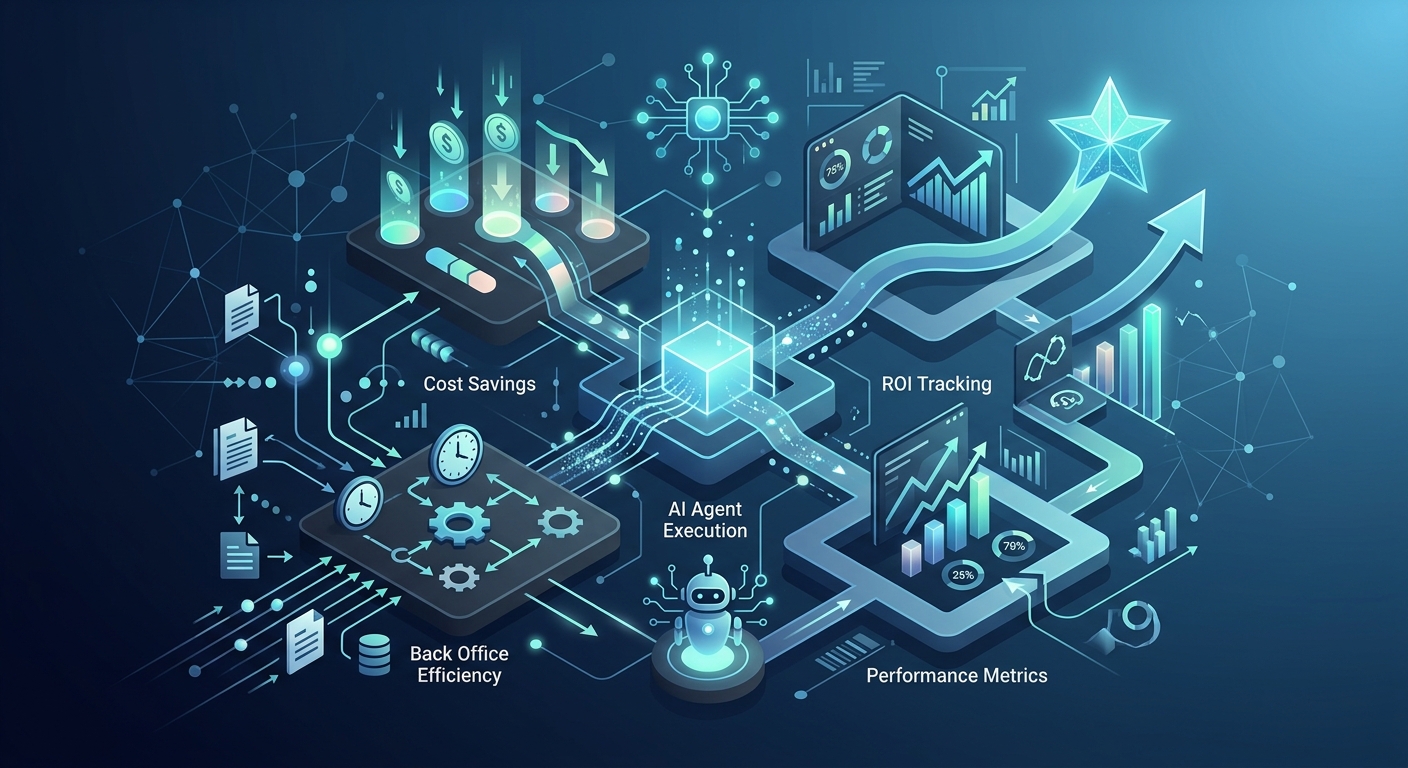
Traditional back offices rely on fixed-cost labor models that scale linearly with volume, breeding structural inefficiencies, seasonal bottlenecks, and hidden administrative drag. As enterprises adopt AI back office automation, success metrics must shift from headcount to transaction-level outcomes. Yet most ROI initiatives fail. They track vanity metrics like “hours saved” or unattributed cost avoidance while overlooking integration, maintenance, and licensing costs. Industry analysis confirms the gap: 78% of companies now deploy operational AI, but only 26% capture attributable ROI. meo closes this gap with an outcome-validation framework that ties agent deployment directly to auditable financial performance. Rather than funding speculative infrastructure, enterprises adopt pay-for-performance AI workforce models that compensate only verified results. This approach replaces unpredictable overhead with scalable, accountable automation. By anchoring evaluation to completion rates, error reduction, and cycle-time compression, executives audit back-office operations with precision. The outcome is a leaner, elastic operating model where AI agents function as a measurable workforce—not an IT experiment.
Core Metrics That Define Back Office AI Performance
Theoretical capacity gains mean nothing without operational baselines. Pre-deployment benchmarking is mandatory: track task completion times, fully loaded labor costs, and baseline exception rates before deploying autonomous agents. Foundational KPIs—cost-per-transaction, processing velocity, and first-pass yield—strip away vendor marketing and reveal whether automation actually compresses operational drag.
Continuous monitoring of accuracy degradation and exception-handling ratios is critical. AI models inevitably encounter edge cases. Tracking human escalation frequency and its associated cost prevents hidden bottlenecks from eroding projected savings. True overhead reduction also requires a clear distinction between theoretical throughput and actual labor displacement. Many enterprises mistake faster processing for cost elimination, ignoring legacy system maintenance, licensing fees, and model retraining expenses.
meo’s framework isolates verifiable savings by mapping agent output directly against baseline FTE equivalents and operational spend. If velocity increases but exception routing demands proportional human oversight, net ROI stagnates. When agents sustain first-pass yields above 95% with minimal calibration, savings compound. By enforcing disciplined metric boundaries, executives separate genuine efficiency gains from inflated projections, ensuring every deployed agent drives measurable bottom-line impact.
Measuring Accounts Payable and Document Processing Agents
High-volume financial workflows demand rigorous auditing and uncompromising compliance guardrails. When deploying accounts payable AI agents, enterprises must align invoice-to-cash cycle benchmarks directly with working capital targets and vendor payment terms. These agents autonomously match purchase orders, route approvals, execute payments, and maintain audit-ready trails. Modern platforms integrate natively with core ERP ecosystems, enabling real-time reconciliation without disrupting existing financial infrastructure.
For document processing agents, performance hinges on extraction accuracy, classification speed, and regulatory adherence. Unstructured data ingestion remains a critical bottleneck; agents must demonstrate consistent, field-level precision across invoices, contracts, and vendor onboarding forms. Benchmarking classification latency against legacy OCR reveals true velocity, while monitoring compliance flags guarantees automated workflows never bypass risk controls. Financial leaders evaluate success by the reduction in manual touchpoints—not raw processing volume.
Data entry automation AI requires equally stringent reconciliation protocols. The priority is preventing error propagation: agents must cross-validate inputs against master data repositories before committing to transactional ledgers. Synchronization with legacy systems is equally critical. When bridging LLM capabilities with older databases, latency and API failure rates must remain within strict enterprise thresholds. Automation maturity now operates across three tiers—task elimination, workflow orchestration, and autonomous decisioning—each requiring targeted measurement protocols. By isolating performance at each tier, finance teams attribute savings directly to agent output. Reducing AP cycle time from 12 days to 48 hours while cutting duplicate payments by 90%, for example, delivers immediate, auditable ROI. meo tracks these outcomes at the transaction level, ensuring agents are evaluated on financial impact, not throughput volume.
The Pay-for-Performance Validation Model
Traditional AI procurement traps enterprises in speculative licensing models that reward deployment, not delivery. meo’s pay-for-performance structure flips this approach by tying contractual compensation directly to verified output. Payouts trigger only when agents hit pre-agreed benchmarks for cost reduction, cycle-time compression, and accuracy. This eliminates the financial drag of underperforming infrastructure and permanently aligns vendor incentives with enterprise outcomes.
Real-time dashboards deliver transparent, auditable visibility into agent productivity, exception routing, and cumulative ROI. Executives monitor live transaction logs, benchmark output against baseline labor costs, and validate savings without waiting for quarterly consulting reviews. As the market shifts toward autonomous workflows, legacy RPA accountability mechanisms fall short. Tying compensation to measurable business results prevents organizations from scaling unproven automation into mission-critical functions.
The model also mandates continuous optimization. Subpar agents automatically trigger recalibration or replacement clauses, keeping the deployed workforce synchronized with shifting operational targets. Financial leaders stop funding speculative pilots and start purchasing verified outcomes. This validation framework elevates back-office technology from a discretionary cost center to a performance-driven asset. When capital expenditure correlates directly to lower processing costs, tighter compliance, and accelerated cash conversion, AI adoption ceases to be an IT experiment and becomes disciplined capital allocation.
Executive Implementation Blueprint for Scalable Deployment
Scaling AI back office automation requires phased execution, not enterprise-wide disruption. Start with pilot validation: isolate one high-volume workflow, lock in baseline metrics, and deploy agents under controlled, audited conditions. Once transaction-level accuracy and target cost-per-transaction rates stabilize, advance to full system integration. Agents must interface natively with existing ERPs, document management platforms, and compliance databases without introducing architectural fragility.
Governance protocols are mandatory. Define explicit human-oversight pathways, exception-routing rules, and continuous model calibration schedules. While AI agents operate autonomously, executive accountability demands structured intervention frameworks. As deployment scales, strategy must pivot from experimental generalists to specialized systems engineered to drive specific financial objectives.
Measure compounding ROI through workforce reallocation and operational elasticity. As agents absorb repetitive functions, redeploy human capital toward strategic analysis, vendor negotiation, and process optimization. This shift generates secondary value that compounds each quarter. Monitor elasticity metrics to verify how rapidly the automated workforce scales during peak volume without proportional cost increases. Disciplined rollout phases and rigorous governance boundaries convert AI from a tactical pilot into a permanent, scalable operational advantage.
Conclusion: Building an Accountable, Outcome-Driven Back Office
The modern back office must transition from a structural cost center to a measurable value engine. Executives who audit legacy workflows and deploy accounts payable AI agents and document processing agents under a pay-for-performance model secure a sustainable competitive advantage. meo’s outcome-validated framework ties capital deployment to verified, transaction-level results. Speculative AI overhead is obsolete. Accountable, outcome-driven automation is the new enterprise standard.