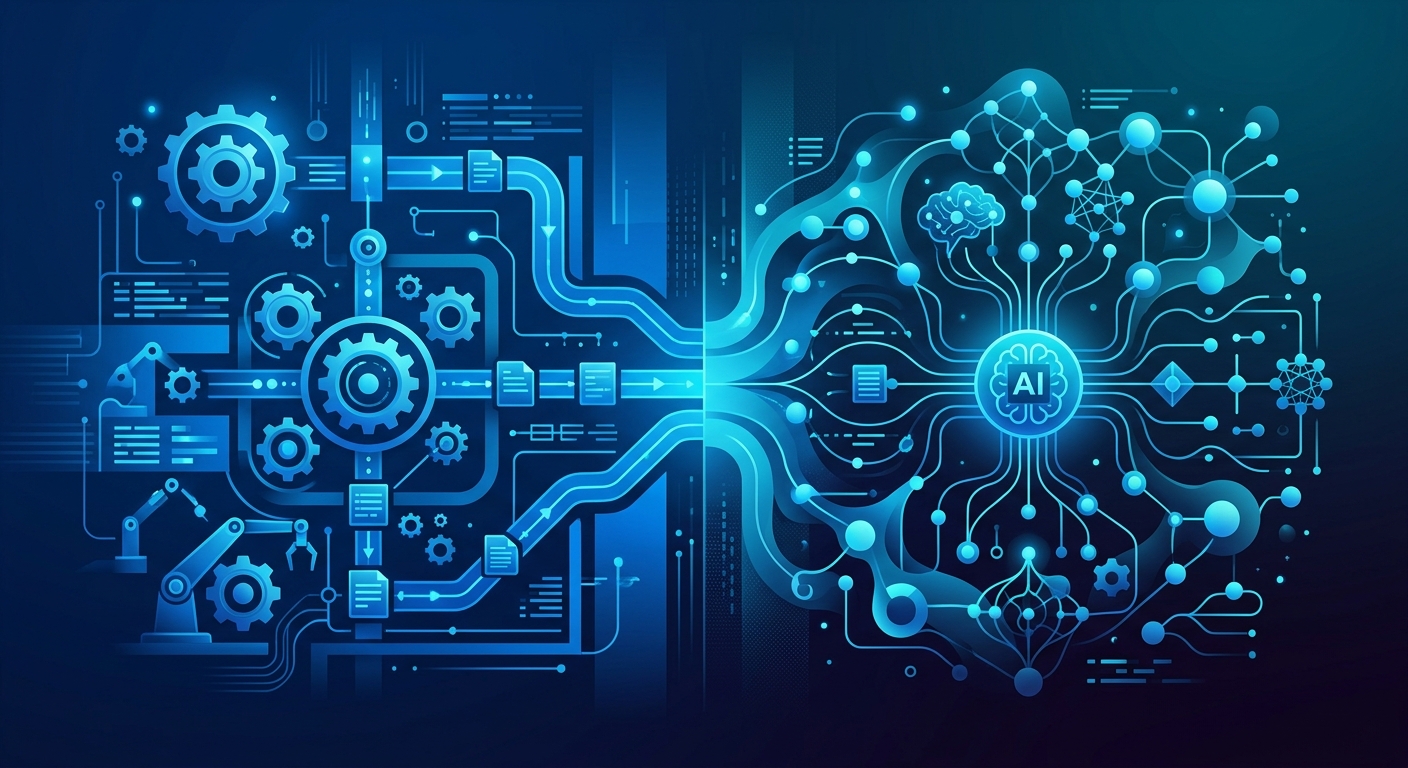
In the modern enterprise landscape, the distinction between Robotic Process Automation (RPA) and Artificial Intelligence (AI) defines the boundary between simple execution and cognitive reasoning. As organizations seek to scale efficiency, understanding the nuances of RPA vs AI is no longer a technical luxury but a strategic necessity. While RPA acts as the "digital muscle," executing repetitive tasks with unwavering precision, AI serves as the "digital brain," capable of interpreting complex patterns and making probabilistic decisions.
According to UTI, RPA is designed for structured, rule-based tasks that follow a clear sequence, such as copying data between systems or processing high-volume transactions. Conversely, AI is required for tasks involving interpretation, analysis, or problem-solving, such as natural language processing (NLP).
Key Takeaways
- RPA is Rule-Based: It excels at "doing" tasks that follow strict, pre-defined logic without deviation.
- AI is Data-Driven: It focuses on "thinking," using machine learning to handle unstructured data and uncertainty.
- Integration is Key: The most successful enterprises combine both to create Intelligent Process Automation (IPA).
- ROI Differences: RPA offers quick wins (3–18 months), while AI provides long-term value through adaptive learning.
What is RPA (Robotic Process Automation)?
Robotic Process Automation (RPA) is a technology that uses software scripts—often called "bots"—to emulate human actions within digital systems. It is primarily used to automate high-volume, repetitive tasks that are governed by strict rules. Because RPA operates at the user interface level, it can interact with legacy systems just as a human would, clicking buttons, copying fields, and moving files without requiring complex API integrations.
UTI notes that RPA is specifically designed for structured tasks. For example, in a finance department, an RPA bot might be programmed to open an email, download a standardized CSV invoice, and input that data into an ERP system. If the invoice format never changes, the bot will perform the task with 100% accuracy and at a speed no human can match.
What is AI (Artificial Intelligence)?
Artificial Intelligence (AI) is a broad field of computer science focused on creating systems capable of performing tasks that typically require human intelligence. Unlike RPA, which follows "if-then-else" logic, AI uses algorithms to recognize patterns, learn from data, and make predictions.
AI is essential for processing unstructured data—information that does not fit neatly into rows and columns, such as emails, voice recordings, or handwritten notes. While RPA mimics human actions, AI mimics human cognition. In the context of business automation, AI often takes the form of Machine Learning (ML), Natural Language Processing (NLP), or Computer Vision. This allows the system to "understand" the context of a request rather than just follow a script.
Key Differences Between RPA vs AI
The fundamental difference between RPA and AI lies in their approach to data and logic. RPA is deterministic; given the same input, it will always produce the same output based on fixed rules. AI is probabilistic; it evaluates data and provides the most likely correct response based on its training.
| Feature | Robotic Process Automation (RPA) | Artificial Intelligence (AI) |
|---|---|---|
| Core Function | Mimics human actions (Doing) | Mimics human intelligence (Thinking) |
| Data Type | Structured | Unstructured and Semi-structured |
| Logic | Rule-based (Deterministic) | Data-driven (Probabilistic) |
| Adaptability | Fragile; breaks if UI changes | Adaptive; learns from new data |
| Complexity | Simple, repetitive workflows | Complex, cognitive problem-solving |
Key Insight: RPA is the "digital muscle" that handles the heavy lifting of data entry, while AI is the "digital brain" that decides what data needs to be entered and why.
How RPA and AI Work Together: The Rise of IPA
While the RPA vs AI debate often frames these technologies as competitors, the reality is that they are highly complementary. When integrated, they form what is known as Intelligent Process Automation (IPA). In an IPA framework, AI acts as the front-end processor that makes sense of messy data, and RPA acts as the back-end executor that carries out the resulting actions.
For example, consider a customer service workflow. An AI model (NLP) can read an incoming customer email to determine the intent (e.g., a refund request) and extract the relevant order number. Once the AI has "interpreted" the request, it passes the structured data to an RPA bot, which then logs into the legacy billing system to process the refund. This end-to-end automation reduces human intervention to nearly zero.
Common Applications of RPA and AI in Industry
Different sectors use the strengths of both technologies to address specific pain points. In healthcare, the impact is particularly visible. According to a narrative review in PMC11489308, RPA and AI reduce healthcare costs by automating administrative tasks, minimizing errors, and streamlining operations.
Healthcare Use Cases
- RPA: Automating patient scheduling and billing claims processing to reduce manual labor.
- AI: Improving diagnostics and patient management by analyzing medical imagery or predicting patient readmission rates.
Financial Services Use Cases
- RPA: Reconciling bank statements and generating standard compliance reports.
- AI: Detecting fraudulent transaction patterns that deviate from a user's normal behavior.
Technical Prerequisites for Transitioning to AI-Integrated Systems
One significant gap in standard automation guides is the failure to address the infrastructure required to move from basic RPA to AI-integrated systems. Organizations must ensure a robust infrastructure with sufficient computing resources, strong network connectivity, and compatibility with existing systems.
To successfully transition to an AI-integrated IPA system, the environment must support the processing of both structured and unstructured data. This often requires moving from on-premise legacy servers to cloud-based environments that can handle the high-compute demands of machine learning models. Furthermore, data governance is critical; AI is only as good as the data it is trained on, meaning organizations must clean and label their data before AI can deliver meaningful ROI.
Maintenance Cycles and 'Bot Decay' vs AI Learning
A critical operational difference between these technologies is how they are maintained over time. Rule-based RPA scripts are deterministic and fragile. They are susceptible to "bot decay"—a phenomenon where the automation fails because a software vendor updated a button's location or changed a field name in a web form. This requires constant maintenance and manual rewriting of scripts.
In contrast, self-learning AI models are adaptive. While they require initial "training" and periodic "tuning," they can handle variations in data more gracefully. A machine learning model used for document extraction does not care if the text is moved two inches to the left; it identifies the data based on context and visual patterns, significantly reducing maintenance pressure compared to rigid RPA scripts.
Comparative ROI Timelines: Quick Wins vs Long-term Value
When evaluating RPA vs AI, decision-makers must weigh the speed of return against the depth of impact. RPA typically offers a rapid ROI timeline ranging from 3 to 18 months. Because the implementation is straightforward and does not require deep data science expertise, companies can see immediate cost savings in labor hours.
AI agents and cognitive models have a wider variance. While some lightweight AI agents can achieve ROI in as little as 2 to 3 months, large-scale enterprise AI deployments may take up to 24 months to reach break-even. However, the value curve for AI is often exponential. While RPA value plateaus once the task is 100% automated, AI continues to improve its accuracy and decision-making capabilities as it processes more data, eventually far outpacing the initial investment.
"RPA and AI optimize resource allocation, enhance efficiency in billing and claims processing, and reduce the need for manual labor." — Increasing Trends of Artificial Intelligence With Robotic Process Automation in Health Care
Train for the Future: A New Career Path
As these technologies become ubiquitous, the demand for skilled professionals is shifting. Organizations are moving from traditional IT roles to specialized positions like RPA Developers, AI Ethics Officers, and Automation Architects. Programs like UTI's Robotics & Automation program are designed to bridge this gap, teaching students how to manage the hardware and software that drive these systems.
For professionals, this means moving away from manual data entry and toward managing the "digital workforce." Understanding how to orchestrate AI agents vs. traditional automation is becoming a core competency for operations managers and IT leaders alike. This shift is also reflected in the changing nature of computer and mathematical occupations, where the focus is moving from coding simple scripts to designing complex, self-healing automation ecosystems.
Choosing the Right Solution for Your Business Goals
Deciding between RPA and AI depends entirely on the problem you are trying to solve.
- Start with RPA if: Your process is stable, the data is structured, and the goal is to reduce human error in high-volume, repetitive tasks.
- Start with AI if: The process involves high levels of variability, requires the interpretation of text or images, or needs to make predictions based on historical data.
- Combine both if: You want to achieve true Intelligent Process Automation that handles both the cognitive and execution phases of a workflow.
For many enterprises, the journey begins with an RPA to Agentic AI Migration, slowly introducing cognitive capabilities into existing rule-based workflows to minimize disruption while maximizing efficiency.
Frequently Asked Questions
Is RPA a form of AI?
Technically, no. While both are forms of automation, RPA is rule-based and lacks the ability to learn or make autonomous decisions based on patterns. However, many modern RPA platforms now include "AI-lite" features like OCR (Optical Character Recognition) to bridge the gap.
Can AI replace RPA?
AI is not necessarily a replacement for RPA but rather an evolution. RPA is still more cost-effective for simple, high-volume tasks that do not require intelligence. Using AI to perform a simple data entry task is like using a supercomputer to solve 2+2—it is overkill and inefficient.
Which is more expensive to implement, RPA or AI?
Generally, AI has a higher initial cost due to the need for data scientists, large datasets, and significant compute power. RPA is typically cheaper to deploy initially but can carry higher long-term maintenance costs due to its fragility.
How does AI improve RPA bots?
AI improves RPA by providing "vision" (Computer Vision) and "understanding" (NLP). This allows bots to work with documents that are not perfectly standardized and to handle exceptions that would normally cause a standard RPA bot to fail.
What is the biggest risk of RPA?
The biggest risk is "process debt." If you automate a broken or inefficient process with RPA, you simply make the mistake happen faster. AI can help identify these inefficiencies, but RPA alone cannot fix a flawed workflow.