Title
Handling Workflow Exceptions With AI Agents vs RPA: Why Traditional Automation Fails at Scale
Answer Capsule
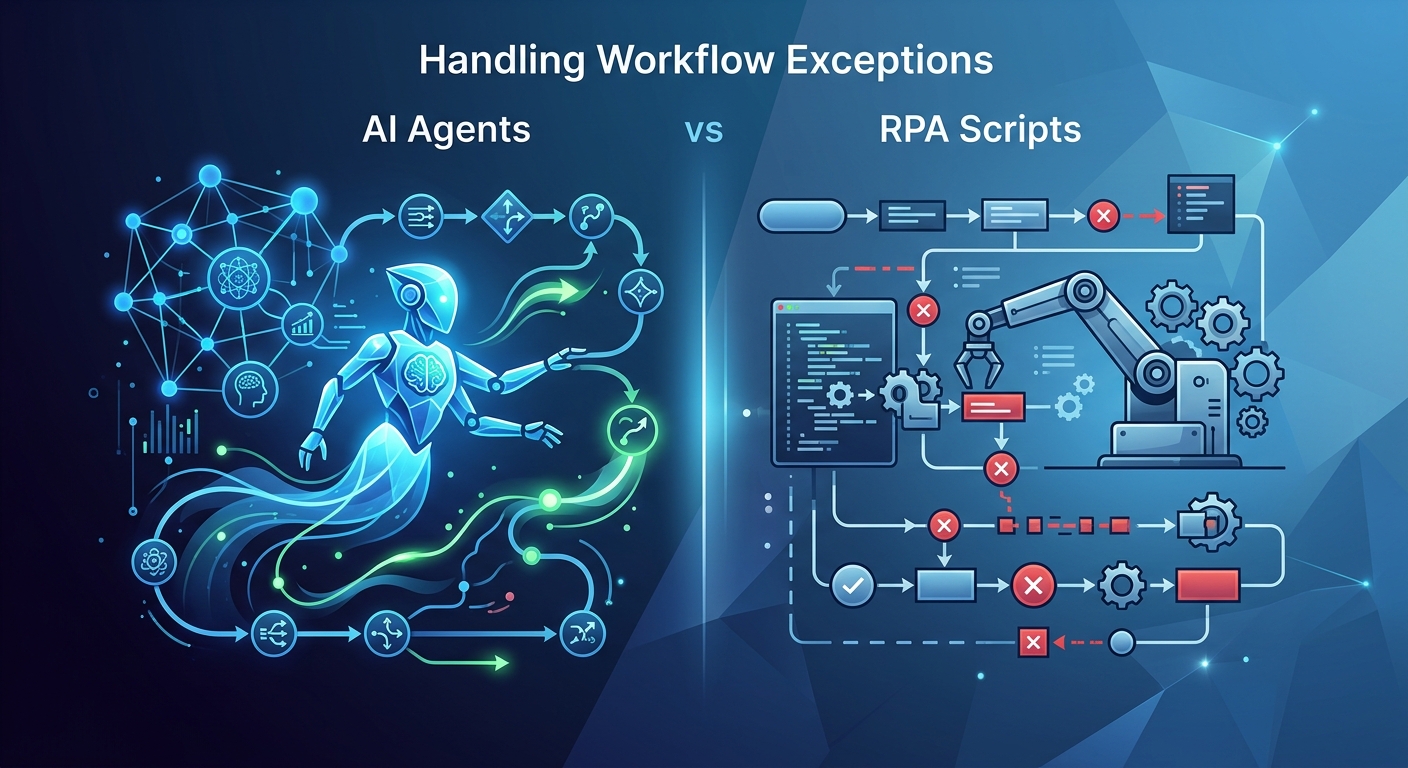
Question: How do AI agents handle workflow exceptions better than traditional RPA scripts? Answer: Unlike rigid RPA scripts that fail at edge cases and force manual escalation, AI agents use contextual reasoning and autonomous self-correction to resolve exceptions in real time. This dynamic, adaptive approach eliminates hidden labor overhead, ensures continuous operational uptime, and shifts automation from speculative IT maintenance to guaranteed, pay-for-performance business outcomes.
Content
Enterprise leaders were promised predictable automation through scripted workflows. Yet as traditional systems scale, they consistently break at a single point: workflow exceptions. When rigid scripts encounter unstructured data, policy shifts, or edge cases, execution halts. The resulting manual intervention quietly erodes projected ROI. The debate is no longer about feature parity; it is about operational resilience. Organizations relying on brittle, rule-based systems absorb compounding labor overhead. Forward-thinking enterprises are migrating to autonomous, outcome-driven architectures. At meo, we deploy agentic AI workforces that replace speculative automation investments with measurable results. This is how modern automation resolves the exceptions legacy systems cannot.
The Hidden Cost of Exception Handling in Legacy Automation
Traditional automation excels in deterministic environments. The moment a workflow encounters an edge case—a misaligned document field, an updated contract clause, or an anomalous data format—the script fails. Instead of resolving the anomaly, legacy systems halt and route exceptions to human operators. This forced intervention creates a hidden labor tax that directly undermines ROI projections. Every stalled workflow pulls specialized staff away from strategic initiatives for manual remediation. Unresolved exceptions compound quickly, transforming minor anomalies into systemic backlogs that stall throughput. Industry analysis shows that exception routing and maintenance routinely consume a significant portion of projected automation savings, turning capital investments into ongoing operational liabilities. The reality is straightforward: if your automation cannot self-correct, it is not scaling. It is centralizing operational risk. The true cost lies not in deployment, but in the unmeasured labor required to maintain it when reality diverges from the script.
How RPA Scripts Process Exceptions: The Fragility of Rule-Based Automation
Robotic Process Automation (RPA) operates on hard-coded logic and rigid decision trees designed exclusively for known variables. When confronted with novel or unstructured scenarios, these systems lack the cognitive flexibility to interpret context or adapt. Instead of resolving deviations, they trigger error states and default to human escalation queues. This creates invisible downtime that fractures SLAs and introduces unpredictable latency into core processes. Furthermore, IT teams bear a heavy maintenance burden, continuously patching scripts, updating selectors, and rewriting logic as upstream systems evolve. This cycle generates long-term technical debt, diverting engineering resources from innovation to reactive troubleshooting. The fragility of rule-based automation compounds at scale. A single upstream schema change can cascade across dozens of interdependent workflows, requiring synchronized updates and rigorous regression testing. Rather than reducing friction, brittle automation amplifies it, forcing executives to choose between costly overhauls or accepting chronic exception rates that degrade customer experience and operational velocity.
AI Agents vs Traditional Automation: Dynamic Resolution at Scale
The distinction between AI agents and traditional automation is defined by how each handles uncertainty. Where RPA fails and escalates, intelligent agents reason, adapt, and resolve. Powered by advanced reasoning frameworks and structured orchestration, agentic AI parses unstructured inputs, identifies anomalies, and executes autonomous self-correction. Rather than routing exceptions to human supervisors, agents triage deviations in real time, applying logical fallbacks, querying enterprise knowledge bases, and executing verified corrective actions. This capability replaces static rule maintenance with continuous, adaptive execution. By enforcing strict guardrails, scoped tool permissions, and deterministic verification layers, enterprises deploy autonomous systems that operate safely within governed parameters while maintaining uninterrupted throughput. The result is a shift from reactive maintenance to proactive execution. Agents learn from historical exceptions, refine decision boundaries, and optimize routing logic without manual code deployments. Operational uptime is no longer dependent on perfect data conditions; it is engineered through adaptive reasoning that scales human problem-solving at machine speed.
Agentic AI vs Rule-Based Automation: Measurable Outcomes Over Maintenance
Evaluating agentic AI against rule-based automation requires a fundamental shift in value measurement. Traditional metrics track script execution counts and system uptime, masking the true cost of exception routing and IT patching. Agentic architectures prioritize executive accountability and resolved workflow throughput. Instead of funding speculative CapEx for software licenses and maintenance contracts, organizations transition to outcome-based procurement. Pay-for-performance pricing aligns vendor incentives directly with business results, ensuring capital is deployed only when agents deliver verified, measurable outcomes. This model eliminates the financial risk of projects that stall at the exception-handling phase. When intelligent systems are accountable for end-to-end resolution, operational focus shifts from IT-driven troubleshooting to strategic throughput optimization. Leaders gain transparent visibility into exception rates, resolution times, and cost-per-transaction. The conversation pivots from keeping scripts running to scaling resolved volume. By tying investment directly to business impact, enterprises transform automation from a cost center into a predictable, revenue-protecting asset.
Deploying an Exception-Resilient Workforce With meo
At meo, we architect exception-resilient AI workforces for enterprise deployment. Our methodology begins with a phased migration from brittle scripts to governed, auditable AI agents that integrate seamlessly with existing infrastructure. We do not advocate for disruptive rip-and-replace overhauls. Instead, we deploy agentic layers that intercept high-friction workflows, apply contextual resolution, and maintain strict compliance with enterprise security and governance standards. Every agent operates with transparent logging, deterministic verification, and real-time performance telemetry, ensuring complete operational visibility. We back deployments with performance SLAs under our pay-for-performance model: organizations invest only when agents demonstrably resolve workflows and reduce labor overhead. This risk-mitigated approach removes deployment uncertainty while scaling predictable outcomes across complex, multi-system environments. By replacing speculative automation budgets with outcome-driven contracts, meo transforms operational infrastructure into a self-correcting, accountable workforce. The future of enterprise automation does not rely on writing more rules. It relies on deploying intelligent agents that deliver measurable results from day one.
Conclusion
The era of brittle automation is over. Organizations that continue to fund rigid scripts will remain trapped in cycles of manual triage, hidden labor costs, and degraded ROI. Transitioning to agentic AI is not a technological experiment; it is an operational imperative for enterprises demanding scalable, accountable workforces. Partner with meo to deploy an exception-resilient architecture that replaces speculative investments with verified outcomes. Schedule an executive briefing to see how our pay-for-performance model can optimize workflow throughput while permanently eliminating the hidden costs of legacy automation.