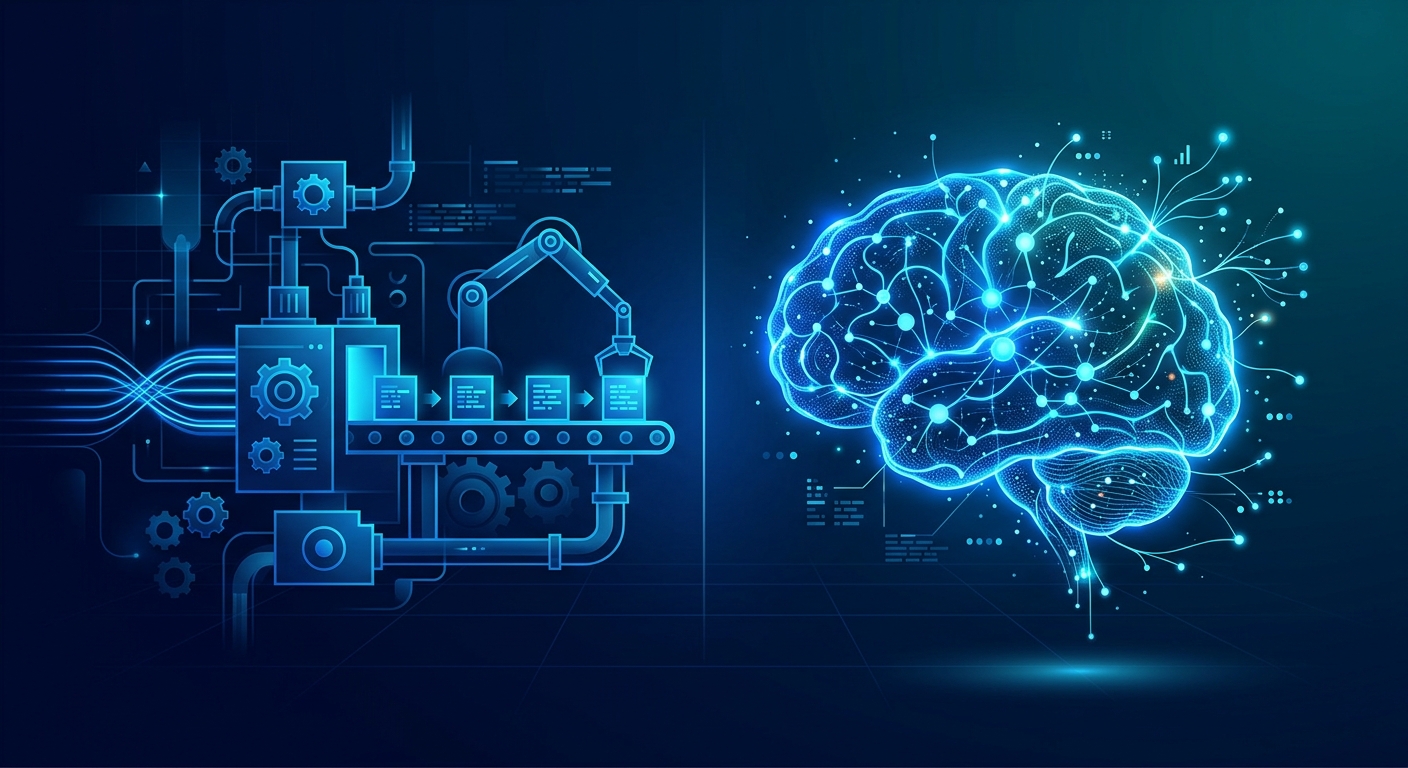
Automation and Artificial Intelligence (AI) are the two primary engines driving modern corporate efficiency, yet they operate on fundamentally different principles. While the terms are often used interchangeably in boardrooms, their technical architectures and business outcomes diverge significantly. Automation is a tool for consistency; AI is a tool for adaptability. Understanding the nuances of automation vs AI is no longer just a technical requirement for IT departments—it is a strategic necessity for enterprise leaders aiming to scale operations without increasing fragility.
Traditional automation executes repetitive, rule-based tasks to increase operational efficiency. In contrast, Artificial Intelligence (AI) uses algorithms to mimic human intelligence, enabling continuous learning and complex decision-making based on data patterns. The distinction is best summarized by the nature of the problems they solve: automation handles "known-knowns" through pre-defined instructions, while AI is designed to navigate "known-unknowns" by identifying hidden correlations within vast datasets.
Key Takeaways
- Fundamental Logic: Automation follows a linear "if-this-then-that" logic, whereas AI uses probabilistic models to predict outcomes.
- Primary Value: Automation delivers speed and cost reduction for stable processes; AI provides insights and strategic transformation.
- Maintenance Needs: Automation requires manual updates when rules change; AI requires continuous monitoring for bias and reliability.
- Integration Strategy: The highest ROI is achieved by layering AI on top of automation to create "Intelligent Automation" (IA).
What is Automation?
Automation is the technology by which a process or procedure is performed with minimal human assistance. In the enterprise context, this usually refers to software-based systems that follow a deterministic path. A deterministic system is one where the same input will always produce the exact same output, provided the rules remain unchanged.
Robotic Process Automation (RPA) is the most common form of this technology. It mimics human interactions with digital systems—such as copying data from a spreadsheet into a CRM—using fixed scripts. According to the NIST Artificial Intelligence Risk Management Framework, traditional software systems (automation) are generally characterized by their predictability and lack of autonomous learning. They do not "think"; they merely "do."
Key Insight: Automation is typically rule-based and follows pre-defined instructions to perform repetitive tasks. It excels in environments where the process is stable and the data is structured.
What is Artificial Intelligence (AI)?
Artificial Intelligence (AI) is a branch of computer science focused on creating systems capable of performing tasks that typically require human intelligence. These tasks include visual perception, speech recognition, decision-making, and language translation. Unlike automation, AI is non-deterministic. It uses Machine Learning (ML) to improve its performance over time as it is exposed to more data.
AI does not rely on a rigid set of instructions. Instead, it builds a mathematical model based on sample data, known as "training data," to make predictions or decisions without being explicitly programmed to do so. This allows AI to handle unstructured data—such as natural language in a customer email or anomalies in a financial report—that would break a traditional automation script.
AI vs. Automation: What's the Difference?
The core difference between AI and automation lies in the "brain" of the operation. Automation is about execution, while AI is about cognition.
| Feature | Traditional Automation | Artificial Intelligence (AI) |
|---|---|---|
| Logic Basis | Rule-based (If/Then) | Data-driven (Probabilistic) |
| Learning | None; requires manual updates | Continuous; learns from new data |
| Data Type | Highly structured | Structured and Unstructured |
| Goal | Efficiency and Consistency | Insight and Adaptability |
| Failure Mode | Stops when a rule is broken | May "hallucinate" or provide biased output |
As noted by Harvard Business School Online, operational gains from AI do not always move the needle strategically unless they are linked to organizational transformation. While automation makes a process faster, AI can fundamentally change what the process is. For example, AI Agents vs. Traditional Automation shows that while a bot can file an invoice, an AI agent can negotiate the terms based on historical vendor behavior.
The Benefits of AI in Automation
When AI is integrated into automation workflows, it creates a hybrid known as Intelligent Automation (IA). This combination overcomes the primary limitation of traditional automation: brittleness. Traditional bots fail the moment a user interface changes or a field is moved. AI-enhanced automation can "see" the interface and adjust its actions accordingly.
Key benefits include:
- Handling Complexity: AI can interpret nuances in sentiment or intent, allowing automated systems to handle customer service inquiries that previously required a human.
- Reducing Maintenance: Because AI can adapt to slight variations in data formats, the "maintenance tax"—the labor cost of fixing broken bots—is significantly reduced.
- Predictive Capability: Automation can report that a machine has stopped; AI-driven Predictive Maintenance can predict the failure before it happens.
Intelligent Automation: The Intersection of AI and Automation
Intelligent Automation (IA) represents the convergence of RPA and AI. This intersection allows enterprises to automate end-to-end processes rather than just fragmented tasks. For instance, in a mortgage application process, traditional automation can move a PDF from an email to a folder. IA, however, can extract data from that PDF (even if it's a blurry photo), verify the applicant's income against bank statements, and flag potential fraud for human review.
This combination is essential for scaling. As organizations move toward the Agentic Enterprise, the focus shifts from "doing more with less" to "knowing more to do better." The NIST AI RMF emphasizes that as these systems become more autonomous, the risks—such as bias and lack of explainability—must be managed through rigorous governance frameworks.
How is AI Used in Automation?
AI is used in automation to provide the "eyes" and "ears" for digital workers. Common applications include:
- Natural Language Processing (NLP): Used in AI Lead Qualification Agents to understand and respond to prospect inquiries.
- Computer Vision: Enabling bots to read documents, recognize objects in images, or navigate legacy software interfaces that lack APIs.
- Anomaly Detection: Monitoring transaction flows to identify patterns that deviate from the norm, which is critical for security and compliance.
Key Insight: AI systems require continuous monitoring for bias and reliability, unlike static automation workflows. This necessitates a robust AI Agent Audit Trail to ensure accountability.
Use Cases for Intelligent Automation Tools
- Finance and Accounting: Moving beyond simple data entry to AI Agents for Invoice Exception Handling, where the system decides how to resolve a discrepancy between a purchase order and an invoice.
- Customer Support: Using Outcome-based AI Helpdesk Automation to resolve tickets autonomously rather than just routing them to the right department.
- Supply Chain: Optimizing inventory levels by predicting demand surges rather than simply reordering when stock hits a minimum threshold.
Addressing the Technical Debt of Agentic AI
One significant risk that enterprise leaders often overlook is the technical debt introduced when layering agentic AI on top of legacy rule-based systems. According to research published in Nature, the impact of AI on work is profound, but the technical implementation can be perilous.
Layering agentic AI on legacy systems introduces risks such as cascading failures and orchestration fragility. These systems face "permission aggregation," where agents accumulate authority across systems, expanding the security attack surface. If an AI agent is given the power to override a legacy rule-based system without proper guardrails, it can create "coordination breakdowns" where the two systems work at cross-purposes. Meo works under the client's security and privacy requirements and can complete their vendor security review to help mitigate these architectural risks.
Human-in-the-Loop: Mitigating AI Hallucinations
To mitigate hallucination risks in automated decision-making, organizations must implement robust Human-in-the-Loop (HITL) protocols. Hallucinations—where an AI generates plausible-sounding but false information—can be catastrophic in regulated industries.
HITL protocols require people to approve or reject AI outputs at critical decision points. For example, in Automated Regulatory Change Tracking, an AI might identify a new law, but a human compliance officer must validate the interpretation before the system updates internal policies. This closed-loop feedback not only prevents errors but also provides the high-quality data needed to refine the AI's future performance.
Implement an AI Automation Solution in Your Organization
Moving from simple automation to AI-driven transformation requires a phased approach. Organizations should not attempt to replace all legacy systems at once. Instead, follow this roadmap:
- Audit Existing Workflows: Identify which processes are truly rule-based (prime for RPA) and which involve judgment (prime for AI).
- Define Success Metrics: Move beyond "time saved" to metrics like "accuracy improvement" or "revenue growth per employee."
- Establish Governance: Before deployment, define the audit trails and security protocols required to manage non-deterministic systems.
- Pilot and Scale: Start with a high-impact, low-risk area like Sales Outreach before moving to core operational systems.
The Future: Agentic AI and Automation
The next frontier is "Agentic AI," where AI systems don't just suggest actions but execute them autonomously across multiple platforms. Unlike traditional bots that follow a linear path, agentic AI can reason, plan, and adjust its strategy to achieve a goal. This shift represents a transition from "task automation" to "outcome automation."
As we look toward 2026, the distinction between automation and AI will continue to blur, but the requirement for human oversight will remain constant. The goal is not to remove the human from the loop, but to elevate the human to a position of orchestration and strategy.
Frequently Asked Questions
Is RPA considered AI?
No, traditional RPA is not AI. RPA is a rule-based automation technology that follows specific instructions. However, many modern RPA platforms now incorporate AI features, such as OCR or NLP, to handle more complex tasks.
Which is more expensive to implement: AI or automation?
Generally, AI is more expensive to implement due to the costs of data preparation, model training, and specialized talent. However, the AI Implementation Cost vs ROI shows that AI often delivers higher long-term value by enabling new business models.
Can AI replace traditional automation?
AI is not a replacement for automation but an evolution of it. For simple, high-volume, repetitive tasks, traditional automation remains more cost-effective and predictable. AI should be used where judgment or data interpretation is required.
What are the risks of using AI in automation?
Key risks include algorithmic bias, lack of explainability (the "black box" problem), and hallucinations. These are not present in traditional automation, which is why AI requires different governance and monitoring protocols.
How do I know if a process needs AI or just automation?
If the process has a clear "if-this-then-that" structure and uses structured data, automation is sufficient. If the process involves variable inputs, natural language, or requires predictions, AI is necessary.