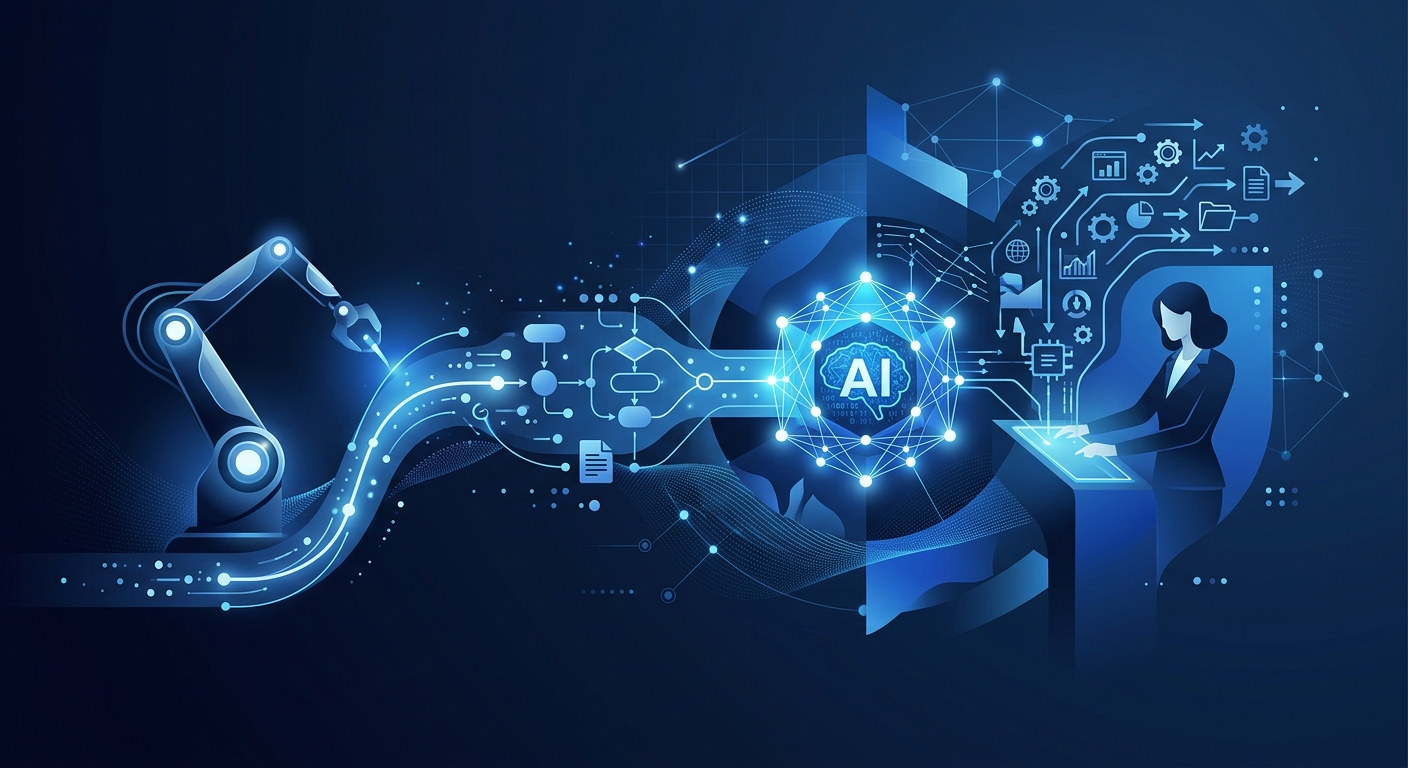
In the modern enterprise landscape, the distinction between manual labor and automated efficiency is increasingly defined by the integration of Robotic Process Automation (RPA) and Artificial Intelligence (AI). While these technologies were once viewed as separate silos—one for simple task execution and the other for complex data processing—their convergence has produced a new era of Intelligent Process Automation (IPA). This integration allows organizations to automate not just the "hands" of a process, but also the "eyes" and "brain."
Key Takeaways
- RPA is the Execution Layer: Robotic Process Automation is primarily used for rule-based, repetitive manual tasks like payroll and data entry.
- AI is the Intelligence Layer: Artificial Intelligence is distinct from RPA in its ability to analyze large datasets to uncover patterns and trends.
- Integration Drives ROI: The combination of AI and RPA enables the automation of data collection along with real-time reporting and insights.
- Industry Impact: In healthcare, RPA-AI systems handle complex workflows including electronic health records and robotic-assisted surgery support.
Understanding Robotic Process Automation (RPA)
Robotic Process Automation (RPA) is a technology that uses software robots, or "bots," to emulate human actions within digital systems to execute business processes. RPA is inherently deterministic; it follows a set of predefined rules to complete high-volume, repetitive tasks. Common applications include data entry, invoice processing, and simple record updates.
According to the U.S. Government Accountability Office, agencies should implement controls and better track benefits to ensure these bots are performing as intended. RPA excels in environments where the data is structured and the process logic does not change. However, RPA alone is limited by its inability to handle ambiguity or unstructured data, such as handwritten notes or conversational intent.
Understanding Artificial Intelligence (AI)
Artificial Intelligence (AI) refers to the simulation of human intelligence processes by machines, especially computer systems. Unlike RPA, which is rule-bound, AI is probabilistic. It uses machine learning (ML), natural language processing (NLP), and computer vision to learn from data and make informed decisions or predictions.
As noted by UTI, AI excels at analyzing large datasets to uncover patterns and trends. While RPA mimics human actions, AI mimics human judgment. This allows AI to process unstructured data, recognize faces in images, or understand the sentiment behind a customer's email—tasks that are impossible for standard RPA scripts.
The Difference Between RPA and AI
To understand how to deploy these technologies, decision-makers must distinguish between their core functions. The primary difference lies in the nature of the tasks they perform. RPA is focused on "doing," while AI is focused on "thinking."
| Feature | Robotic Process Automation (RPA) | Artificial Intelligence (AI) |
|---|---|---|
| Core Function | Task-oriented, rule-based execution | Data-oriented, decision-based learning |
| Data Type | Structured data (spreadsheets, forms) | Unstructured data (emails, images, voice) |
| Nature | Deterministic (Follows instructions) | Probabilistic (Predicts outcomes) |
| Flexibility | Rigid; breaks if the UI changes | Adaptive; learns from new data patterns |
For instance, in Human Resources, RPA can automate tasks like payroll processing and employee onboarding. Conversely, AI can analyze employee performance data to identify areas for improvement and recommend training programs AI vs. RPA: Understanding the Differences | UTI.
How RPA and AI Drive End-to-End Intelligent Process Automation
Intelligent Process Automation (IPA) is the result of layering AI's cognitive abilities onto RPA's execution power. This combination enables a seamless, end-to-end workflow where the system can handle exceptions and make decisions without human intervention.
Key Insight: The integration of AI and RPA enables the automation of data collection combined with real-time reporting and insights, moving beyond simple task completion to strategic business intelligence.
In a typical IPA workflow, AI acts as the intake mechanism. It might use Optical Character Recognition (OCR) to read a complex invoice or NLP to categorize a customer request. Once the AI interprets and structures the data, the RPA bot takes over to input that data into an ERP system or trigger a specific business logic sequence. This removes the "human-in-the-loop" requirement for data translation, significantly accelerating cycle times.
How RPA and AI Interact
The interaction between these two technologies is often sequential but can also be iterative. In a sequential model, AI prepares the data for RPA. In an iterative model, RPA might gather data from multiple sources and present it to an AI model for a risk assessment or fraud detection score. Based on that score, the RPA bot then follows a specific path—either approving the transaction or flagging it for human review.
This interaction is particularly prevalent in the agentic enterprise, where AI agents vs. traditional automation represent the next evolution of this partnership. By integrating these systems, companies move from simple bot-driven tasks to autonomous agents capable of planning and executing complex, multi-step goals.
The Rise of Intelligent Process Automation (IPA)
The rise of IPA is driven by the enterprise need to process vast amounts of unstructured data that RPA cannot handle alone. As businesses digitize, the volume of images, PDFs, and audio files has grown rapidly. IPA provides the bridge to automate these formats.
In the healthcare sector, the use of AI with RPA has increased significantly. Activities like patient scheduling, registration, electronic health records (EHR), and even robotic-assisted surgery support are now handled by integrated tools Increasing Trends of Artificial Intelligence With Robotic Process Automation in Health Care. This trend highlights a shift from back-office efficiency to front-line clinical and administrative support.
9 Common Uses for RPA and AI
- Invoice Processing: AI extracts data from various invoice formats; RPA enters it into accounting software.
- Customer Support: AI-powered chatbots understand intent; RPA bots retrieve account details or reset passwords.
- Employee Onboarding: RPA creates accounts and credentials; AI recommends personalized training paths based on the new hire's resume.
- Claims Processing: In insurance, AI assesses damage from photos; RPA calculates payouts based on policy rules.
- Regulatory Compliance: AI monitors for regulatory changes; RPA updates internal records to ensure compliance.
- Supply Chain Optimization: AI predicts demand spikes; RPA triggers purchase orders automatically.
- Healthcare Administration: Integrated systems manage admission and discharge procedures, reducing manual labor and improving patient flow PMC11489308.
- Fraud Detection: AI identifies suspicious patterns in transaction logs; RPA immediately freezes the affected accounts.
- Data Migration: RPA moves data between legacy systems; AI ensures data quality and maps disparate fields accurately.
Benefits of Intelligent Process Automation
The primary benefit of combining RPA and AI is a dramatic increase in operational capacity without a corresponding increase in headcount.
- Increased Accuracy: By removing manual data entry, integrated systems reduce the risk of human error, which is critical in high-stakes environments like healthcare and finance.
- Scalability: Digital workers can be scaled up or down instantly to meet demand, unlike human teams, which require lengthy hiring and training cycles.
- Enhanced Insights: Because AI can analyze the data RPA collects, businesses gain real-time visibility into process bottlenecks and customer behavior.
- Cost Reduction: Integrated RPA-AI systems reduce manual labor and improve accuracy in data-driven environments Increasing Trends of Artificial Intelligence With Robotic Process Automation in Health Care.
Preparing Your Business for RPA and AI Integration
Moving from standalone RPA to an integrated AI-RPA environment requires a shift in both technology and governance. Businesses must move away from static automation scripts toward a more dynamic infrastructure.
Key Insight: AI-integrated automation needs a new governance model that monitors agent behavior rather than only auditing rules.
One of the biggest challenges is managing technical debt. Layering AI on top of brittle, legacy RPA scripts can create a maintenance burden. Organizations should consider a native IPA platform or ensure their RPA tools are compatible with modern AI orchestration layers. Furthermore, governance frameworks must evolve to address model transparency and the autonomous reasoning of agentic systems, moving beyond simple manual checklists to automated policy enforcement.
Frequently Asked Questions
What is the main difference between RPA and AI?
RPA is rule-based software that automates repetitive tasks by mimicking human actions, whereas AI is a data-driven technology that mimics human intelligence to make decisions and recognize patterns.
Can RPA work without AI?
Yes, RPA can function independently for simple, structured tasks like moving files or copying data between spreadsheets. However, it cannot handle unstructured data or make complex decisions without AI.
How does AI improve RPA performance?
AI improves RPA by allowing the system to process unstructured data (like text or images) and handle exceptions, which reduces the need for human intervention in the automation loop.
Is RPA-AI integration expensive?
While initial setup costs for AI-integrated RPA are higher than for standalone RPA, the ROI is typically greater due to the broader range of processes that can be fully automated and the reduction in manual oversight.
Which industries benefit most from RPA and AI?
Industries with high volumes of data and strict compliance requirements, such as healthcare, banking, insurance, and human resources, see the most significant benefits from this integration.
Does AI replace the need for RPA bots?
No, AI and RPA are complementary. AI provides the decision-making (the brain), while RPA provides the execution (the hands). They work together to create end-to-end automation.