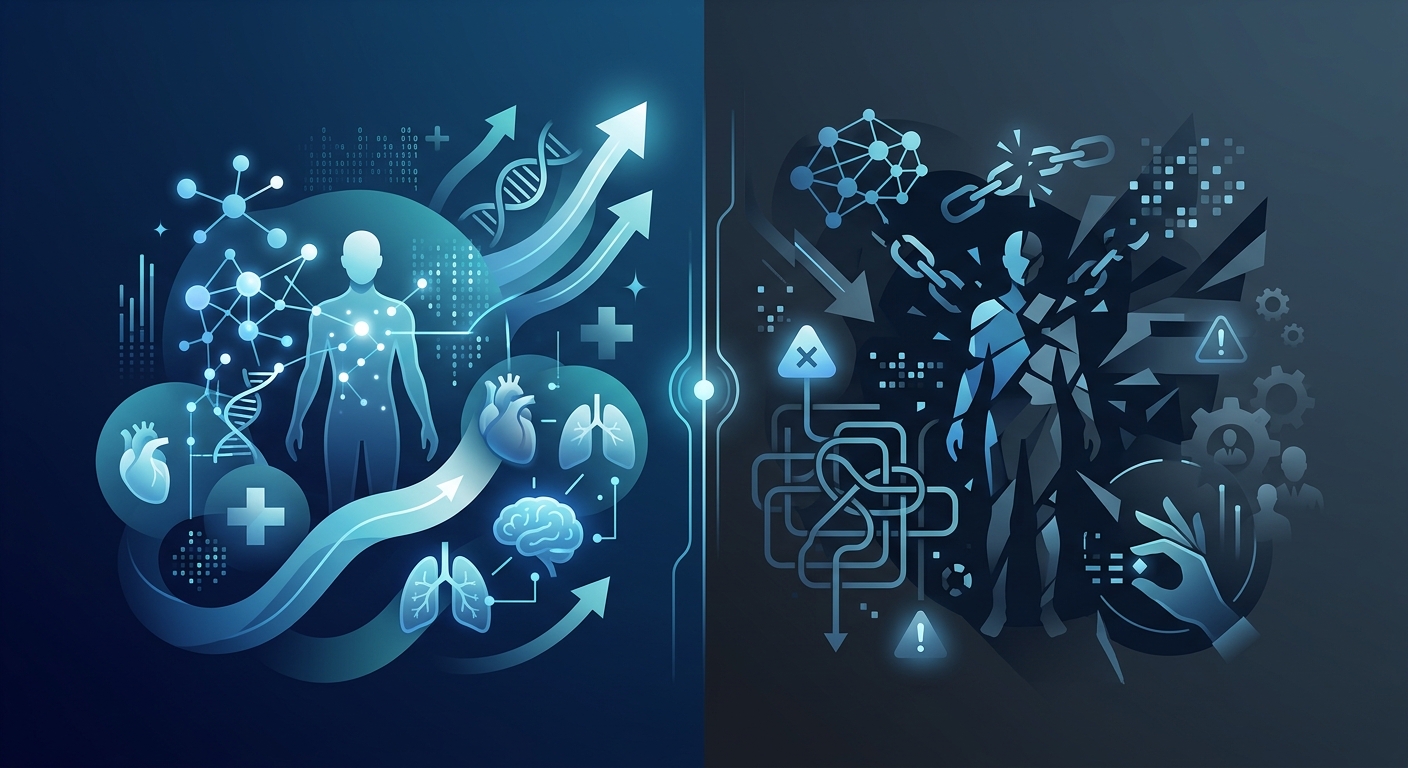
Artificial Intelligence (AI) in healthcare is a suite of advanced technologies, including machine learning (ML) and natural language processing (NLP), designed to emulate human cognition in the analysis, interpretation, and comprehension of complex medical and healthcare data. For enterprise stakeholders, the integration of these tools represents a fundamental shift from reactive treatment to proactive, data-driven wellness management. While the potential for improved patient outcomes is vast, the implementation of AI introduces systemic risks regarding data governance, clinical liability, and algorithmic transparency.
Key Takeaways
- Enhanced Diagnostics: AI systems, such as artificial neural networks, have achieved 88% to 89% accuracy in predicting diabetic complications.
- Efficiency Gains: Automation of administrative tasks can save health systems between $200 billion and $360 billion annually.
- Risk Factors: Data privacy, algorithmic bias, and the lack of a federal liability framework remain primary barriers to adoption.
- Accessibility: AI-driven tools enable specialist-level screenings in remote areas, particularly for conditions like diabetic retinopathy and malaria.
Abstract: The Current State of AI Integration
The landscape of modern medicine is undergoing a digital transformation driven by the rapid adoption of AI-enabled solutions. Current research indicates that AI is no longer a theoretical concept but a functional component of clinical workflows. By applying vast datasets, AI models provide clinicians with actionable insights that were previously obscured by the sheer volume of unstructured information. This section serves as a high-level overview of how AI acts as a force multiplier for human expertise, focusing on its role in early disease detection and the mitigation of provider burnout through AI impact analysis.
Introduction to AI in Clinical Settings
Artificial Intelligence in healthcare refers to the application of machine learning algorithms and software to mimic human cognition in the analysis of complex medical data. Unlike traditional rule-based systems, modern AI can learn from patterns within data to make predictions or provide recommendations. The primary goal of AI in this sector is to assist healthcare providers in delivering more accurate, personalized, and efficient care. As health systems face rising costs and physician shortages, AI offers a pathway to scale high-quality care without linearly increasing human labor costs.
How AI Is Used in Healthcare Today
AI is currently deployed across three primary domains: clinical decision support, administrative automation, and drug discovery. In clinical settings, AI assists in medical imaging and diagnostics. For example, AI-driven systems in ophthalmology enable screening for eye diseases in remote and underserved populations without a specialist present Artificial intelligence-driven transformative applications.
Beyond the clinic, AI is transforming back-office operations. Administrative use cases include AI agents for prior authorization automation and AI agents for medical claims reconciliation. By automating these routine tasks, healthcare professionals can refocus their time on direct patient care, effectively reducing the administrative burden that leads to burnout.
Advantages of Using AI in Healthcare
The benefits of AI in healthcare are quantified by significant improvements in diagnostic precision and systemic cost reductions. One of the most compelling advantages is the ability to identify diseases at their earliest, most treatable stages.
1. Superior Diagnostic Accuracy
AI has demonstrated substantial improvements in diagnostic accuracy across various diseases. For instance, the AIDMAN system for diagnosing malaria achieved a 95% accuracy rate and 94% sensitivity Empowering public health. Furthermore, artificial neural networks applied to the prediction of diabetic complications have demonstrated an accuracy rate of approximately 88% to 89% Artificial intelligence-driven transformative applications.
2. Operational Efficiency and Cost Savings
Wider adoption of AI could generate long-term systemic savings of 5% to 10% annually, or approximately $200 billion to $360 billion, by improving efficiency and reducing wasteful spending. These savings stem from optimized resource allocation and the reduction of medical errors that lead to costly readmissions.
3. Personalized Medicine
AI algorithms can analyze a patient's genetic profile, lifestyle, and environment to recommend tailored treatment plans. This shift toward precision medicine ensures that patients receive the right intervention at the right time, minimizing adverse reactions and maximizing efficacy.
Key Insight: AI-driven systems in ophthalmology provide significant benefits in accessibility, particularly for remote and underserved populations, by making it possible to screen for eye diseases without the need for an on-site specialist.
Challenges and Risks of Using AI in Healthcare
Despite the advantages, the integration of AI is not without significant hurdles. These challenges primarily revolve around ethics, security, and the reliability of the underlying models.
1. Data Privacy and Security
AI models require large amounts of patient data to function effectively. This creates a vulnerability for AI agent data privacy. Protecting sensitive health information (PHI) while allowing AI to access it is a complex balancing act that requires robust encryption and strict data security protocols.
2. Algorithmic Bias
AI systems are only as good as the data they are trained on. If the training data lacks diversity, the AI may produce biased results that negatively affect specific demographic groups. This risk requires continuous AI agent monitoring to detect and correct for bias in real time.
3. High Implementation Costs
While AI offers long-term savings, the initial investment for hardware, software, and staff training is substantial. Small-to-medium-sized clinics may find it difficult to compete with large health systems that have the capital to deploy enterprise-grade AI infrastructure.
Legal Frameworks and Liability: A Gap in Governance
A critical question for healthcare leaders is: What specific legal frameworks currently exist to determine liability when an AI-driven diagnosis results in medical malpractice?
Currently, there is no federal law in the United States that shifts medical malpractice liability from clinicians to AI tools or their developers. While legal experts have proposed a "shared responsibility model" to distribute liability among doctors, hospitals, and developers, the legal system is still defining where responsibility for AI-driven healthcare decisions begins and ends. Clinicians remain the final decision-makers, meaning they often bear the legal burden of an AI's error, even if the error was caused by a black-box algorithmic failure.
Retraining Protocols for Clinical AI Models
Another significant gap in current industry knowledge involves the standardized protocols for retraining AI models when clinical guidelines change or new pharmaceutical data emerges.
While the FDA's "7-Step Credibility Framework" requires documentation of a model's entire lifecycle, current research indicates a lack of established industry-wide practices for model updates. This lack of standardization can lead to "model drift," where an AI's performance degrades as it encounters new data types or outdated medical protocols. Organizations must implement their own rigorous monitoring protocols to ensure clinical safety over time.
Materials and Methods for AI Evaluation
To evaluate the efficacy of AI in healthcare, researchers often use a combination of retrospective cohort studies and prospective clinical trials. The primary metrics for success include sensitivity (the ability to correctly identify those with the disease), specificity (the ability to correctly identify those without the disease), and the Area Under the Curve (AUC), which measures the overall diagnostic performance of the model. For example, machine learning models that distinguish benign from malignant nodules in oncology are evaluated by their ability to reduce false positives while maintaining high sensitivity for early-stage cancer Artificial intelligence in healthcare and medicine.
Using AI in Healthcare Effectively and Responsibly
For an agentic enterprise in the healthcare space, responsible AI use requires a "human-in-the-loop" approach. AI should be viewed as an augmentative tool rather than a replacement for human judgment.
"AI technologies in ophthalmology provide significant benefits in accessibility, particularly for remote and underserved populations." – Scoping Review on AI-DrivenAtive Applications Source
Healthcare leaders should follow these best practices:
- Transparency: Ensure all AI-driven decisions are explainable to both clinicians and patients.
- Bias Audits: Regularly test models against diverse datasets to ensure equitable outcomes.
- Governance: Establish clear internal policies for AI oversight, aligning with automated regulatory change tracking.
Navigating the Rise of AI in Healthcare
The transition to AI-integrated healthcare is inevitable, but its success depends on strategic navigation of the technical and ethical landscape. Organizations must invest in data literacy for their staff and ensure that AI deployments are aligned with ROI and performance metrics. By focusing on high-impact use cases—such as early disease detection and administrative automation—health systems can realize the benefits of AI while building the necessary safeguards to protect patient trust.
Frequently Asked Questions
Does AI replace doctors in the diagnostic process?
No. AI is designed to support clinicians by providing data-driven insights. While it can identify patterns faster than humans, the final diagnostic decision and treatment plan remain the responsibility of the medical professional.
How does AI affect patient privacy?
AI requires access to large datasets, which can increase the risk of data breaches. However, modern AI implementations use techniques like federated learning and data anonymization to protect patient identities while still allowing the model to learn.
Is AI in healthcare regulated by the FDA?
Yes. The FDA regulates AI-based medical devices and software. The agency has introduced frameworks to ensure the safety and effectiveness of AI tools throughout their entire lifecycle, from development to post-market performance.
Can AI help reduce healthcare costs for patients?
In the long term, yes. By improving efficiency and reducing the need for redundant tests or hospital readmissions, AI is expected to lower systemic costs, which can eventually translate to lower premiums and out-of-pocket costs for patients.
What is algorithmic bias in healthcare?
Algorithmic bias occurs when an AI model produces systematically prejudiced results. In healthcare, this often happens because the data used to train the AI does not represent the full diversity of the patient population, leading to less accurate results for certain groups.