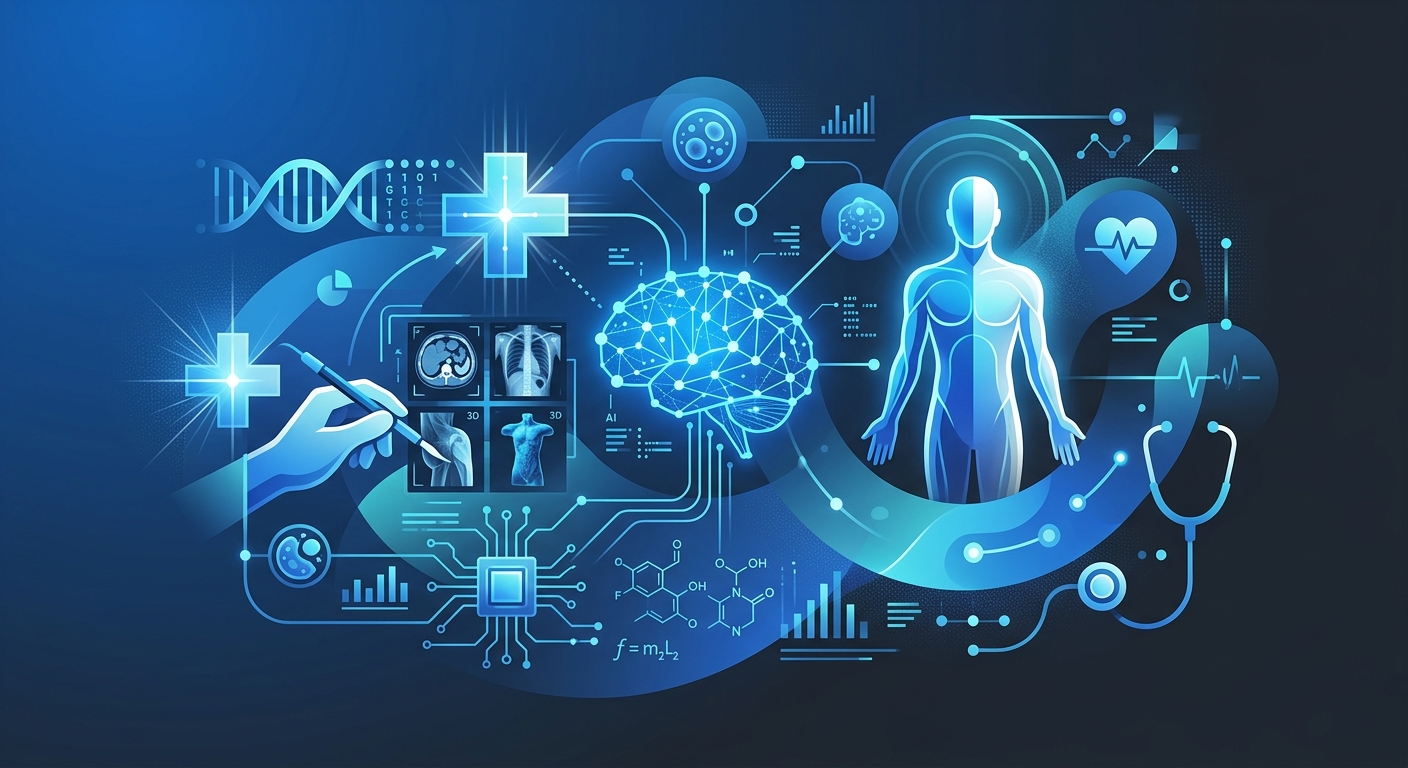
Artificial Intelligence (AI) is a branch of computer science capable of analyzing complex medical data to approximate human cognition in the analysis, interpretation, and comprehension of medical and healthcare data. In the current enterprise landscape, AI is helping healthcare by shifting the industry from a reactive, volume-based model to a proactive, value-based system. By integrating machine learning (ML) and deep learning algorithms into clinical workflows, healthcare providers are achieving unprecedented levels of precision in both patient care and operational management.
Key Takeaways
- Diagnostic Precision: AI algorithms now match or exceed specialist accuracy in identifying oncology and neurology markers in medical imaging.
- Operational Relief: Automation of administrative tasks like EHR documentation is a primary tool for mitigating physician burnout.
- Accelerated R&D: AI reduces drug discovery timelines by identifying biomarkers and optimizing clinical trial populations.
- Predictive Care: Machine learning models allow for early intervention by predicting patient deterioration before clinical symptoms manifest.
How Is AI Used in Healthcare?
AI is used in healthcare to bridge the gap between massive datasets and actionable clinical insights. The technology functions as an assistive layer across three primary domains: clinical diagnostics, administrative operations, and pharmaceutical research. According to USAHS, AI is transforming healthcare by automating the recording of notes and reviewing medical records in electronic health records (EHR), which is a leading cause of lost productivity and physician burnout.
Beyond administrative tasks, AI is used to process unstructured data—such as physician notes, lab results, and genomic sequences—that traditional software cannot parse. This allows for the creation of a comprehensive "digital twin" of a patient, enabling doctors to simulate treatment outcomes before a single dose of medication is administered.
Key Insight: A comprehensive review of 138 selected studies found that AI algorithms frequently achieve diagnostic performance comparable to, and often surpassing, that of human specialists in medical imaging ScienceDirect.
Providing Diagnostic Assistance Through Advanced Imaging
One of the most mature applications of AI is in diagnostic imaging. AI algorithms, particularly those using deep learning, are trained on millions of labeled images to recognize patterns that may be invisible to the human eye. According to Park University, AI-powered tools identify abnormalities like tumors, fractures, or early signs of neurological disease more accurately and efficiently than many traditional methods.
In practice, this means a radiologist can use AI as a "second set of eyes" to flag high-priority cases. For example, in a busy trauma center, an AI agent can scan a batch of 100 CT scans and immediately move a scan showing a potential brain hemorrhage to the top of the radiologist's queue. This prioritization saves critical minutes that are often the difference between recovery and permanent disability.
| Application Area | AI Role | Clinical Impact |
|---|---|---|
| Radiology | Pattern recognition in X-rays/MRIs | Early tumor detection |
| Pathology | Digital slide analysis | Increased diagnostic consistency |
| Cardiology | ECG waveform interpretation | Real-time arrhythmia detection |
| Dermatology | Skin lesion classification | Improved melanoma screening |
Aiding Drug Discovery and Development
The traditional drug discovery process is notoriously slow and expensive, often taking over a decade and billions of dollars to bring a single drug to market. AI is helping healthcare by optimizing the design of clinical trials through the analysis of patient data and the summarization of biomedical literature Global Campus.
AI models can predict how different chemical compounds will interact with specific proteins in the human body, effectively narrowing down millions of potential candidates to a handful of high-probability leads. Furthermore, AI helps with investigating drug repurposing—finding new uses for existing, FDA-approved drugs—which significantly reduces the time and cost associated with safety testing. By identifying specific disease biomarkers, researchers can also design trials that target the genetic profiles of patients most likely to respond to a treatment.
Personalizing Healthcare and Precision Medicine
Personalized healthcare, or precision medicine, is an approach to patient care that allows doctors to select treatments most likely to help patients based on their genetic makeup, environment, and lifestyle. AI supports this by processing genomic data at a scale impossible for human researchers. Global Campus notes that AI is essential in identifying biomarkers that indicate how a patient will respond to specific therapies.
For instance, in oncology, two patients with the same type of lung cancer may require vastly different treatments based on their genetic mutations. AI agents can cross-reference a patient's genetic sequence with a global database of clinical outcomes to recommend the specific chemotherapy or immunotherapy drug with the highest statistical probability of success. This reduces the "trial and error" phase of medicine, improving patient quality of life and reducing wasted healthcare spend.
Using Predictive Analytics to Improve Patient Outcomes
Predictive analytics involves using historical data to make informed predictions about future events. In a hospital setting, this is used to identify patients at high risk of complications such as sepsis or cardiac arrest before they occur. By monitoring vital signs in real time, AI models can detect subtle shifts—such as a slight increase in heart rate combined with a decrease in oxygen saturation—that often precede a clinical emergency by several hours.
These systems are not intended to replace clinical judgment but to augment it. When an AI system flags a patient as "high risk," it prompts the nursing staff to perform an immediate assessment. This proactive approach has been shown to reduce mortality rates and shorten the length of stay for ICU patients. Organizations interested in this transition often look toward AI Agents for Medical Claims Reconciliation to understand how data flows from clinical outcomes to financial settlement.
Acting as Virtual Health Assistants
Virtual health assistants are AI-driven interfaces that help patients manage their health outside of the clinic. These tools range from simple chatbots that schedule appointments to sophisticated systems that provide medication reminders and monitor chronic conditions. By providing 24/7 support, virtual assistants help reduce the burden on primary care physicians and emergency rooms.
For patients with chronic diseases like diabetes, a virtual assistant can analyze glucose monitor readings and provide real-time dietary advice. If readings reach a dangerous level, the assistant can automatically alert the patient's care team. This level of continuous monitoring is a cornerstone of the modern Healthcare & Life Sciences enterprise strategy.
Overcoming the 'Black Box' and Data Privacy Gaps
A significant barrier to AI adoption in healthcare is the "black box" problem, where the reasoning behind an AI's decision is not transparent. Healthcare providers are addressing this by deploying Explainable AI (XAI) systems. These tools express AI logic in clinical language, allowing doctors to validate the evidence the model used to reach a conclusion. This transparency is critical for maintaining the trust of both clinicians and patients.
Furthermore, the governance of patient data is evolving. Under GDPR Article 35, healthcare organizations must conduct Data Protection Impact Assessments for AI models using biometric data. In the United States, updates to the HIPAA Security Rule are focusing on how AI models store and process sensitive information. Organizations must ensure that their AI Agent Data Privacy Compliance protocols are robust enough to handle these emerging regulatory requirements.
Key Insight: AI can improve the accuracy and efficiency of interpreting medical images such as X-rays, MRIs and CT scans.
Frequently Asked Questions
How does AI reduce physician burnout?
AI reduces burnout by automating administrative tasks like clinical documentation and EHR entry. By using natural language processing to transcribe patient encounters, AI allows doctors to focus on the patient rather than a computer screen.
Can AI replace human doctors?
No. AI is designed to be an assistive tool that augments human expertise. While it can process data faster, it lacks the empathy, ethical judgment, and complex physical dexterity required for comprehensive medical care.
Is patient data safe with AI?
Security is a top priority. AI systems in healthcare must comply with frameworks like HIPAA and GDPR. This includes using data encryption, anonymization techniques, and strict access controls to ensure patient privacy.
How does AI help in early cancer detection?
AI algorithms can identify micro-calcifications or small lesions in imaging (like mammograms or lung CTs) that are often missed by the human eye, leading to earlier diagnosis and higher survival rates.
Does AI increase the cost of healthcare?
In the short term, implementing AI requires significant investment. However, in the long term, it is expected to lower costs by improving efficiency, reducing diagnostic errors, and preventing expensive emergency interventions through predictive care.
What is Explainable AI (XAI)?
XAI refers to AI systems designed so that their actions and decisions can be easily understood by human experts, which is vital for clinical safety and accountability.
Are You Inspired?
The integration of AI into healthcare is no longer a futuristic concept; it is a current operational necessity. For enterprise leaders, the focus must shift from "if" to "how" AI should be implemented. Whether through AI Agents for Prior Authorization Automation or advanced diagnostic imaging suites, the goal remains the same: better patient outcomes and higher operational efficiency. As we look toward the Future of Artificial Intelligence in Healthcare, the organizations that prioritize data integrity and clinical transparency will lead the next generation of medical excellence.